One of the most rapidly developing specialties in the career options & contemporary healthcare environment is reproductive medicine. As infertility, late parenthood and reproductive problems that arise due to lifestyle continue to rise, the need to have trained fertility specialists is on the rise the world over. Physicians who undergo a Fellowship in Reproductive Medicine acquire expertise in more complicated fertility procedures, assisted reproductive technology (ART), and reproductive endocrinology. However, the most universal question that the doctors will pose themselves before joining this specialization is: What are the career opportunities after a Fellowship in Reproductive Medicine?
This Blog describes the scope of career, job description, salary potential and career opportunity that come with pursuing a Fellowship in Reproductive Medicine, as well as all that a doctor ought to know prior to joining the field.
Understanding a Fellowship in Reproductive Medicine
Fellowship in Reproductive Medicine is a postgraduate medical training program that deals with the management of infertility and reproductive diseases. It allows physicians the skills to identify and cure complicated fertility problems in both men and women.
The training that is normally part of the program incorporates:
- Assisted Reproductive Technologies (ART)
- In Vitro Fertilization (IVF)
- Intrauterine Insemination (IUI).
- Reproductive endocrinology
- Fertility preservation
- Infertility treatment of males and females.
- Embryology basics
- High-technology reproductive operations.
This is the specialized training that equips doctors to work at fertility clinics, hospitals, research centers and academic institutions.
Why Reproductive Medicine Is a Growing Medical Specialty
Infertility is now more widespread because of lifestyle changes, stress, late marriage and illnesses. Global fertility research indicates that infertility problems are faced by almost 1 out of 6 couples.
This increased demand has led to an overwhelming need of doctors who have specialised in reproductive medicine. Consequently, the accomplishment of a Fellowship in Reproductive Medicine provides various career opportunities to medical personnel.
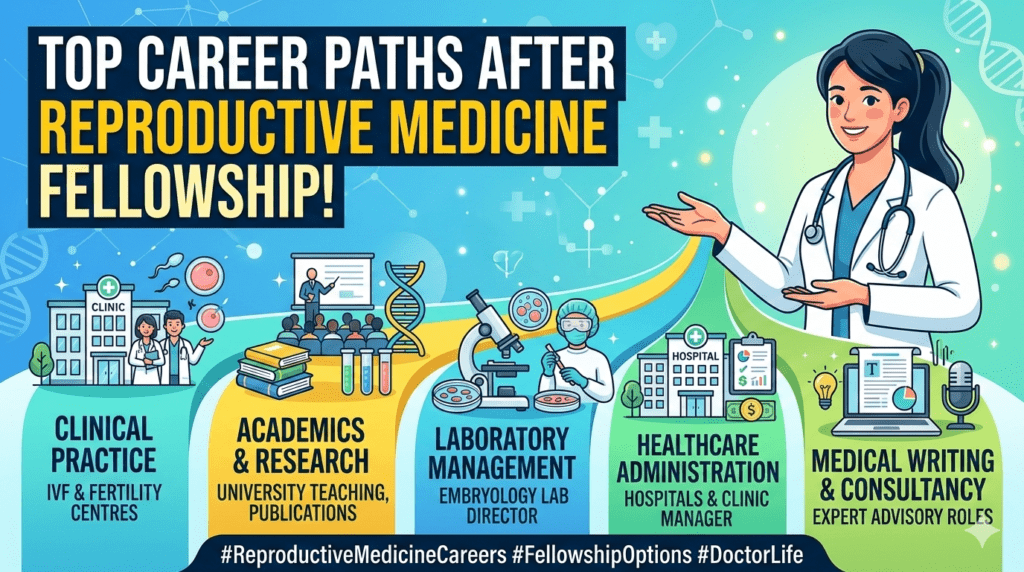
Top Career Opportunities After a Fellowship in Reproductive Medicine
1. Fertility Specialist in IVF Clinics
A career opportunity in a fertility specialist in IVF clinics is one of the most prevalent career opportunities after a Fellowship in Reproductive Medicine.
Under this position, physicians are tasked with diagnosing infertility, creating treatment regimes and carrying out fertility treatments including IVF and IUI.
Responsibilities include:
- Infertility diagnosis
- Ovulation induction
- IVF treatment planning
- Embryo transfer procedures
- Patient counseling
The vehemently expanding IVF centers have seen fertility specialists remain in high demand both in hospitals and in private clinics.
2. Consultant in Reproductive Medicine
Multispecialty hospitals or fertility centers may also have doctors that work as consultant reproductive medicine specialists.
Consultants deal with complicated cases of infertility and work with:
- Embryologists
- Andrologists
- Gynecologists
- Genetic specialists
This position needs excellent clinical knowledge and decision making.
3. Starting Your Own IVF or Fertility Center
After a Fellowship in Reproductive Medicine, most physicians opt to open their own fertility clinic or IVF center.
A fertility clinic in the right setting and personnel can be an extremely successful medical practice.
Doctors need knowledge of:
- IVF lab setup
- Medical equipment
- Fertility treatment procedures.
- Clinic management
- Legal and ethical standards.
This is also a rewarding career for entrepreneurial doctors.
4. Academic and Teaching Career
The other career opportunity is employment in medical education and training.
Physicians having a Fellowship in Reproductive Medicine may practice as:
- Faculty in medical colleges
- Fertility institute clinical trainers.
- Reproductive medicine programs mentors.
They have the ability to impart subjects like infertility care, reproductive endocrinology and assisted reproductive technologies.
5. Research in Reproductive Medicine
Reproductive medicine is a fast developing branch where scientific progress is ongoing.
Research positions available to doctors who may wish to conduct research include:
- Human subjects organizations.
- Fertility research centers
- Pharmaceutical companies
- Biotechnology laboratories
Research areas may include:
- IVF success rates
- Fertility preservation
- Genetic screening
- High-technology reproductive technologies.
The use of research publication also can help to strengthen the professional image of a doctor.
6. Specialist in Fertility Preservation
Preservation of fertility is an emerging branch of reproductive medicine. Cancer patients or individuals who are interested in postponing parenthood typically consider such options as egg or sperm freezing.
Medical doctors that train in reproductive medicine may specialize in:
- Egg freezing
- Sperm cryopreservation
- Embryo freezing
- Ovarian tissue banking.
It is a developing popular area across the globe.
7. International Career Opportunities
International opportunities can also be opened with the help of a Fellowship in Reproductive Medicine.
Doctors may work in:
- International IVF clinics
- Global fertility networks
- Foreign research institutions.
The developed fertility programs in countries are usually in demand trained reproductive specialists.
Skills Doctors Gain from a Fellowship in Reproductive Medicine
The completion of this fellowship assists doctors to acquire the following skills which are crucial:
- High-level diagnosis of infertility.
- IVF procedure expertise
- Endocrinological knowledge of reproduction.
- Patient communication and counseling.
- Fertility treatment planning.
- Organization with embryologists in the laboratory.
- These competencies render physicians very useful in the fertility medical field.
Wages Prospective Following a Fellowship in Reproductive Medicine.
Salary Potential After a Fellowship in Reproductive Medicine
Salary guiding scales can consist of:
- Junior fertility specialist: 40000-80000 per annum (depends on country)
- Senior IVF consultant: 100,000 and above per year.
- The owners of a private fertility clinic: much more dependent on the number of patients.
Fertility specialists can enjoy much higher income in India and a lot of other countries in the field of private practice.
Future Scope of Reproductive Medicine
The future of reproductive medicine is very bright. Genetic testing, AI-based embryo selection, and fertility preservation methods have altered this domain because of technological breakthroughs.
Due to increasing awareness of infertility, there is an increasing number of couples seeking fertility treatments. This tendency will only add more pressure to the demand of doctors who have been trained in Fellowship in Reproductive Medicine.
Conclusion
A Fellowship in Reproductive Medicine prepares doctors with an extensive variety of career paths to include being employed as fertility specialists and IVF consultants, conducting research, teaching, or owning a clinic. As the need for infertility treatment among people in the world increases, the specialization presents a good career boost, financial compensations besides the ability to make a significant impact in the lives of patients.
In a bid to develop expertise in fertility treatments and assisted reproductive technologies, physicians may consider organised training programs provided by organisations like Medical Global Academy that specialise in advanced clinical Information and clinical exposure in reproductive medicine.
FAQs
1. Who can pursue a Fellowship in Reproductive Medicine?
The qualifications that doctors are typically required to have in order to be eligible to receive a Fellowship in Reproductive Medicine include MD/MS in Obstetrics and Gynecology. DNB or its equivalent might also be accepted in some of the courses.
2. How long does a Fellowship in Reproductive Medicine take?
The duration of most programs is normally 6 months to 2 years depending on the institution and intensity of clinical training.
3. Is reproductive medicine a good career option?
Yes, reproductive medicine is an emerging specialty that is being observed to have great demand for trained fertility specialists all over the world.
4. What procedures do doctors learn during the fellowship?
Some of the procedures that doctors are normally trained in include:
- IVF (In Vitro Fertilization)
- IUI (Intrauterine Insemination)
- Ovulation induction
- Embryo transfer
- Methods of fertility preservation.
5. Can doctors open their own IVF clinic after completing the fellowship?
Yes, there is an abundance of those doctors who open their own fertility clinics after accumulating experience and receiving specialized training in reproductive medicine.