Medical Global Academy

Author name: admin

Working doctor taking an online fellowship course after MBBS on a laptop
FELLOWSHIP

Online Fellowship Courses After MBBS: Are They Worth It in 2026?

Quick Answer Online fellowship courses after MBBS are structured, specialty-focused medical education programs delivered through live evening sessions, recorded lectures, and case-based modules. They allow working doctors to specialise in a clinical area — such as cardiology, dermatology, emergency medicine, or critical care — without pausing their careers. For doctors who cannot attend full-time programs, they are a practical, credible route to professional development. If you are a practising MBBS doctor wondering whether you can specialise without stepping away from your OPD or hospital job, the answer is yes. Online fellowship courses after MBBS have made this possible in a way that traditional postgraduate programs never could. A decade ago, a doctor who wanted a fellowship had two options: either attend a full-time hospital-based program or go without. Neither worked well for someone already in practice. Today, the structure has changed. Evening live sessions, recorded lectures, and case-based online modules have created a genuine third option — one that lets you continue earning while you build clinical expertise in a specific specialty. But with more institutions offering online fellowships, the obvious question follows: are they all worth it? How do you evaluate them? What should you look for in a program? And which specialties translate well to online learning? This guide answers each of those questions honestly, based on how fellowship learning models actually work — without overpromising outcomes. 1 year Typical fellowship duration Evening Classes after OPD hours 60+ MGA specialty programs What this guide covers What is an online fellowship course after MBBS? How online fellowship programs are structured Online vs offline fellowship — honest comparison Which specialties work well in an online format What accreditation actually means for online fellowships Who should consider an online fellowship Who should not How to evaluate an online fellowship program before enrolling MGA fellowship programs — how they are delivered Frequently asked questions What is an online fellowship course after MBBS? An online fellowship course is a structured continuing medical education program that delivers specialty-focused clinical learning through a digital format. Unlike a traditional hospital-based fellowship that requires physical attendance, online fellowship programs use live evening sessions, recorded lectures, case-based discussions, and digital assessments to deliver the same core clinical curriculum to working doctors. The term “online fellowship” covers a wide spectrum. At one end are rigorous, curriculum-driven programs with structured assessments, faculty-led live sessions, and clear accreditation frameworks. At the other end are loosely organised webinar series or short certificate programs that use the word “fellowship” without the structure to support it. The difference matters — and this guide will help you identify which category a program falls into before you enrol. For MGA’s purposes, fellowship programs are CPD accredited with international recognition through applicable UK accrediting bodies. They run for one year, follow a structured curriculum, and include an assessment component of approximately 100 pages of assignment during the academic year where applicable. How online fellowship programs are structured A well-designed online fellowship program is not a set of YouTube videos. It follows a deliberate structure that builds clinical knowledge progressively over the program duration. Here is what that typically looks like: Live evening sessions Most online fellowship programs designed for working doctors schedule their live classes after OPD hours — typically between 7 PM and 9 PM. These sessions are instructor-led and cover specific clinical topics from the fellowship curriculum. They allow real-time interaction with faculty and fellow participants. Recorded lectures Sessions are recorded and made available to participants who cannot attend live. This is especially valuable for doctors with unpredictable schedules — shifts, on-call duties, or emergency responsibilities that occasionally conflict with class timings. Recorded access ensures continuity without penalty for missing a session. Case-based clinical modules The most effective online fellowships include structured clinical case discussions — real patient scenarios presented in a learning format, where participants are asked to work through diagnosis, management, and decision-making. This is where the practical application of theoretical knowledge happens. Assessment Structured programs include formal assessment components — written assignments, case submissions, or end-of-module tests. The assessment process is what separates a credible fellowship from a participation-only webinar series. It ensures the doctor has actually engaged with and understood the curriculum. Faculty Faculty credentials vary significantly between programs. Look for programs where faculty are active clinicians with specialist expertise in the program’s specialty area — not generalist educators delivering broad overviews. Online vs offline fellowship — honest comparison This is the question most doctors actually want answered before they choose. The honest answer is: it depends on what you need the fellowship for. Factor Online fellowship Traditional (offline) fellowship Flexibility High — continue working full-time Low — requires full-time attendance Clinical knowledge depth Strong — if program has structured curriculum and assessment Strong — direct exposure to clinical environment Income during study Uninterrupted — you keep earning Reduced or stopped — depends on program terms Geographic access Available from anywhere in India Requires relocation to program city Accreditation Varies — CPD, UK body, or institution-specific Varies — hospital or institution-specific Peer interaction Limited to live sessions and group discussions Daily in-person interaction with peers and faculty Best for Working doctors building specialty knowledge Doctors prioritising deep immersive clinical exposure Suitability Strong for knowledge-based specialties Essential for procedure-heavy specialties The key insight from this comparison: online fellowships are not inferior to offline fellowships in a general sense. They are the right format for specific situations — primarily doctors who are already in clinical practice and want to build specialty knowledge without interrupting their career or relocating. Which specialties work well in an online fellowship format Not all specialties translate equally well to online learning. The programs that work best are those where the core competency is clinical decision-making, interpretation of investigations, and patient management protocols — skills that can be developed through structured case-based curriculum and faculty-led discussion without requiring physical procedure training. Strong fit for online fellowship Clinical Cardiology ECG interpretation, heart failure management, arrhythmia protocols, cardiac pharmacology —
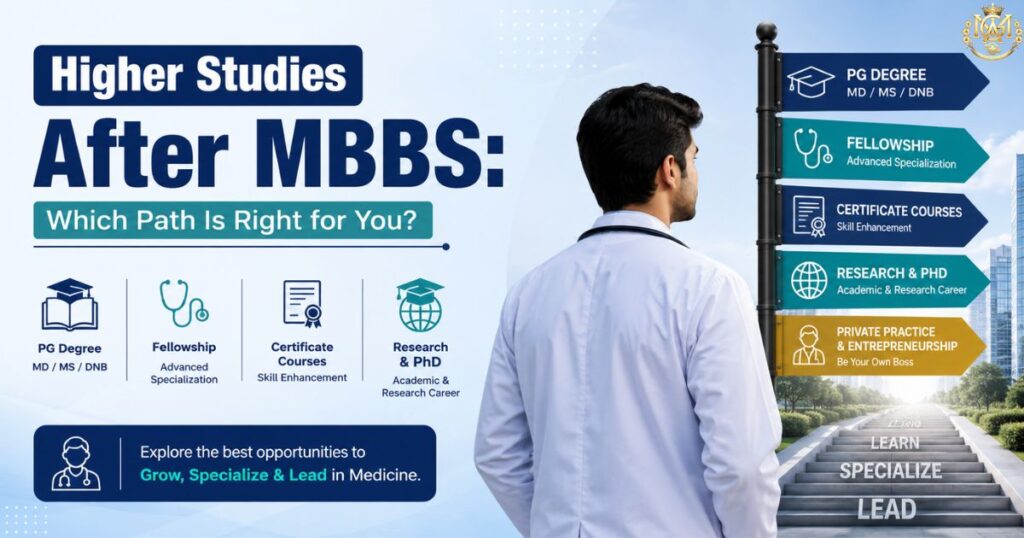
Higher Studies After MBBS: Which Path Is Right for You?
FELLOWSHIP

Higher Studies After MBBS: Which Path Is Right for You?

Reviewed by the Medical Global Academy academic team | Last updated: July 31, 2026 Finishing MBBS is only the first milestone. The next decision — what higher study path to take — shapes the next several years of your career, and it is rarely a simple choice. Should you attempt NEET-PG for MD/MS? Consider DNB? Take a faster PG Diploma? Or build a practical skill through a fellowship while you keep working? This guide compares every major option for higher studies after MBBS so you can choose with a clear picture of entrance requirements, duration, recognition, and career fit. This is a decision framework, not a simple listicle: rather than listing every course available, it explains how the major pathways differ and how to match one to your own goals, timeline, and risk tolerance. WHAT ARE YOUR OPTIONS FOR HIGHER STUDIES AFTER MBBS? MBBS graduates in India generally choose among five broad paths: MD/MS — a 3-year postgraduate medical degree via NEET-PG, for full clinical specialisation. DNB — a 3-year NBEMS qualification, legally equivalent to MD/MS, also entered via NEET-PG. PG Diploma — a shorter, more focused postgraduate qualification (university diplomas via NEET-PG, or private CPD diplomas without an entrance exam). Fellowship courses — 6-24 month skill-certification programmes for a specific clinical skill, usually without an entrance exam. Non-clinical higher studies — MBA, MPH, PhD, or health-tech/data programmes for doctors moving toward management, public health, or research. (Source: pathway structure cross-verified against NBEMS/NMC eligibility rules, detailed below.) MD/MS VS. DNB VS. PG DIPLOMA VS. FELLOWSHIP: COMPARISON AT A GLANCE The table below summarises how the four most-compared pathways differ on entry requirement, duration, official recognition, and who each one suits best. MD / MS Entry Requirement NEET-PG (mandatory) Duration 3 years Recognition Full postgraduate medical degree, NMC-recognised Best For Doctors set on a specific clinical specialisation DNB Entry Requirement NEET-PG (mandatory) Duration 3 years Recognition Equivalent to MD/MS under the NMC Act, 2019 (Sec. 37) Best For Doctors open to hospital-based/DNB-accredited institutes PG Diploma Entry Requirement NEET-PG (for NMC/university diplomas) Duration 2 years (university); shorter for private CPD diplomas Recognition University diplomas are NMC-recognised; private CPD diplomas are skill-certification, not medical degrees Best For Doctors who want faster, focused specialisation Fellowship Entry Requirement Usually no entrance exam; MBBS + registration Duration 6-24 months Recognition CPD/skill certification, not an NMC postgraduate degree Best For Doctors adding a practical skill without a multi-year residency (Sources: National Board of Examinations in Medical Sciences (NBEMS) (https://natboard.edu.in/) on NEET-PG as the mandatory common entrance test for MD/MS/PG Diploma admissions; National Medical Commission Act, 2019, Section 37 (https://www.indiacode.nic.in/bitstream/123456789/11820/1/A2019_30.pdf), on DNB’s equivalence to MD/MS.) OPTION 1: MD/MS — FULL POSTGRADUATE SPECIALISATION MD (Doctor of Medicine) and MS (Master of Surgery) are India’s traditional 3-year postgraduate degrees, undertaken at a medical college or university. Admission requires clearing NEET-PG, which the NBEMS confirms is the single mandatory entrance test for MD/MS/PG Diploma seats nationwide — no state or institutional exam substitutes for it. MD/MS remains the most recognised route into a clinical specialty and is generally required for senior academic and many government positions. OPTION 2: DNB — DIPLOMATE OF NATIONAL BOARD DNB is awarded by NBEMS and, since the National Medical Commission Act, 2019 (Section 37), is legally recognised as equivalent to MD/MS. DNB is also entered through NEET-PG and typically takes 3 years, usually at accredited hospitals rather than traditional medical colleges. Acceptance of DNB-qualified doctors for faculty roles, fellowships, and consultant positions has grown significantly in recent years, particularly in corporate and private hospital networks. OPTION 3: PG DIPLOMA AFTER MBBS This is where terminology gets confusing, and it is worth being precise. A university-awarded PG Diploma (offered by a medical college/university and listed under NMC regulations) is a formal, NEET-PG-gated postgraduate qualification, generally shorter than MD/MS. Separately, many private academies — including Medical Global Academy — offer PG Diploma-branded CPD (continuing professional development) programmes in specific skills such as ultrasonography, dermatology, or nephrology. These are valuable for building practical, hands-on competence and do not require NEET-PG, but they are skill-certification credentials, not a substitute for an NMC-recognised postgraduate medical degree. OPTION 4: FELLOWSHIP COURSES AFTER MBBS Fellowship programmes are typically 6 to 24 months, focus on one clinical skill area (e.g., fetal medicine, internal medicine, laparoscopy, arthroplasty), and generally do not require an entrance exam — most accept any MBBS graduate with a valid registration. Like private CPD diplomas, fellowships are skill-certification programmes rather than NMC postgraduate medical degrees. They suit doctors who want to build a specific, practice-ready skill alongside — rather than instead of — their existing MBBS registration, without committing to a multi-year residency. OPTION 5: NON-CLINICAL HIGHER STUDIES AFTER MBBS Not every MBBS graduate wants to stay purely clinical. Common non-clinical paths include an MBA in Healthcare/Hospital Management, an MPH (Master of Public Health), a PhD for a research career, or emerging programmes in health-technology and health-data analytics. These typically have their own separate entrance and eligibility processes distinct from NEET-PG, and are best suited to doctors aiming for management, policy, public health, or research roles rather than direct patient care. HOW TO CHOOSE: A SIMPLE DECISION FRAMEWORK Instead of asking “which course is best,” ask these questions in order: Do you want to practise as a recognised specialist (surgeon, physician, radiologist, etc.)? If yes, MD/MS or DNB via NEET-PG is the direct route. Are you open to re-attempting NEET-PG, or do you want to start building skills now? If you want to start now, a focused PG Diploma or fellowship lets you build competence while you decide on (or attempt) NEET-PG. Do you want a shorter time commitment? Fellowships (6-24 months) and CPD diplomas are faster than the 3-year MD/MS/DNB route. Do you want to move away from direct clinical practice? Consider MBA/MPH/PhD or health-tech programmes instead. Whatever you choose, confirm how the qualification is regulated (NMC-recognised degree vs. CPD/skill certification) so your career and compliance expectations match reality. COMMON MISTAKES TO AVOID WHEN PLANNING HIGHER STUDIES AFTER MBBS

best medical courses after MBBS
Learning blogs

Best Medical Courses After MBBS in 2026: Fellowship, PG Diploma, Certificate, Online & CME Guide

What are the best medical courses after MBBS? In short: The best medical courses after MBBS in 2026 fall into five categories — (1) Fellowship programmes, (2) PG Diploma courses, (3) Certificate courses, (4) Online medical courses, and (5) CME (Continuing Medical Education) programmes. Fellowships are currently the fastest-growing option because they don’t require NEET PG and deliver focused, hands-on specialty training. The 5 Best Course Categories After MBBS in 2026 Each format serves a different goal. Below is a quick tour of each, with typical duration and who each suits best. For the full catalog, see Medical Global Academy’s All Courses page. 1. Fellowship Courses (Trending in 2026) Fellowship courses are structured specialty-training programmes typically lasting 6 to 24 months. They combine theory with supervised clinical work and, importantly, most private and university-affiliated fellowships in India do not require NEET PG for entry. This has made them the trending choice for MBBS doctors in 2026. Popular tracks include cardiology, dermatology, emergency medicine, interventional radiology, reproductive medicine, and critical care. Fellowships suit doctors who want depth in a single specialty and hospital-grade clinical exposure. Browse the full range on Medical Global Academy’s Fellowship Courses hub, or read the detailed shortlist in Fellowship Courses After MBBS in India. 2. PG Diploma Courses A PG Diploma is a postgraduate-level programme, usually 1 to 2 years long, that combines academic modules with clinical training. Diplomas exist across a wide range of specialties — ultrasonography, dermatology, family medicine, diabetology, emergency medicine, pediatrics, and more. They’re a strong middle path between short certificates and a full MD/MS. PG diplomas suit MBBS doctors who want a longer, more structured programme with recognised accreditation (UGC / NAAC / CPD depending on institute). Explore the current catalog on the PG Diploma Medical Courses page, and compare formats in Post-MBBS Fellowship vs PG Diploma. 3. Certificate Courses Certificate courses are the shortest formal option — usually 3 to 12 months — and are designed for focused skill acquisition rather than full specialty training. Common examples include certificates in diabetology, ECG interpretation, infection control, echocardiography, and aesthetic medicine. They suit MBBS doctors, general physicians, or specialists who want to add one specific competency to their existing practice quickly. Browse available options on the Certificate Courses page. 4. Online Medical Courses Online medical courses have grown fastest since 2020 and now cover fellowship, diploma, and certificate formats delivered fully online or in hybrid mode. Live and recorded lectures, LMS-based case studies, and clinical attachment at affiliated hospitals let working doctors upskill without leaving their job. Look for programmes with UGC, NAAC A+ or CPD accreditation and a defined clinical component. See available formats on the Online Medical Course Options page, and specifically online medical courses with certificate if formal certification is important to your practice. 5. CME (Continuing Medical Education) CME programmes are short, credit-bearing sessions — from one-day workshops to multi-week modules — used to stay updated and, in many states, to renew medical registration. Formats include conferences, webinars, hands-on workshops, and structured online modules with a credit certificate on completion. CME suits every practising doctor regardless of specialty. It’s not a replacement for a fellowship or diploma, but it complements them: use a fellowship or diploma to build the core specialty, then keep those skills current through structured CME every year. Fellowship vs PG Diploma vs Certificate vs Online vs CME Use the table below as a quick comparison. It’s a starting point — always confirm duration, fee, and accreditation with the specific institute before enrolling. Course Type Duration Eligibility Fee Range (₹) NEET PG? Best Suited For Fellowship 6–24 months MBBS / MD / MS 50k – 2L Not required Hands-on specialty skills PG Diploma 1–2 years MBBS + internship 50k – 2L Not required* Structured specialty training Certificate 3–12 months MBBS or MD/MS 20k – 80k Not required Focused skill top-up Online Course Varies MBBS or higher 20k – 1.5L Not required Working doctors, flexibility CME 1 day – few weeks Any RMP Free – 25k Not required Licence renewal, updates *NEET PG is not required for most private fellowship and diploma programmes. For university-linked MD/DNB/MS routes, NEET PG rules still apply. How to Choose the Right Course After MBBS Three factors matter most when picking a course type: Depth vs speed — a fellowship or PG diploma gives depth (6 months to 2 years). A certificate or CME gives speed (a few weeks to a few months). Format fit — if you’re working full-time, a hybrid/online programme with weekend classes and a defined clinical attachment is often more realistic than a full-time offline diploma. Accreditation & clinical hours — check whether the certificate is issued by a recognised body (UGC / NAAC / CPD) and how many supervised clinical hours are included. This matters more than the course label. If you’re still deciding between paths, the guide on Courses After MBBS in India and Courses After MBBS Without NEET PG walk through each option in detail. Frequently Asked Questions Which course is best after MBBS without NEET PG? Fellowship and PG Diploma programmes offered by private institutes and universities are the most popular routes that do not require NEET PG. Fellowships are typically shorter and more specialty-focused, while PG diplomas offer a longer, more structured curriculum. How long is a fellowship after MBBS? Most post-MBBS fellowships in India run between 6 and 24 months, depending on the specialty and institute. Cardiology, interventional radiology, and reproductive medicine fellowships tend to be longer; dermatology and emergency medicine fellowships are often 12 months. Are online medical courses valid in India? Online medical courses are valid when issued by a recognised accrediting body such as UGC, NAAC-graded universities, or CPD & Training Council–linked institutes, and when the programme includes a defined clinical training component. Always verify the certifying body before enrolling. Can I do both a fellowship and a PG diploma? Yes. Many doctors stack a PG diploma for structured specialty training with a shorter fellowship for a sub-skill (for example, a PG diploma in radiology followed by a fellowship in interventional radiology). Sequence them based

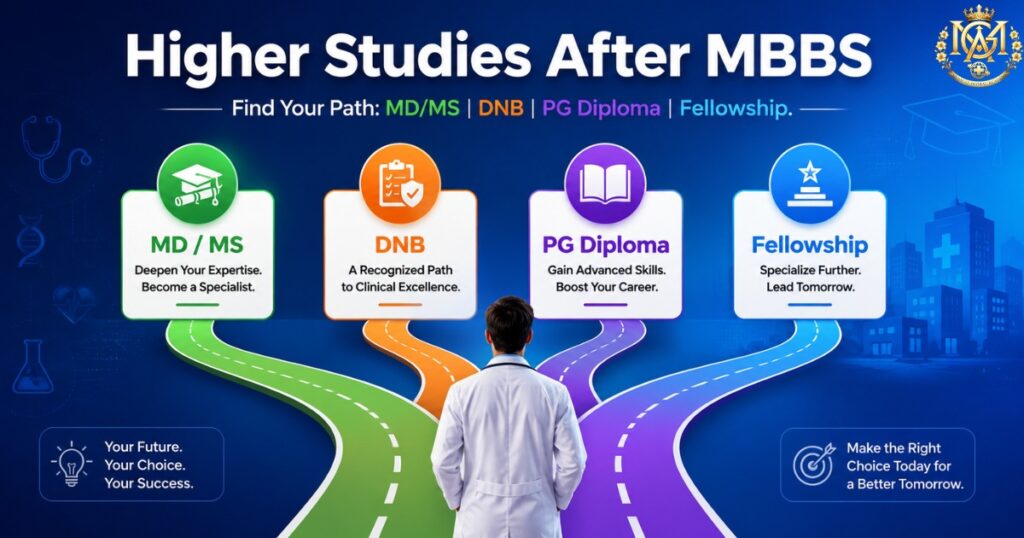
Career pathway decision guide showing four routes (MD/MS, DNB, PG Diploma, Fellowship) with color-coded branches, timeline durations (3-6-24 months), icons for each specialty path, and "Find Your Path" subtitle on blue gradient background for MBBS doctors planning postgraduate studies.
Learning blogs

Higher Studies After MBBS: Which Path Is Right for You?

Reviewed by the Medical Global Academy academic team | Last updated: July 31, 2026 Finishing MBBS is only the first milestone. The next decision — what higher study path to take — shapes the next several years of your career, and it is rarely a simple choice. Should you attempt NEET-PG for MD/MS? Consider DNB? Take a faster PG Diploma? Or build a practical skill through a fellowship while you keep working? This guide compares every major option for higher studies after MBBS so you can choose with a clear picture of entrance requirements, duration, recognition, and career fit. This is a decision framework, not a simple listicle: rather than listing every course available, it explains how the major pathways differ and how to match one to your own goals, timeline, and risk tolerance. WHAT ARE YOUR OPTIONS FOR HIGHER STUDIES AFTER MBBS? MBBS graduates in India generally choose among five broad paths: MD/MS — a 3-year postgraduate medical degree via NEET-PG, for full clinical specialisation. DNB — a 3-year NBEMS qualification, legally equivalent to MD/MS, also entered via NEET-PG. PG Diploma — a shorter, more focused postgraduate qualification (university diplomas via NEET-PG, or private CPD diplomas without an entrance exam). Fellowship courses — 6-24 month skill-certification programmes for a specific clinical skill, usually without an entrance exam. Non-clinical higher studies — MBA, MPH, PhD, or health-tech/data programmes for doctors moving toward management, public health, or research. (Source: pathway structure cross-verified against NBEMS/NMC eligibility rules, detailed below.) MD/MS VS. DNB VS. PG DIPLOMA VS. FELLOWSHIP: COMPARISON AT A GLANCE The table below summarises how the four most-compared pathways differ on entry requirement, duration, official recognition, and who each one suits best. MD / MS Entry Requirement NEET-PG (mandatory) Duration 3 years Recognition Full postgraduate medical degree, NMC-recognised Best For Doctors set on a specific clinical specialisation DNB Entry Requirement NEET-PG (mandatory) Duration 3 years Recognition Equivalent to MD/MS under the NMC Act, 2019 (Sec. 37) Best For Doctors open to hospital-based/DNB-accredited institutes PG Diploma Entry Requirement NEET-PG (for NMC/university diplomas) Duration 2 years (university); shorter for private CPD diplomas Recognition University diplomas are NMC-recognised; private CPD diplomas are skill-certification, not medical degrees Best For Doctors who want faster, focused specialisation Fellowship Entry Requirement Usually no entrance exam; MBBS + registration Duration 6-24 months Recognition CPD/skill certification, not an NMC postgraduate degree Best For Doctors adding a practical skill without a multi-year residency (Sources: National Board of Examinations in Medical Sciences (NBEMS) (https://natboard.edu.in/) on NEET-PG as the mandatory common entrance test for MD/MS/PG Diploma admissions; National Medical Commission Act, 2019, Section 37 (https://www.indiacode.nic.in/bitstream/123456789/11820/1/A2019_30.pdf), on DNB’s equivalence to MD/MS.) OPTION 1: MD/MS — FULL POSTGRADUATE SPECIALISATION MD (Doctor of Medicine) and MS (Master of Surgery) are India’s traditional 3-year postgraduate degrees, undertaken at a medical college or university. Admission requires clearing NEET-PG, which the NBEMS confirms is the single mandatory entrance test for MD/MS/PG Diploma seats nationwide — no state or institutional exam substitutes for it. MD/MS remains the most recognised route into a clinical specialty and is generally required for senior academic and many government positions. OPTION 2: DNB — DIPLOMATE OF NATIONAL BOARD DNB is awarded by NBEMS and, since the National Medical Commission Act, 2019 (Section 37), is legally recognised as equivalent to MD/MS. DNB is also entered through NEET-PG and typically takes 3 years, usually at accredited hospitals rather than traditional medical colleges. Acceptance of DNB-qualified doctors for faculty roles, fellowships, and consultant positions has grown significantly in recent years, particularly in corporate and private hospital networks. OPTION 3: PG DIPLOMA AFTER MBBS This is where terminology gets confusing, and it is worth being precise. A university-awarded PG Diploma (offered by a medical college/university and listed under NMC regulations) is a formal, NEET-PG-gated postgraduate qualification, generally shorter than MD/MS. Separately, many private academies — including Medical Global Academy — offer PG Diploma-branded CPD (continuing professional development) programmes in specific skills such as ultrasonography, dermatology, or nephrology. These are valuable for building practical, hands-on competence and do not require NEET-PG, but they are skill-certification credentials, not a substitute for an NMC-recognised postgraduate medical degree. OPTION 4: FELLOWSHIP COURSES AFTER MBBS Fellowship programmes are typically 6 to 24 months, focus on one clinical skill area (e.g., fetal medicine, internal medicine, laparoscopy, arthroplasty), and generally do not require an entrance exam — most accept any MBBS graduate with a valid registration. Like private CPD diplomas, fellowships are skill-certification programmes rather than NMC postgraduate medical degrees. They suit doctors who want to build a specific, practice-ready skill alongside — rather than instead of — their existing MBBS registration, without committing to a multi-year residency. OPTION 5: NON-CLINICAL HIGHER STUDIES AFTER MBBS Not every MBBS graduate wants to stay purely clinical. Common non-clinical paths include an MBA in Healthcare/Hospital Management, an MPH (Master of Public Health), a PhD for a research career, or emerging programmes in health-technology and health-data analytics. These typically have their own separate entrance and eligibility processes distinct from NEET-PG, and are best suited to doctors aiming for management, policy, public health, or research roles rather than direct patient care. HOW TO CHOOSE: A SIMPLE DECISION FRAMEWORK Instead of asking “which course is best,” ask these questions in order: Do you want to practise as a recognised specialist (surgeon, physician, radiologist, etc.)? If yes, MD/MS or DNB via NEET-PG is the direct route. Are you open to re-attempting NEET-PG, or do you want to start building skills now? If you want to start now, a focused PG Diploma or fellowship lets you build competence while you decide on (or attempt) NEET-PG. Do you want a shorter time commitment? Fellowships (6-24 months) and CPD diplomas are faster than the 3-year MD/MS/DNB route. Do you want to move away from direct clinical practice? Consider MBA/MPH/PhD or health-tech programmes instead. Whatever you choose, confirm how the qualification is regulated (NMC-recognised degree vs. CPD/skill certification) so your career and compliance expectations match reality. COMMON MISTAKES TO AVOID WHEN PLANNING HIGHER STUDIES AFTER MBBS

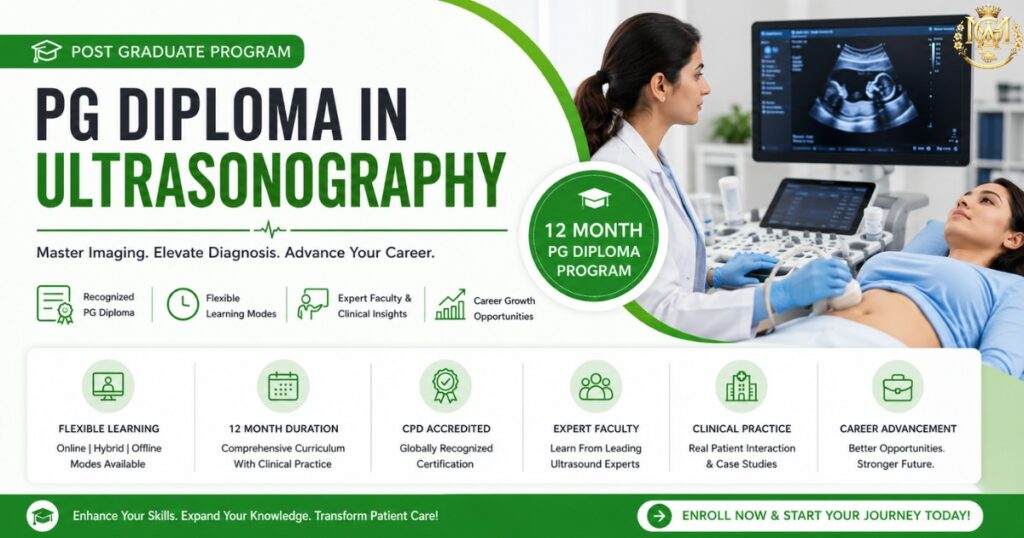
Doctor performing ultrasound scan on patient with modern diagnostic imaging equipment in clinical setting
Learning blogs

PG Diploma in Ultrasonography After MBBS: Eligibility, Duration, Fees, Syllabus & Career Guide (2026)

Ultrasonography has become one of the most in-demand diagnostic skills for MBBS doctors in India. It is noninvasive, fast, and used across specialties from obstetrics to emergency medicine — which is why more medical graduates are choosing a structured PG Diploma in Ultrasonography instead of, or alongside, a full postgraduate degree. This guide covers everything an MBBS doctor needs to know before enrolling: eligibility, course duration, fees, syllabus, career opportunities, and how a PG Diploma compares with a fellowship in ultrasonography. It also explains the regulatory context every doctor practising ultrasonography in India should be aware of. What Is a PG Diploma in Ultrasonography? Quick Definition A PG Diploma in Ultrasonography is a postgraduate-level certificate program for MBBS graduates and practising doctors that combines structured theory (ultrasound physics, anatomy, imaging protocols) with supervised clinical training, so doctors can learn to perform and interpret diagnostic ultrasound scans across It sits alongside — and is often compared with — MD/DNB Radiology (a full postgraduate degree), DMRD (a 2- year diploma), and short-format fellowship programs. A PG Diploma is designed to be completed while continuing clinical practice, typically through a hybrid of live/recorded online classes and hands-on hospital training Why MBBS Doctors Are Choosing Ultrasonography as a Specialisation Ultrasound is one of the most widely used point-of-care and diagnostic imaging tools in modern medicine because it is safe, radiation-free, and delivers real-time information at the bedside. For MBBS doctors, building competence in ultrasonography adds a practical diagnostic skill that is useful in general practice, obstetrics and gynaecology, emergency and critical care, and internal medicine alike. A structured diploma gives doctors a way to build this skill formally — through supervised training and a defined curriculum — rather than picking it up informally on the job. Eligibility Criteria for PG Diploma in Ultrasonography After MBBS Eligibility requirements are set by the training provider and can vary slightly between institutes. In general, the following applies: A recognised MBBS degree from an institution registered with the National Medical Commission (NMC) or an equivalent recognised authority.  Valid medical registration with a State Medical Council or the NMC.  MD/MS and other postgraduate doctors are also eligible and often enrol to add a diagnostic-imaging skill to their existing specialisation.  No prior radiology experience is typically required, since the course is designed to build ultrasonography skills from the fundamentals. Always confirm the exact eligibility criteria, document requirements, and any state-specific conditions directly with the training provider before applying. Course Duration & Learning Format Most PG Diploma in Ultrasonography programs for MBBS doctors in India run for around 12 months and are offered in flexible formats so working doctors can continue clinical practice while studying: Online — live and recorded theory classes, accessible from anywhere. Hybrid — online theory combined with clinical training at an affiliated hospital or imaging centre. Offline — in-person classes plus a dedicated on-site clinical training period. Programs generally include recorded lectures for revision, structured clinical exposure, and post-course mentorship to support doctors as they begin applying ultrasound skills in practice. Syllabus & Curriculum: What You’ll Actually Learn A comprehensive PG Diploma in Ultrasonography curriculum is organised by organ system and technique, moving from fundamentals to advanced applications. A representative module structure looks like this: Module  Core Focus  Skill Outcome Ultrasound Physics & Technology Acoustic principles, image formation, equipment calibration Understand how ultrasound images are generated and optimised Abdominal Ultrasound Liver, gallbladder, pancreas, spleen, renal anatomy Identify common abdominal pathologies on scan Obstetrics & Gynaecology Ultrasound First-trimester scanning, obstetric and gynaecological imaging Perform routine antenatal and gynaecological scans Musculoskeletal & Soft Tissue Joint and soft-tissue imaging Assess musculoskeletal pathology Cardiovascular Ultrasound & Doppler Echocardiography basics, vascular Doppler Evaluate blood flow and basic cardiac imaging Pediatric & Neurological Ultrasound Pediatric anatomy, neonatal brain, carotid Doppler Apply ultrasound in pediatric and neuro-imaging contexts Advanced Techniques Elastography, contrast- Understand emerging and enhanced and interventional ultrasound specialised applications Clinical Internship & Reporting Supervised scanning, case discussions, documentation, ethics Build hands-on competence and reporting standards For the exact current curriculum, batch schedule, and faculty for this program, see Medical Global Academy’s PG Diploma in Ultrasonography course page. Fees & EMI Options Course fees for a PG Diploma in Ultrasonography vary by institute, study mode, and inclusions such as clinical training and mentorship. As of this writing, Medical Global Academy’s program is priced as follows (fees are subject to change — always confirm the current fee on the official course page before enrolling): Study Mode Course Fee Online (full online access) ₹1,00,000 Hybrid (online theory + clinical attachment) ₹1,40,000 Offline (in-person + 1 month training) ₹1,30,000 Interest-free (0%) EMI plans are available on eligible modes — for example, the online track can be split into 3 or 4 monthly instalments after an upfront registration payment. For exact, up-to-date fees and EMI terms, check the PG Diploma in Ultrasonography fee calculator on the official course page or discuss with the admissions team on WhatsApp. PG Diploma vs Fellowship in Ultrasonography: Which Should You Choose? This is one of the most common questions MBBS doctors ask when planning their next step. The honest answer depends on what kind of learning and career outcome you want. Parameter PG Diploma Fellowship Learning style Structured academic curriculum with theory + supervised clinical training Primarily hands-on, skill-intensive clinical training Typical duration Around 12 months Varies by program and institute, often shorter and more intensive Best suited for Doctors who want a comprehensive, exam-backed foundation across multiple ultrasound applications Doctors who want fast, focused, practice-ready skills in a narrower area Career use Broad diagnostic-imaging competence usable across specialties Targeted expertise for a specific clinical role or setting For a deeper breakdown of how fellowships and PG diplomas compare across eligibility, cost, and career impact, see Medical Global Academy’s dedicated comparison: Post-MBBS Fellowship vs PG Diploma in India Career Opportunities After PG Diploma in Ultrasonography A PG Diploma in Ultrasonography can open several career paths for MBBS doctors, depending on your existing qualifications, state regulations, and the practice setting:  Hospitals

Indian doctor in white coat consulting with patient in a modern private clinic setting
Learning blogs

Private Doctor Salary in India: A Complete 2026 Income Guide

Private practice is where Indian medicine’s earning ceiling actually lives — and also where the income swings are widest. A private doctor’s salary in India isn’t a single number the way a government pay scale is. It’s a range shaped by employment structure, specialization, city, patient volume, and how many years a doctor has spent building a reputation. This guide breaks down exactly how private-sector doctor income works in India in 2026: what corporate hospitals pay, what independent practice actually nets after overheads, how earnings differ by specialty and city tier, and what moves the needle from a modest first-year income to an established, high-earning practice. Private Doctor Salary in India — Quick Overview Career Stage Corporate Hospital Consultant Independent Practice Entry-level (0–2 yrs post-qualification) ₹80,000 – ₹1.5 lakh/month Often lower than salaried pay initially Mid-career (3–7 yrs) ₹1.5 lakh – ₹4 lakh/month Comparable to or above corporate pay in a growing practice Established specialist (7–15 yrs) ₹2 lakh – ₹5 lakh/month Can exceed corporate pay significantly with a loyal patient base Senior / high-demand specialist ₹3 lakh – ₹10 lakh+/month Top metro specialists in procedural fields can earn well beyond this These figures are indicative ranges compiled from public salary data and industry reporting, not guaranteed outcomes — actual income depends heavily on specialization, location, and individual practice-building. Two Very Different Private Incomes: Corporate Consultant vs. Independent Practice “Private doctor salary” actually describes two distinct income models, and conflating them is why online salary figures often look inconsistent. Private Hospital / Corporate Consultant Salary This is a salaried or fee-per-visit arrangement with a private hospital chain or nursing home. Entry-level consultants typically start around ₹80,000–₹1.5 lakh per month. Procedure-heavy specialists — radiology, surgery, anesthesia, internal medicine — commonly earn ₹2–5 lakh per month once established, and specialists in high-demand procedural fields such as gastroenterology, nephrology, neurology, and endocrinology can reach ₹3–7 lakh per month at corporate hospitals. This model offers predictable income, infrastructure, and patient flow, but the hospital sets fee structures and takes a share of procedural revenue. Independent Clinic or Nursing Home Income This is self-employed income: consultation fees, procedures, and any ancillary services (diagnostics, pharmacy tie-ups) minus overheads. General practitioners running their own clinics typically see ₹1–3 lakh per month, and private clinic income more broadly ranges ₹1–4 lakh per month depending on patient footfall and specialization. Unlike salaried consultancy, there’s no income ceiling — but there’s also no income floor. A new clinic can earn less than a salaried position for the first two to three years before patient volume and reputation catch up. What Actually Determines a Private Doctor’s Take-Home Pay Four variables explain almost all the variation in private doctor income: Specialization — procedural and high-demand fields command materially higher fees than purely consultative ones. Experience and reputation — patient trust compounds slowly; income in year one rarely resembles income in year ten. Location — metro cities offer higher fee ceilings but far more competition; smaller cities offer lower fees but less competition for specialist care. Practice model — whether a doctor is salaried, on a revenue-share arrangement, or fully independent changes both the upside and the risk. Overheads That Eat Into Practice Income Independent practice income figures are often quoted as gross revenue, not take-home pay. Real costs that reduce net income include clinic or nursing-home rent, staff salaries (nurses, receptionists, technicians), equipment purchase and maintenance, medical indemnity insurance, licensing and compliance costs, and marketing or reputation-building spend in the early years. A doctor evaluating a move into independent practice should model these costs before comparing headline income figures against a salaried consultant role. Private Doctor Salary by Specialization Specialization Typical Private-Sector Monthly Range General Physician / MBBS Consultant ₹40,000 – ₹1.5 lakh MD Specialist (Medicine, Pediatrics, Dermatology) ₹1 – ₹3.3 lakh MS Specialist (Surgery, Ortho, ENT, Ophthalmology) ₹1.25 – ₹5 lakh Gastroenterologist / Nephrologist / Neurologist / Endocrinologist ₹3 – ₹7 lakh Cardiologist ₹2 – ₹6.5 lakh+ Neurosurgeon / Oncologist (senior, high-volume) ₹3 – ₹8 lakh+ DM/MCh Super-Specialist (established) ₹2.5 – ₹16 lakh+ Procedural and interventional disciplines — cardiology, radiology, anesthesia, critical care, orthopedics, and gastroenterology — consistently out-earn primarily cognitive specialties, because procedures and interventions carry higher billable value than consultations alone. Private Doctor Income by City Tier Metro cities (Delhi, Mumbai, Bengaluru, Chennai, Hyderabad) offer the highest absolute fee ceilings and the deepest patient pool for super-specialists, but also the most competition and highest overheads. Tier-2 and tier-3 cities generally offer lower headline fees, but specialist scarcity often means less competition and faster patient-base building — a newly qualified specialist may become “the” cardiologist or nephrologist in a smaller city far sooner than in a saturated metro market. Lower overheads in smaller cities also mean a larger share of gross revenue converts to actual take-home income. This is why tier-2/3 practice is increasingly attractive to specialists who want faster income stabilization rather than the highest theoretical ceiling. The Private Practice Income Curve: Year 1 to Mature Practice Private income doesn’t arrive linearly — it follows a curve that every doctor entering private practice should plan around: Years 1–3: Income is typically modest and can sit below what a comparable salaried corporate-consultant role would pay. This is the patient-base-building phase, and many doctors combine part-time hospital consultancy with early independent practice to stabilize cash flow. Years 4–10 (established practice): Income becomes comparable to, and often exceeds, corporate consultant pay as referral networks and patient loyalty solidify. This is also when many doctors invest in additional certifications or fellowships to expand their scope of practice and fee-earning procedures. Mature practice (10+ years): Top specialists in metro and high-demand tier-2 markets can earn multiples of standard corporate pay, driven by reputation, referral density, and — for surgical and procedural specialists — high case volume. This is the stage where “famous private practitioner” income figures (often several lakh per month or more) actually apply, and it is the outcome of a decade-plus of practice-building, not a starting point. Why Private Income Varies

Government doctor salary in India illustrating pay scale, allowances, career growth, and benefits for MBBS and specialist doctors in public healthcare
Learning blogs

Cardiology Courses After MBBS in India: Complete Guide to Types, Duration & Eligibility

If you’ve recently completed your MBBS and are passionate about treating cardiac patients, specializing in cardiology offers a rewarding career path in India. The journey from a general physician to a cardiologist involves multiple specialized training options, each with distinct durations, eligibility criteria, and career prospects. This comprehensive guide covers everything you need to know about cardiology courses after MBBS, helping you choose the right pathway for your medical career. Why Pursue Cardiology After MBBS? Cardiology is one of India’s most sought-after medical specializations, driven by the rising prevalence of cardiovascular diseases. According to global health data, cardiovascular diseases account for a significant proportion of mortality worldwide, making cardiologists essential healthcare providers. In India, the demand for skilled cardiologists continues to grow across government institutions, private hospitals, and cardiac centers. A cardiology specialization offers: High earning potential and job security in both clinical and academic settings Opportunities to work with cutting-edge diagnostic and interventional equipment Scope for research, publications, and academic advancement The satisfaction of directly managing life-threatening cardiac emergencies Main Types of Cardiology Courses After MBBS There are three primary pathways to specialization in cardiology, each suited to different career goals and timelines: Course Duration Eligibility Focus DM Cardiology 3 years MD/DNB Gen. Med. + NEET-SS Comprehensive specialization Fellowship Programs 1-3 years MBBS + Registration Clinical skills & experience PG Diploma 1-2 years MBBS (some programs Diagnostic skills focus 1. DM (Doctorate of Medicine) in Cardiology: The Traditional Specialization Route DM Cardiology is the most comprehensive cardiology qualification in India and represents the gold standard for full-fledged cardiologists. It’s a three-year super-specialty program that builds upon postgraduate (MD/DNB) training. Duration & Pathway: Total time to become a DM cardiologist from MBBS: approximately 8-9 years MBBS: 5.5 years MD General Medicine: 3 years DM Cardiology: 3 years Eligibility Criteria: Completion of MBBS with internship from a recognized university Registration with Medical Council of India (MCI) or State Medical Council Completion of MD/DNB in General Medicine (or equivalent specialization) Qualification in NEET-SS (National Eligibility cum Entrance Test – Super Specialty) for government institutions What You’ll Learn: DM programs provide in-depth training in non-invasive and invasive cardiology, including electrocardiography, echocardiography, cardiac catheterization, coronary interventions, arrhythmia management, heart failure therapy, and acute coronary syndromes. You’ll also gain experience in cardiac imaging, hemodynamics, and patient management in critical settings. 2. Fellowship in Clinical Cardiology: Shorter, Skill-Focused Training Fellowships offer a practical alternative to DM programs, ideal for doctors seeking specialized training without pursuing a formal super-specialty degree. They focus on clinical competence and hands-on experience. Duration & Eligibility: Duration: 12 months to 3 years (varies by institution) Eligibility: MBBS with internship completion and MCI/State Medical Council registration No NEET-SS requirement for most private institutions Program Focus: Fellowships emphasize clinical skills over theoretical knowledge. Trainees work alongside experienced cardiologists, gaining proficiency in patient assessment, diagnostic procedures like ECG interpretation and echocardiography, and managing common cardiac conditions. Programs are often customizable to suit individual learning goals—whether focusing on invasive procedures, heart failure management, or arrhythmia care. 3. PG Diploma in Clinical Cardiology: Flexible & Diagnostic-Focused A PG Diploma offers a middle ground between short certificate courses and formal super-specialty degrees, combining structured learning with practical training. These programs are increasingly available online and in hybrid formats, making them accessible to working doctors. Duration & Flexibility: Duration: Typically 1-2 years Format: Online, hybrid (blended learning), or full-time on campus Eligibility: MBBS with or without postgraduate qualification Curriculum Highlights: PG Diploma programs prioritize diagnostic cardiology. Core subjects include advanced ECG analysis, 2D and 3D echocardiography, cardiac stress testing, Holter monitoring, and basic cardiac imaging. Many programs include hands-on training with actual cardiac patients under supervision, and mentorship from senior cardiologists. Eligibility Criteria for All Cardiology Courses While eligibility requirements vary slightly by course and institution, all cardiology programs in India share core prerequisites: Bachelor of Medicine, Bachelor of Surgery (MBBS) degree from an approved medical college Successful completion of one-year mandatory internship after MBBS Valid registration with Medical Council of India (MCI), now known as the National Medical Commission (NMC), or respective State Medical Council For DM programs: Prior completion of MD/DNB in General Medicine or an allied field, plus NEET-SS qualification For fellowships and diplomas: MBBS registration is typically sufficient; some premium programs may require entrance tests or interviews Certificate & Short-Term Courses in Cardiology Beyond formal degrees, short-term certificate programs lasting 3-12 months provide introductory training in cardiology topics. These courses cover basics of ECG interpretation, echocardiography fundamentals, cardiac emergency management, and preventive cardiology. They’re ideal for doctors seeking quick skill upgrades or those early in their careers exploring cardiology before committing to longer programs. While certificate courses don’t lead to full specialization, they enhance clinical confidence and marketability in cardiac care. Choosing the Right Cardiology Course for Your Career Which cardiology course suits you best depends on your career timeline, work commitments, and specialization goals: Choose DM if you want comprehensive super-specialty training, plan to work in academic medicine or prestigious cardiac centers, and are willing to invest 8-9 years from MBBS. DM holders are recognized as full cardiologists and eligible for consultant posts and research roles. Choose a Fellowship if you prefer shorter training (1-3 years), need flexibility for work-life balance, or want to develop practical skills quickly while practicing clinically. Fellowships are excellent for those planning to establish private practice. Choose a PG Diploma if you want structured training in 1-2 years, prefer online or hybrid learning formats, and aim to specialize in diagnostic cardiology. Diplomas from accredited institutions gain professional recognition and are valuable for career advancement. Medical Global Academy’s Cardiology Programs If you’re considering cardiology specialization, Medical Global Academy offers accredited programs designed for working professionals and aspiring specialists. Their PG Diploma in Clinical Cardiology combines 1-year structured learning with hands-on practical training, mentorship from experienced cardiologists, hybrid format for working doctors, and focus on diagnostic competence—echocardiography, ECG, and cardiac imaging. They also offer a Fellowship in Clinical Cardiology for doctors seeking advanced clinical training and international exposure. Both programs

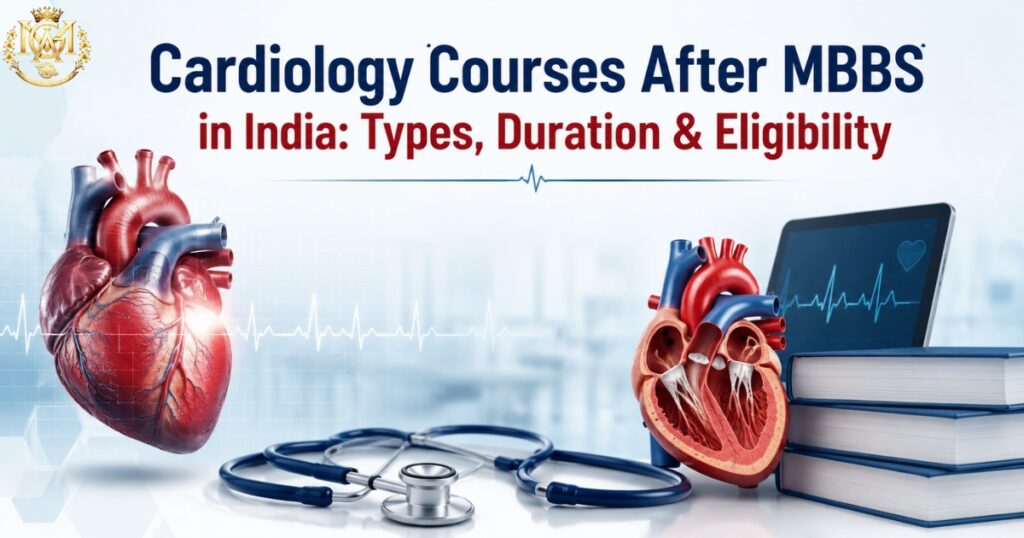
Fellowship in Cardiology in India — eligibility, duration and career scope
Learning blogs

Fellowship in Cardiology in India: Eligibility, Duration, Curriculum, and Career Scope

Are you thinking about specializing in heart care? Chances are, you’ve already searched for a fellowship in cardiology in India — and that’s a smart move. Heart disease is one of India’s biggest health challenges today. General practice alone often falls short when treating complex cardiac patients with real confidence. This guide covers everything you need before you apply. Who qualifies? How long does the course run? What will you actually study? How much time and effort will it take? And what does your career look like once you finish? What Is a Fellowship in Cardiology in India? A fellowship in cardiology in India offers focused, practical training. It helps doctors build real skills to diagnose and manage heart conditions. Unlike a full-time DM in Cardiology, it doesn’t need three years of full-time study. It runs shorter, stays more clinical, and suits doctors who already hold a medical degree and want to go deeper into cardiac care, without pausing their career. Most fellowship programs blend classroom learning with real clinical exposure. You don’t just read about cardiac cases. You see them and manage them under supervision. Who Can Apply for a Fellowship in Cardiology in India? Eligibility rules shift a little from one institute to another, but most programs welcome: MBBS graduates who want strong cardiology skills without a full DM MD or DNB holders in Internal Medicine, Family Medicine, or General Medicine Practicing doctors who want structured, Clinical cardiology training alongside their current work Some programs also take doctors with a few years of clinical experience, even without a postgraduate degree. Always check the exact eligibility rules for the institute you’re looking at. These rules can change based on accreditation and how deep the course goes. Do You Need a Postgraduate Degree First? Not always. Many MBBS doctors join a fellowship right after their degree. You’ll see this often among general practitioners who keep meeting cardiac cases they’d rather treat themselves than send elsewhere. Doctors with an MD in Internal Medicine usually move through the course faster. They already have a stronger base in pharmacology and systemic disease management. How Long Does a Fellowship in Cardiology in India Take? A fellowship saves you real time compared to a full DM in Cardiology. A DM usually takes three years. It needs a full-time academic slot, and most working doctors just can’t take that on. A fellowship in cardiology typically runs between six months and one year. Many programs design their training around practicing doctors. You complete your training through a mix of live sessions, recorded lectures, and scheduled clinical postings. Your practice never has to stop. Programs like the one at Medical Global Academy follow this exact model. They let doctors train while they keep seeing patients. Full-Time vs Part-Time Formats Some institutes run a full-time format with daily clinical postings. This suits doctors who can take a short break from independent practice. Others run a part-time or weekend-heavy format instead. This option works better if you want to keep your clinic running while you train. Before you enroll, ask how the schedule works week to week. This one detail decides how well the course fits your existing commitments. What Does the Curriculum Actually Cover? A good fellowship doesn’t just repeat what you learned in medical school. It goes deeper into the cardiac cases you see in real OPDs every day. Here’s what a solid curriculum usually covers: ECG Interpretation Reading ECGs fast and right is one of the most useful skills a doctor can have. Fellowship training takes you well past basic pattern spotting. You learn to handle tricky and borderline cases too. Acute Coronary Syndrome (ACS) You learn to catch ACS early. You manage it in the critical first hours. And you know exactly when a case needs immediate referral versus stabilization. Hypertension Management Hypertension looks simple, until you face resistant cases, drug interactions, and patients with multiple health issues at once. Fellowships train you to handle these the right way. Heart Failure From diagnosis to long-term care, heart failure needs sharp, careful decisions. Most MBBS or MD programs barely touch this topic. Arrhythmias You learn to read rhythm disorders. When to treat. When to watch. When to refer. This forms a core part of confident cardiac care. Preventive Cardiology Good fellowships also train you in risk checks and prevention steps. This helps you catch problems before they turn into emergencies. The best programs build this curriculum around real case discussions and specialist-led sessions, not just slides. That keeps your learning rooted in real clinical situations. How Much of the Course Is Clinical Training? This is the single most important thing you should check before you enroll. A program packed with recorded lectures but short on clinical postings won’t give you real confidence. Check for a set number of clinical postings. Check for supervised patient interactions and real case discussions. Don’t settle for theory modules you just watch alone. Why This Training Matters Right Now Heart disease numbers in India keep rising every year. And it’s not just older patients anymore. Younger adults now show up with ACS, hypertension, and early heart failure far more often than before. General physicians usually see these patients first. But without focused training, many doctors send hard cases elsewhere, even when they could manage them closer to home. A fellowship in cardiology in India closes exactly this gap. It gives you the confidence to manage cardiac cases yourself, instead of sending every complicated patient elsewhere. The Growing Demand for Cardiac Care in India India has one of the highest rates of heart disease in the world. Lifestyle changes, rising obesity, stress, and genetics all fuel this rise. But the number of trained specialists hasn’t kept pace, especially outside big cities. This creates a real opportunity. Doctors who build focused cardiology skills through a fellowship don’t need to wait years for a DM seat. Career Scope After a Fellowship in Cardiology in India Once you complete the program, your career can move

Government doctor salary in India showing pay scale, allowances, career progression, and salary growth across public healthcare services
Learning blogs

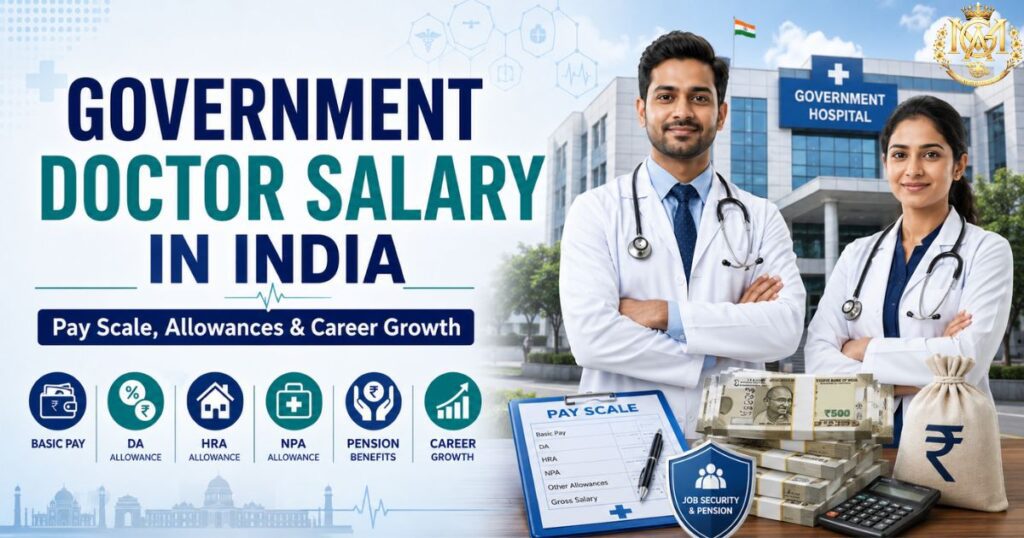
Government Doctor Salary in India: What Can You Earn in Public Healthcare?

For every MBBS graduate and postgraduate weighing career options in India, one question comes up first: how much does a government doctor actually earn? The answer matters — not just for financial planning, but because it shapes the choice between the stability of public healthcare and the higher earning ceiling of private practice. The short answer: government doctors in India earn between ₹60,000 and ₹3,00,000+ per month, depending on qualification, experience, and posting. But the take-home figure only tells part of the story. Non-Practising Allowance, subsidised housing, pension, and lifelong job security add substantial value that a private salary cheque doesn’t reflect. And with the 8th Central Pay Commission now formally constituted, another round of upward revisions is on the horizon. This guide breaks down every layer of a government doctor’s pay — starting salary, allowances, employer-wise differences, career progression, and how to grow your income within the public system. How Much Does a Government Doctor Earn in India? Government doctor salaries in India are standardised and predictable, unlike private-sector pay which fluctuates by hospital, city, and patient volume. Here’s what you can expect at each career stage: Starting salary (Junior Resident / Medical Officer, MBBS): ₹60,000 – ₹85,000 per month Average monthly salary (mid-career MBBS): ₹1,00,000 – ₹1,50,000 Specialist (MD/MS): ₹1,20,000 – ₹3,00,000+ Super-specialist (DM/MCh): ₹3,00,000 – ₹5,00,000+ Annual salary range: ₹7.2 lakh – ₹36 lakh+ (with allowances) The government pay structure follows a fixed pay-matrix governed by Central and State Pay Commissions. Under the 7th Pay Commission, entry-level medical officers sit at Pay Level 10 with a basic pay of ₹56,100, scaling up to ₹1,77,500. Senior consultants and professors reach Pay Level 13 (₹1,23,100 – ₹2,15,900). Table 1: Salary by Career Stage Career Stage Monthly Salary (₹) Typical Employer Intern (MBBS) 26,000 – 30,000 AIIMS, government medical colleges Junior Resident / Medical Officer 60,000 – 90,000 State hospitals, AIIMS, CGHS Senior Resident 78,000 – 1,10,000 AIIMS, ESIC, medical colleges Specialist / Consultant (MD/MS) 1,20,000 – 2,50,000 District hospitals, AIIMS Senior Specialist / Professor 2,00,000 – 3,00,000+ AIIMS, PGI, medical colleges Super-specialist / HOD 3,00,000 – 5,00,000+ AIIMS, PGI, central institutes What Determines a Government Doctor’s Salary? Unlike private practice — where reputation, footfall, and specialisation drive earnings — a government doctor’s salary is determined by a defined set of rules. Understanding these components helps you calculate your realistic take-home pay before accepting any posting. 7th Pay Commission (and the Incoming 8th CPC) The 7th Central Pay Commission has governed government doctor salaries since 2016. It restructured the pay matrix, introduced Pay Level 10 as the entry for medical officers, and set the Non-Practising Allowance at 20% of basic pay. Change is imminent, however. <cite index=”53-1″>The 8th Pay Commission was formally constituted by the Government of India via Gazette Notification on 3 November 2025</cite>. <cite index=”52-1″>The recommendations are expected to be implemented from January 1, 2026</cite>, though actual salary disbursement is likely to follow later with arrears. Analysts project a fitment factor between 1.92x and 2.86x, which could translate into a 20–60% real hike in basic pay. Basic Pay Basic pay is the foundation of the salary structure. It scales with qualification, designation, and years of service. For a fresh MBBS Medical Officer at Level 10, basic pay starts at ₹56,100. Dearness Allowance (DA) DA offsets inflation and is revised twice a year. <cite index=”53-1″>The Union Cabinet has approved an additional 2% Dearness Allowance (DA) and Dearness Relief (DR), effective from 1 January 2026, taking DA from 58% to 60% of Basic Pay/Pension</cite>. For a Level 10 doctor, that’s an extra ₹33,660 per month. House Rent Allowance (HRA) HRA is calculated as a percentage of basic pay based on city classification — 27% in metros (X-category cities like Delhi, Mumbai), 18% in Y-category, and 9% in Z-category. Doctors allotted government quarters receive quarters in place of HRA. Non-Practising Allowance (NPA) NPA is a defining feature of the government doctor pay package. Set at 20% of basic pay, it compensates doctors for foregoing private practice while in service. It is also pensionable — meaning it counts toward retirement calculations. State vs Central Government Central government roles (AIIMS, CGHS, Central Health Services, Railways) follow the Central Pay Commission and typically offer higher, more standardised pay. State government roles follow individual state pay commissions and vary significantly — Delhi, Kerala, and Tamil Nadu tend to pay more competitively, while smaller states offer lower base pay but often better rural incentives. Experience, Designation & Location Seniority drives progression through pay matrix levels. A Chief Medical Officer earns significantly more than a Medical Officer despite similar clinical qualifications. Location matters too — metro postings attract higher HRA, while remote or hardship postings unlock additional rural allowances. Table 2: Factors Affecting Government Doctor Salary Factor Impact on Salary Qualification (MBBS vs MD/MS vs DM/MCh) Directly determines pay level and starting basic pay Years of experience Annual increments + promotion-linked jumps Designation (MO / Sr MO / CMO / Director) Each rank sits on a higher pay level Central vs State employer Central postings generally pay more, uniformly City category (X/Y/Z) HRA varies 9% – 27% of basic pay Rural/hardship posting Extra allowances of ₹5,000 – ₹20,000+ NPA eligibility Adds 20% to basic pay if no private practice Government Doctor Salary Across Different Healthcare Services The “government doctor” umbrella covers many distinct services, each with its own pay structure and perks. Here’s how the major ones compare. Central Government Hospitals & CGHS The Central Government Health Scheme employs doctors across Delhi, Mumbai, Kolkata, and other metros. <cite index=”40-1″>For a General Duty Medical Officer (GDMO), pay starts at Level 10 with a basic of ₹56,100</cite>, plus NPA, DA, HRA, and TA. Total gross reaches ₹1.15 – ₹1.25 lakh per month in Delhi. AIIMS Doctors AIIMS represents the gold standard of central-government medical employment. <cite index=”9-1″>Doctors at AIIMS are central government employees, paid according to the 7th CPC pay matrix, but with additional academic allowances and non-practicing allowance (NPA) that significantly boost their total compensation</cite>. Junior Resident

mbbs doctor salary in india
Learning blogs

MBBS Doctor Salary in India: What Can You Really Earn After MBBS?

Last updated: July 2026 Five to six years of MBBS. Sleepless nights before anatomy exams. A gruelling internship year. If you’re going through this — or you’re a parent watching your child go through it — one question keeps coming back: what will it actually pay off to? The good news is that MBBS is one of the few degrees in India where your income doesn’t plateau early — it keeps climbing for decades, as long as you keep making the right career moves. This guide walks you through exactly what MBBS doctors earn at every stage, what pushes that number up, and how to plan your own path to a stronger income. How Much Does an MBBS Doctor Earn in India? Let’s get straight to the number you’re here for. A fresh MBBS graduate in India typically earns ₹4–8 lakh per year (₹35,000–₹70,000 a month), depending on whether you join a government or private hospital, and which city you’re in. That’s your starting point — not your ceiling. With experience, postgraduate qualifications, or a private practice, that number can realistically grow 5–10x over a career. Here’s how it breaks down stage by stage: Career Stage Typical Monthly Salary Typical Workplace Internship (final MBBS year) ₹15,000 – ₹35,000 Government/private medical college hospital Fresh MBBS graduate (Medical Officer) ₹40,000 – ₹90,000 Government or private hospital Junior Resident (pursuing MD/MS) ₹55,000 – ₹95,000 Government medical college 3–5 years’ experience ₹80,000 – ₹1.5 lakh Government/private hospital 5–10 years’ experience ₹1 lakh – ₹2 lakh Senior Medical Officer / RMO Senior doctor / Consultant (10+ years) ₹2 lakh – ₹5 lakh+ Private/corporate hospital Super-specialist (DM/MCh, 15+ years) ₹5 lakh – ₹15 lakh+ Corporate hospital / own practice Two things stand out here. First, your income after MBBS alone is respectable but not extraordinary — it’s what you do next that changes everything. Second, the growth curve for doctors is unusually long: unlike many careers that plateau by your 40s, senior consultants and specialists often keep earning more well into their 50s and 60s. What Factors Influence an MBBS Doctor’s Salary? Two MBBS graduates from the same batch can end up with wildly different incomes ten years later. Here’s what actually drives that gap. Factor Salary Impact Government vs private sector Government offers stability and steady increments; private/corporate offers a lower starting base but faster growth and bonuses City / location Metro cities (Delhi, Mumbai, Bengaluru) pay 20–30% more than tier-2/tier-3 cities Years of experience Each 3–5 year block roughly adds 30–50% to your monthly income Postgraduate qualification (MD/MS/DNB) Can double or triple your earning potential compared to MBBS alone Specialization Surgical and procedure-heavy specialties (cardiology, neurosurgery, orthopaedics) earn significantly more than general practice Hospital brand/institution Premier institutes (AIIMS, PGIMER) and top corporate chains (Apollo, Fortis, Max) pay above-average Additional certifications/fellowships Short courses in ICU care, emergency medicine, or ultrasound can boost pay without a full PG Night shifts and on-call duty Typically add 10–35% extra to base pay Notice that only one of these — your MBBS degree itself — is fixed once you graduate. Everything else in this table is a decision you get to make. That’s the real takeaway: your income after MBBS is far more in your control than most students realize. MBBS Doctor Salary Across Different Career Paths “Government or private” isn’t really the full choice anymore. Here’s how income compares across the paths MBBS graduates actually take today. Career Path Typical Monthly Salary Growth Potential Government Medical Officer ₹50,000 – ₹1.5 lakh Steady, structured, pension-backed Private hospital doctor ₹40,000 – ₹90,000 (fresher) Faster early growth, performance-linked Junior Resident (MD/MS in progress) ₹55,000 – ₹95,000 High — leads directly to specialist pay Corporate hospital (Apollo, Fortis, Max, Manipal) ₹60,000 – ₹1.3 lakh High, with structured career ladders Emergency medicine / ICU roles ₹50,000 – ₹90,000+ High, due to risk premium and shift pay Telemedicine / online consultation ₹30,000 – ₹80,000 (often part-time/hybrid) Moderate, but flexible and stackable with other income Private practice (own clinic) Highly variable Uncapped — depends entirely on reputation and patient volume If you’re the kind of person who values predictability, the government path gives you a clear, pension-backed ladder. If you’re comfortable with more risk in exchange for a higher ceiling, private and corporate healthcare — especially combined with specialization — tends to pay off faster. Many doctors don’t have to choose just one: a government job with evening private practice is a common and financially smart combination. How Can MBBS Doctors Increase Their Salary? This is the part most guides skip — and it’s the part that actually matters for your future income. Here’s what moves the needle, ranked by impact. Career Decision Income Impact Pursuing MD/MS/DNB Often the single biggest jump — can 2–3x your income over a fresher’s MBBS salary Choosing a high-demand specialization (cardiology, oncology, radiology) Adds a further multiplier on top of your PG salary Getting a fellowship or PG diploma Faster and cheaper than a full PG; useful if you want to raise your salary within 1–2 years Building procedural/surgical skills Procedure-based work generally pays more than consultation-only roles Moving to a metro or building a strong local reputation Boosts both salary and private practice income Starting a private practice alongside employment Adds an independent, uncapped income stream Developing an online presence / telemedicine practice Increasingly important — patients now search for and choose doctors online Strong communication and patient-handling skills Directly affects private practice growth and referrals, which compounds over years Here’s the honest picture: an MBBS degree gets you into the profession, but it’s specialization, skill-building, and smart career choices that get you into the top income brackets. Doctors who stop at just MBBS with no further upskilling tend to plateau around ₹80,000–₹1.5 lakh a month. Doctors who invest in an MD/MS, a sought-after specialization, or their own practice routinely cross ₹3–5 lakh a month — and the highest-earning super-specialists and successful private practitioners can go well beyond that. What Does Long-Term Career Growth Look Like After

Scroll to Top