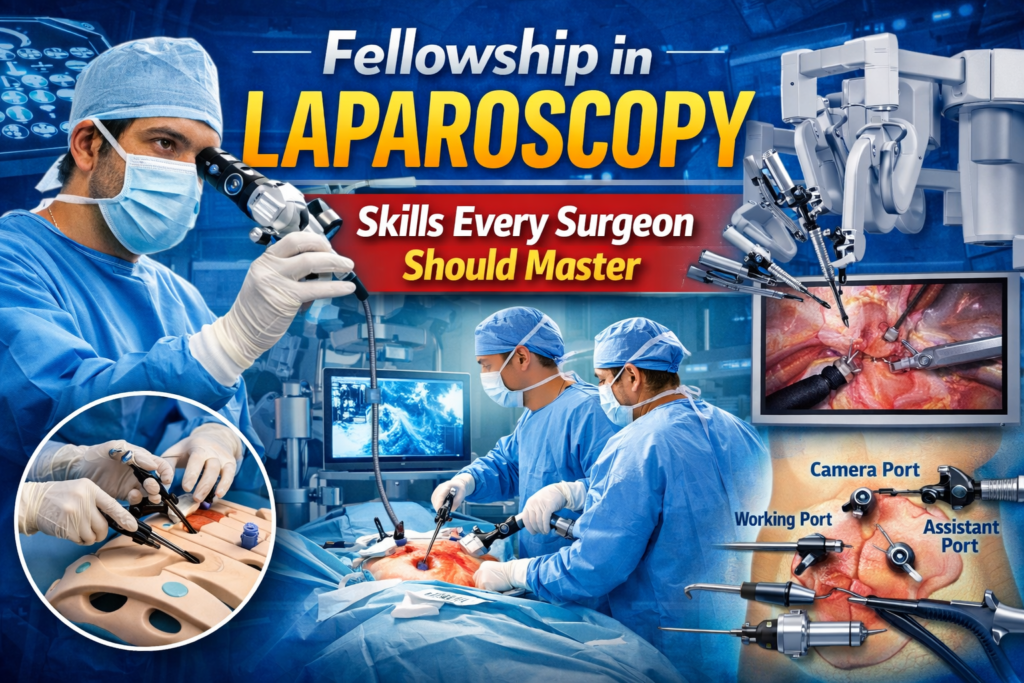
Minimally invasive surgery has experienced an extremely rapid expansion in the last ten years, and Fellowship in Laparoscopy has become one of the most in demand programs among surgeons the world over. This fellowship equips the surgeons with high level skills in surgery, practical experience, and exposure to new advanced methods. This blog will address the most important skills that every surgeon must learn during their fellowship in Laparoscopy, which will not only allow them to grow in their career but also provide the best patient care.
Learning Fellowship in Laparoscopy
Laparoscopy Fellowship is an advanced training program that targets surgeons that intend to increase their capabilities in minimally invasive procedures. The program has specialized on the technical, theoretical and clinical aspects of laparoscopic surgery. Surgeons have the opportunity to work closely with the mentors, carrying out the procedure of simple diagnostic laparoscopy through very complicated robotic-assisted surgeries.
Important Advantages of Laparoscopy Fellowship
- Experience in the practice of least invasive surgery.
- Introduction to the latest laparoscopic technologies and tools.
- Increased accuracy and decreased time of patient recovery.
- Research and publication in laparoscopic surgery.
- Greater career opportunities and specialization.
The Skills that Every Surgeon Needs To Learn
In a Fellowship in Laparoscopy, surgeons should be able to acquire a set of technical, cognitive, and soft skills. These competencies do not only guarantee better surgical results but also make the surgeon more confident and have better judgment skills.
1. High-level Hand-Eye Co-ordination
Laparoscopic surgery is an operation where a long procedure is carried out using very small cuts and a monitor is used to view the operation. High-level hand-eye coordination is essential to:
- Precisely manipulate instruments.
- Avoid tissue injury
- Complete complicated suture and knot-tying.
2. Laparoscopic Instruments Knowledge
There are also machines like trocars, laparoscopes, graspers, dissectors, and energy devices that the surgeons should be trained to use. The profound knowledge of these tools can guarantee:
- Dexterous tissue manipulation.
- Decreased intraoperative complications.
- Rapid learning of various laparoscopic systems.
3. Mastery of Basic and Advanced Laparoscopy
A Laparoscopy Fellowship would expose the surgeon to the following procedures:
- General Operations: Appendectomy, cholecystectomy, laparoscopic diagnosis.
- Procedures of the advanced type: Hernia repair, bariatric surgery, colorectal procedures, gynecological surgeries.
These procedures are necessary in order to develop competency and confidence in complex cases.
4. Three-Dimensional Pictorialization and Space consciousness
Laparoscopic surgery is done as compared to the open surgery being done under a 2D visual field. The surgeons have to learn to:
- 3D visualization of anatomy.
- Perceives judge distances and tissue planes perfectly.
- Adapt to complicated anatomical differences.
5. Handling and Dissection Techniques of Tissues
Tissues are delicate and require careful treatment to reduce the trauma and guarantee healing. Surgeons must learn:
- Sharp and blunt dissection
- Safe tissue retraction
- Electrosurgical equipments should be used under controlled consumption.
6. Skills in Suturing and Knot-Tying
Laparoscopic knot tying and laparoscopic suture are difficult procedures that need a lot of practice because of the lack of space and the inability to move instruments. Surgeons should master:
- Knot methods in intracorporeal and extracorporeal.
- Constant and intermittent suturing.
- Effective sealing of the superficial and deep tissues.
7. Intraoperative Complications Management
A Laparoscopy Fellowship will expose surgeons to complications that include:
- Vascular and bleeding injuries.
- Organ perforation
- Equipment malfunction
- Conversion to open surgery
Ready reserves will guarantee patient safety and minimise postoperative morbidity.
8. Laparoscopic Anatomy knowledge
It is essential to have a clear explanation of anatomical landmarks both normal and variant. Surgeons should be able to:
- Recognize organ and structures during laparoscopy.
- Be familiar with the anatomy of the vessels and nerves.
- Make safe dissections and resections.
9. Robotic-Assisted Laparoscopy
Robot surgery training is now being incorporated into many fellowships. Surgeons should:
- Study operator robotic training.
- Learn the dynamics of instruments.
- Make minute movements and complicated steps.
10. Research and Academic Skills
Participation in research is promoted by a good fellowship. Surgeons should be able to:
- Carry out clinical trials and research.
- Share results in peer-reviewed journals.
- Present at conferences
Involvement of the research increases credibility and keeps the surgeons abreast with innovations.
11. Patient Selection and Preoperative Planning
Laparoscopic surgery is a type of surgery that needs to be mastered by surgeons in the field of patient assessment. Key skills include:
- Assessing comorbidities and risk factors.
- Planning the location of ports and strategy of procedures.
- Addressing patients about risks, benefits and alternatives.
12. Follow-Up and Care after the Surgery
Operative management is no less important than surgery. Surgeons should:
- Watch out on complications such as infection or bleeding.
- Recommendations on early mobilization and diet.
- Make sure that there are appropriate recovery protocols.
Tips to Excel a Fellowship in Laparoscopy
- Laparoscopy practice on Simulators: Laparoscopy Practice Before operating patients, practice laparoscopy on laparoscopic simulators or in animal models.
- Find Mentorship: Get the guidance of the knowledgeable laparoscopic surgeons that can help with the development of techniques.
- Attend Workshops: Participate in specialized workshops and conferences to stay updated.
- Doc. Cases: Keep a journal of processes, problems and results.
- Keep abreast: Read journals and publications to ensure you are abreast with innovations in laparoscopic surgery.
Conclusion
There is much more to a Fellowship in Laparoscopy than a certificate, it is a challenging course of skills development, knowledge and experience in surgery. Surgeons are able to learn advanced hand-eye coordination, instrumentation, suturing, tissue handling, complication management, and robotic surgery by mastering all that can help them dramatically better patient outcomes, and increase their career opportunities. To every would-be minimally invasive surgeon, they are not optional but must be skillful.
FAQs
Q1. How long do Fellowships in Laparoscopy last?
A: Generally, the duration of the fellowship is between 6 months and 2 years, but this is program and institution specific.
Q2. Who do you qualify to be a Fellowship in Laparoscopy?
A: Eligible surgeons are those who have undergone their MBBS and have undergone their residency in general surgery or any other related specialty.
Q3. Will laparoscopic fellowships have an international opportunity?
A: Yes, there are a lot of countries with a developed laparoscopic fellowship, such as USA, UK, Germany and India.
Q4. Are robotic surgery present in every laparoscopic fellowship?
A: Not every program has robotic surgery, but most of the advanced fellowships incorporate it into the program.
Q5. What are the benefits of a fellowship to a surgeon?
A: It raises the level of technical competencies, increases the accuracy of surgery, research opportunities, and employment opportunities in specialized hospitals.