Introduction: Why Dermatology Skills Matter in Daily Practice
Anyone who spends time in a busy outpatient clinic quickly notices how often patients come in with skin-related complaints. In a typical OPD, it is quite common to see multiple cases of acne, fungal infections, itching disorders, hair loss, or pigmentation concerns in a single day.
For many MBBS doctors, dermatology becomes an unavoidable part of everyday practice.In clinics that are not specifically designed in the treatment of skin diseases, the patients often consult regarding dermatological issues since their primary care doctor is normally the first consultant.
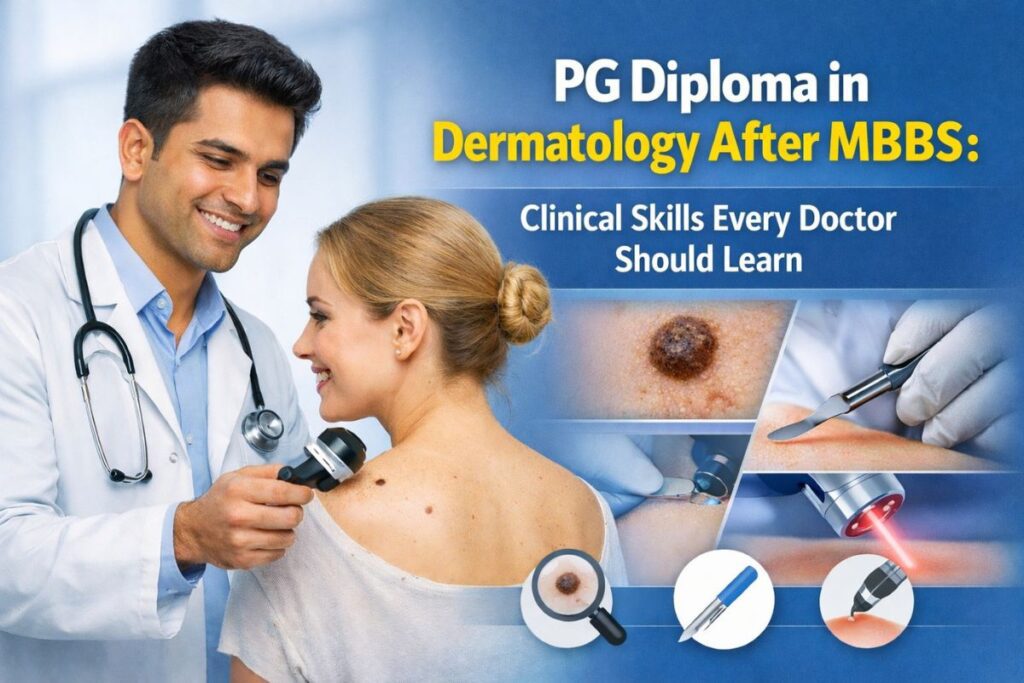
However, diagnosing skin conditions is not always as straightforward as it appears. Two different diseases may look very similar during the initial examination. At the same time, a seemingly minor rash can sometimes indicate an underlying systemic issue.
It is due to this that the development of useful dermatology skills will be able to greatly enhance the manner in which doctors will treat such cases. When a doctor becomes comfortable identifying lesion patterns and understanding common treatment protocols, managing routine dermatological problems becomes much easier.
This is one reason why many physicians consider a PG Diploma in Dermatology after MBBS. Such programs are usually designed to provide focused clinical exposure and help doctors build confidence in managing common skin disorders.
Growing Importance of Dermatology in Modern Medical Practice
Dermatology has developed to an incremental extent in ordinary medical practice over the past few years. This has been brought about by a number of factors.
The first apparent cause is the fact that the number of patients presenting with skin conditions is on the rise. This trend has been influenced by environmental factors and the changing life styles as well as increased awareness on personal health. Acne, seborrheic dermatitis, superficial fungal infections and pigmentation disorders are now common in various age groups.
The other reason is the increased awareness of cosmetic dermatology. Most patients nowadays are becoming more attentive to their looks and skin conditions. Such problems as the acne scar, irregular skin color, or hair loss will prompt them to consult a doctor sooner than ever before.
In the case of the primary care physician, this is a move towards making dermatology more relevant. Doctors can initiate proper management and counsel patients better when they are able to identify commonly prevalent skin conditions at the earliest opportunity.
Understanding a PG Diploma in Dermatology After MBBS
A PG Diploma in Dermatology is typically designed as a focused training pathway for MBBS doctors who want to strengthen their understanding of skin diseases.
Diploma courses in contrast to longer specialty programs tend to be focused on practical dermatology. The primary objective is to assist physicians in training to diagnose and treat common forms of dermatological illnesses that are commonly encountered in an outpatient setting.
In such training programs, doctors are usually exposed to clinical cases that involve:
- Acne and related disorders
- Superficial fungal infections
- Hair loss conditions
- Pigmentation disorders
- Common inflammatory skin diseases
This structured exposure helps doctors develop a systematic approach when evaluating patients with skin complaints.
Instead of relying solely on symptomatic treatment, doctors learn how to assess the lesion carefully, consider possible differential diagnoses, and choose rational therapy.
Core Clinical Skills Doctors Develop During Dermatology Training
One of the most valuable aspects of dermatology education is the development of clinical observation skills. Dermatology relies heavily on careful examination and pattern recognition.
Clinical Evaluation of Skin Disorders
A significant part of dermatology involves learning how to interpret the visual features of skin lesions.
Doctors are trained to observe factors such as:
- lesion morphology
- distribution across the body
- surface texture and scaling
- associated symptoms like itching or burning
These observations often provide important clues that help narrow down the possible diagnosis.
Acne Diagnosis and Management
Acne is an outpatient dermatologic disorder that is widely seen in the outpatient clinics particularly among adolescents and young adults.
In the process of training dermatology, physicians are taught to distinguish between different acne lesions and determine the degree of the disease. Depending on this evaluation, it is possible to choose treatment strategies more adequately.
Topical agents, systemic drugs, in some cases, and patient education on the factors that can play a role on the severity of acne are management procedures.
Recognition of Fungal Skin Infections
Fungal infections are very prevalent in most clinical environments. It is frequently manifested in patients with itching, redness or ring-shaped lesions of various body parts.
Dermatology training assists physicians in identifying the appearance of common clinical manifestation of dermatophyte infections like:
- tinea corporis
- tinea cruris
- tinea faciei
Understanding these patterns allows doctors to start appropriate antifungal therapy and avoid unnecessary medications.
Hair Fall Assessment
Hair loss is another frequent concern among patients visiting clinics. However, hair fall can occur due to several different causes.
Doctors are trained to evaluate common forms of alopecia, including:
- androgenetic alopecia
- telogen effluvium
- alopecia areata
Correct identification of the underlying cause is essential for effective treatment and proper patient counseling.
Pigmentation Disorders
Issues with pigmentation may be very anxiety-inducing to patients. Melasma and post-inflammatory hyperpigmentation are conditions that are usually observed in a clinical setting.
Dermatology training assists physicians to be aware of the processes that underlie these conditions and to be able to explain to the patients what they should expect in treatment.
Basic Dermatology Procedures
Some training programs also introduce doctors to basic dermatology procedures that are commonly used in clinical practice.
These may include:
- cryotherapy for selected skin lesions
- introductory understanding of chemical peels
- basics of intralesional injections
Although procedural expertise develops gradually with experience, early exposure helps doctors understand how these treatments are used in dermatology practice.
How Dermatology Training Improves Clinical Confidence
Clinical confidence can be listed among the most evident effects of a structured dermatology training.
Physicians who have an experience in dermatology cases tend to adopt a more methodical process in assessing the skin cases. They do not only treat symptoms but learn to examine lesions and make decisions on treatments depending on clinical results.
The consequences of this approach usually include:
- improved diagnostic accuracy
- more structured treatment planning
- better patient satisfaction
Patients also appreciate when their doctor can explain the nature of their condition and outline a clear treatment plan.
Dermatology Skills in General Practice
In the case of general practitioners, dermatology knowledge may be very helpful. In general, frequent skin issues that patients bring to primary care doctors concern fungal infections, acne, allergy, hair loss, or pigmentation alterations.
The thing is that with necessary training, doctors are able to cope with a great number of such conditions in their own clinics.
Simultaneously, doctors can know about dermatology, which will assist in recognizing cases that need a specialist, and patients will be provided with the necessary attention.
Conclusion
Dermatology is rapidly gaining significance in contemporary clinical practice. Skin disorders play an important role in the day-to-day consultation of doctors in outpatient facilities.
Developing practical dermatology skills allows physicians to evaluate skin conditions more confidently and manage common disorders more effectively. Structured training programs such as a PG Diploma in Dermatology after MBBS can provide valuable clinical exposure and strengthen diagnostic abilities.
To most physicians, a better acquisition of dermatology eventually leads to the provision of better healthcare and a more holistic practice in the clinics.