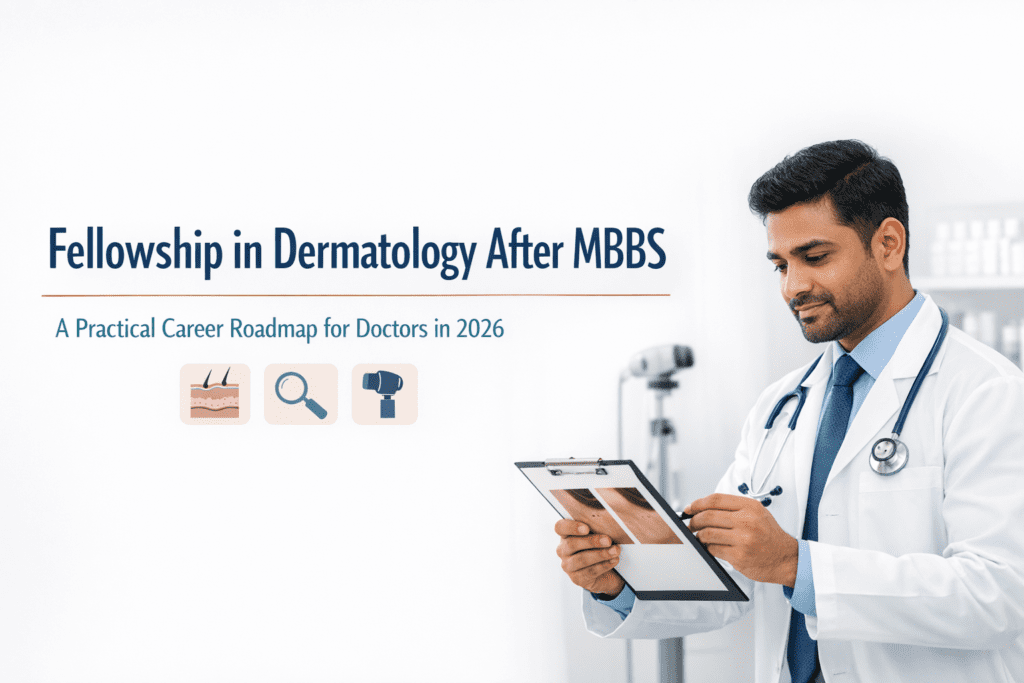
Fellowship in Dermatology After MBBS: A Practical Career Roadmap for Doctors in 2026
Introduction Completing MBBS is both satisfying and unsettling. After years of structured learning, postings, and examinations, you suddenly find yourself asking a very simple but difficult question: What next? Some prepare for postgraduate entrance exams immediately. Some join government service. Others enter private practice to gain clinical exposure. Yet many doctors, especially those working in outpatient settings, gradually notice something important — a significant proportion of daily cases involve skin. From recurrent fungal infections to acne, eczema, pigmentation disorders, and hair loss, dermatology is not an occasional subject in practice.It is regular, observable and more topical. In the coming years (2026), the patient interest in skin health, preventive healthcare, and aesthetic procedures will only increase. Teleconsultation paradigms are growing. The expectations are shaped by social exposure. Fellowship in Dermatology post MBBS is one of the programs that many new doctors are considering as an organized skill-development strategy in the changing environment. However, this decision requires clarity — not assumption, not marketing influence, and certainly not unrealistic expectations. Let us examine it practically. Why Dermatology Is Gaining Attention After MBBS During general practice, one realization becomes obvious: dermatological complaints rarely stop. Seasonal fungal infections, steroid-modified tinea, adolescent acne, adult-onset acne, chronic eczema, psoriasis, melasma, and drug eruptions form a steady stream of consultations. Dermatology offers several professional advantages: It is predominantly outpatient-based. Emergencies are relatively limited compared to critical care specialties. It combines clinical reasoning with procedural skills. Treatment outcomes are often visible and measurable. Yet it is essential to remain grounded. Dermatology is not merely aesthetic medicine. It includes autoimmune disorders, pediatric dermatoses, infectious diseases, systemic associations, and chronic inflammatory conditions requiring long-term follow-up. For MBBS doctors, dermatology becomes attractive not because it is “easy,” but because it is practical, clinically engaging, and frequently encountered in real-world practice. What Exactly Is a Fellowship in Dermatology? A Fellowship in Dermatology is typically a 6–12 month structured clinical training program. It is designed to improve focused dermatology skills under supervision. It does not replace MD or DNB Dermatology, nor does it confer specialist equivalence. A credible fellowship usually includes: Supervised OPD exposure Case-based discussions Theoretical teaching modules Introduction to dermoscopy Demonstration of basic procedures Training in documentation and follow-up The training primarily focuses on commonly encountered dermatological conditions and introductory procedural skills. In contrast, MD/DNB Dermatology is a three-year academic residency involving in-depth research training, inpatient exposure, advanced dermatosurgery, and comprehensive subspecialty learning. The academic depth and institutional recognition are significantly broader. Understanding this distinction protects professional credibility and patient safety. Skills Doctors Can Realistically Gain 1. Clinical Competence The greatest value of a structured fellowship lies in improving diagnostic confidence. Doctors commonly strengthen their ability to: Grade and manage acne systematically Plan long-term psoriasis and eczema treatment Use topical and systemic steroids rationally Diagnose fungal and bacterial dermatoses accurately Interpret basic dermoscopic findings Identify lesions that require biopsy or referral Dermatology depends heavily on pattern recognition. Pattern recognition develops through repeated supervised exposure, not through short workshops or online modules. 2. Procedural Foundations Depending on the institute and supervision level, exposure may include: Superficial chemical peels Intralesional injections PRP basics Cryotherapy or cautery Conceptual introduction to laser systems It is important to emphasize: procedural dermatology demands restraint. Complication recognition, aseptic technique, patient selection, and documentation are as important as technical skill. Good training teaches caution before confidence. 3. Clinical Judgment Perhaps the most underrated benefit is improved decision-making: When to manage independently When to refer to a dermatologist How to recognize early adverse drug reactions How to handle patient expectations realistically Clinical maturity is demonstrated not by performing every available procedure, but by understanding professional limits. Can a Fellowship Replace MD Dermatology? This question is frequently asked. The answer is straightforward: No. MD Dermatology offers: Comprehensive academic grounding Research exposure and thesis work Inpatient management of complex cases Advanced dermatosurgery training Institutional academic privileges A fellowship is narrower and more practice-oriented. It is meant to strengthen outpatient-level competence, not create superspecialists. For doctors aiming at academic careers, tertiary care consultancy, or advanced procedural dermatology, postgraduate specialization remains essential. However, for MBBS doctors seeking structured dermatology skill enhancement within defined boundaries, a fellowship can be meaningful and practical. Career Pathways After Fellowship Completion of a fellowship expands options, but success depends on consistent effort and ethical practice. Common pathways include: Hospital Attachment – Additional supervised experience working with a dermatologist. Hybrid Practice Model -Introduction of dermatology-oriented services into general practice. Collaborative Aesthetic Set-up Before proceeding to work independent procedural work, the employee will be working with senior dermatologists. OPD-Based Clinic – The treatment of the well-defined scope of common dermatology conditions. There is a slow growth in financial aspects in dermatology. It relies on patient faith, results, and communication expertise as well as ethical steadfastness rather than on certifications. Medico-Legal and Ethical Responsibilities Dermatology is visually outcome-oriented, and therefore expectations are high. Ethical discipline becomes essential. Every practicing doctor should prioritize: Detailed informed consent Standardized documentation with photographs (where appropriate) Clear explanation of risks and realistic outcomes Transparent cost discussion Timely referral of complicated or systemic cases Avoidance of exaggerated promotional claims Short-term marketing success can damage long-term professional credibility. Responsible dermatology practice is conservative, patient-centered, and legally aware. Continuous medical education and periodic case review strengthen safety. Who Should Consider This Fellowship? A fellowship may be suitable for: MBBS physicians unable to undertake postgraduate entrance exams at once. Doctors who regularly have dermatology cases. Researchers in structured procedure learning. Physicians intending to practice semi-urban or urban based on outpatient. Nurse practitioners who want to enhance dermatology confidence in a responsible manner. It is less suitable for individuals expecting instant specialist recognition without sustained academic effort. 2026 Outlook: The Future of Dermatology Practice Looking ahead, dermatology is likely to expand in three clear directions: Preventive and lifestyle-focused skincare Evidence-based aesthetic interventions Technology-supported consultation and dermoscopic imaging At the same time, regulatory oversight and patient awareness are increasing. Documentation quality, standard treatment protocols, and ethical transparency will define sustainable growth. The future