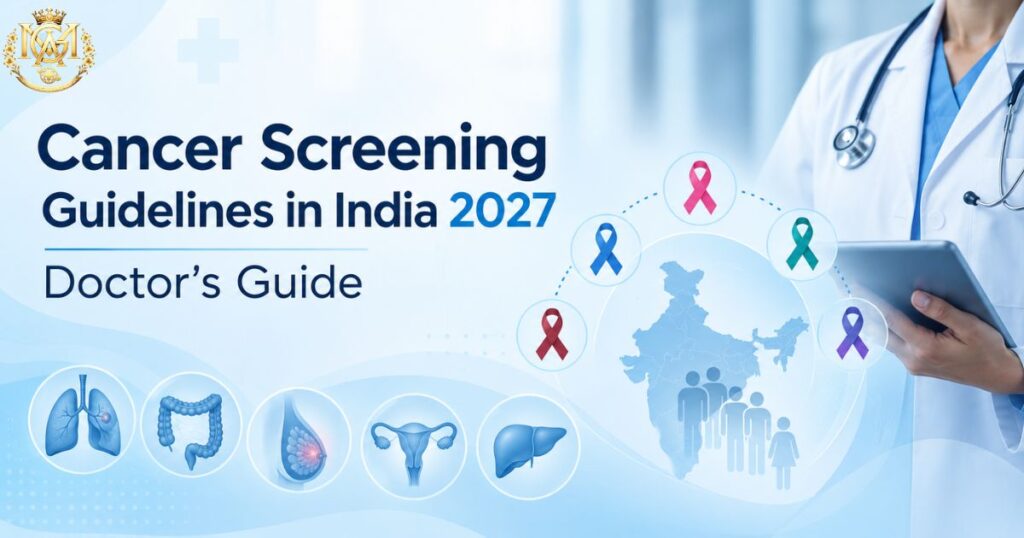
Cancer Screening Guidelines in India 2027: A Practical Guide for Doctors
📅 Updated September 2026 ⏰ 9 min read 🎓 General Physicians & Oncology Fellows ⚡ Quick Answer What are the current cancer screening guidelines in India? India’s National Programme for Prevention and Control of Non-Communicable Diseases (NP-NCD) offers free oral, breast, and cervical cancer screening at Health and Wellness Centres for adults aged 30 to 65. The National Cancer Grid (NCG) publishes resource-stratified screening guidelines for these same three cancers. Despite this framework, actual screening coverage remains below 2% in the eligible population. This gap, not a lack of guidelines, is the real problem doctors need to address. India adds an estimated 1.4 to 1.6 million new cancer cases every year. A large share of these are diagnosed late, when treatment options are more limited and outcomes are worse. The tools to catch many of these cancers earlier already exist. National screening guidelines are already published. What’s missing is consistent implementation at the point of care. This guide summarises the current cancer screening guidelines in India for the three national-priority cancers — oral, breast, and cervical — and looks honestly at why coverage remains so low despite a free, structured programme already being in place. India’s National Screening Framework Cancer screening in India runs through the National Programme for Prevention and Control of Non-Communicable Diseases (NP-NCD). Health and Wellness Centres — now also called Ayushman Arogya Mandirs — offer oral, breast, and cervical cancer screening free of cost under this programme. The target population is adults aged 30 to 65. Community health workers help identify eligible individuals and connect them to these services at the primary care level. Clinical guidance behind India’s cancer screening guidelines comes primarily from the National Cancer Grid (NCG), a government-backed network of over 240 cancer centres across India. NCG’s guidelines are deliberately resource-stratified. They offer different recommendations depending on whether a facility has essential, optimal, or high-resource capacity. This structure matters because a screening protocol that assumes advanced lab infrastructure isn’t useful in a primary health centre with limited resources. Breast Cancer Screening Guidelines ICMR guidance recommends a Clinical Breast Examination (CBE) every one to three years as a practical baseline. Clinicians advise monthly self-breast examination alongside this. Doctors may recommend a mammogram every two years, particularly for women with additional risk factors. ℹ️ CBE is emphasised as the practical entry point in India specifically because it requires no equipment beyond clinical training. This makes it deployable even in resource-limited primary care settings where mammography access is inconsistent. Cervical Cancer Screening Guidelines Cervical screening in India follows a resource-stratified approach. In higher-resource settings, clinicians prefer HPV testing every five years for women aged 30 to 65. Doctors accept a Pap smear every three years as an alternative where HPV testing isn’t available. For women aged 25 to 29, guidelines generally advise a Pap test every three years. In lower-resource settings, Visual Inspection with Acetic Acid (VIA) remains the recommended screening method according to NCG and FOGSI guidance. This reflects a practical reality: not all facilities have HPV testing infrastructure uniformly available across India. So guideline developers built them to work with the screening tools actually accessible at a given facility. Oral Cancer Screening Oral cancer is one of the most common cancers in India, closely linked to tobacco and areca nut use. Screening is comparatively straightforward. It relies on visual and physical oral examination by a trained healthcare worker or doctor, without requiring specialised equipment. This is exactly why oral cancer screening was included as one of the three NP-NCD priority cancers. It’s genuinely deployable at scale through primary care. Why Screening Rates Remain Low — And What Doctors Can Do Despite India’s structured national screening guidelines and a free programme in place, screening coverage for oral, breast, and cervical cancer remains below 2 percent among the eligible population. This figure is confirmed across independent sources, including a 2026 implementation-research protocol published in BMJ Open. The guidelines are not the bottleneck here. Awareness, consistent referral, and follow-through at the point of care are. General physicians are often the first point of contact for patients who would otherwise never seek out screening proactively. Actively raising screening during routine consultations for age-eligible patients, rather than waiting for symptoms to appear, is one of the most direct ways a doctor can close this gap. Even a brief prompt during an unrelated visit can be the difference between early detection and a late-stage diagnosis. Frequently Asked Questions Is cancer screening free in India?▼ Yes, for the three national-priority cancers. Oral, breast, and cervical cancer screening is offered free of cost under NP-NCD at Health and Wellness Centres for adults aged 30 to 65. Which organisation sets cancer screening guidelines in India?▼ The National Cancer Grid (NCG), a government-backed network of over 240 cancer centres, publishes resource-stratified screening guidelines for oral, breast, and cervical cancer. ICMR also issues specific recommendations, particularly for breast cancer screening intervals. Why is cervical cancer screening different across facilities?▼ Developers deliberately stratified guidelines by resource level. Where infrastructure allows, clinicians prefer HPV testing. In lower-resource settings where facilities can’t consistently access HPV testing, guidelines recommend VIA (Visual Inspection with Acetic Acid) instead. Why does India still have low screening coverage despite free programmes?▼ The gap is largely one of implementation, not guidelines. Awareness, consistent point-of-care referral, and patient follow-through remain the primary barriers, rather than a lack of published protocols or free access. Should general physicians proactively raise cancer screening with patients?▼ Yes. Given how low current screening coverage is, proactively raising it during routine visits for age-eligible patients is one of the most effective things a general physician can do, rather than waiting for a patient to ask or for symptoms to appear. Build Deeper Expertise in Cancer Prevention and Care Understanding screening is one part of the broader oncology picture. MGA’s Fellowship in Oncology helps eligible doctors build structured, skill-focused knowledge across the full spectrum of cancer care — as a complement to formal oncology training, not a substitute for it. Explore