
How Does a Fellowship in General Laparoscopic Surgery Change the Patient Experience?
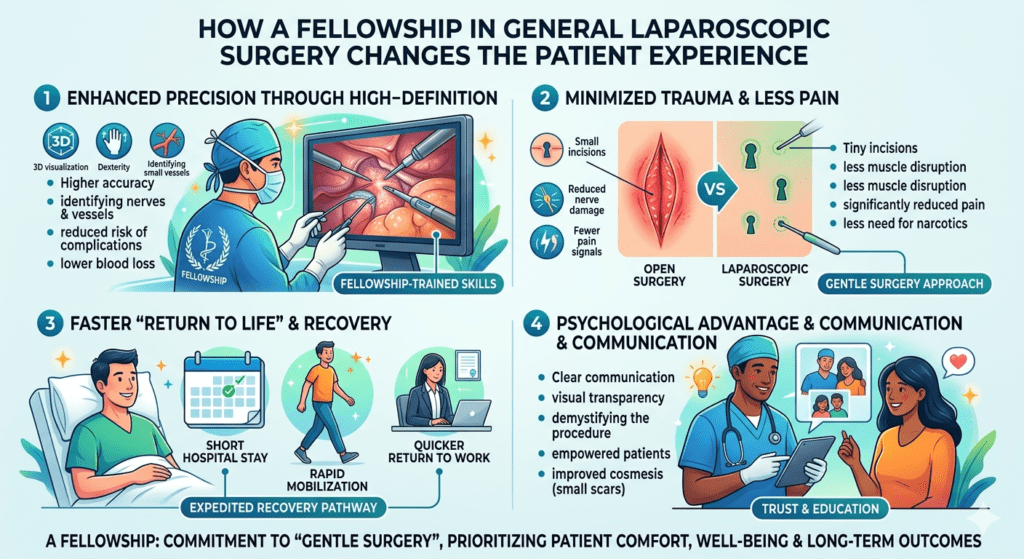
The face of modern medicine is constantly changing and evolving, and the field of general surgery is no exception. Minimally Invasive Surgery (MIS) has dramatically changed the face of modern medicine and healthcare. The use of laparoscopic procedures has transformed the way surgeons perform surgery. This change is significant and has provided many benefits to the patient. For the general surgeon, it has become essential to acquire specialized knowledge. A fellowship in general laparoscopic surgery is therefore of immense benefit and has the power to change the way the general surgeon practices medicine and, most importantly, the patient experience. A General laparoscopic Surgery fellowship gives surgeons specialized knowledge and training that takes them beyond the basic knowledge they acquired during their surgical residency. Let’s explore how the specialized knowledge of the surgeon will benefit the patient at every stage of their medical journey. 1. Minimally Invasive Approach: The Core of the Change The single biggest factor in changing the patient experience is the use of small incisions, rather than one large incision in the abdomen. These small incisions are generally less than an inch in length. A laparoscope and surgical instruments are inserted through these small incisions. The first benefit of laparoscopic surgery is the lack of trauma to the body. While in traditional surgery muscles and tissues are separated over a large distance, in laparoscopic surgery the surgeon works with minimal disturbance of the body’s core structures. This lack of disturbance in the body’s tissues is the cause of all subsequent patient benefits. 2. Enhanced Precision and Better Outcomes General laparoscopic surgery fellowships are demanding and emphasize the importance of improving the skill and hand-eye coordination of the surgeon using MIS equipment. This means that the precision of the surgeon is improved. The surgeon is using the high-definition screen that displays the magnified and three-dimensional view of the surgical site. This improves the identification of the structures and reduces the risk of damaging the adjacent organs, nerves, and blood vessels due to poor visualization. The precision of the surgeon improves the outcomes of the patient because Lower rates of complications: Greater accuracy also reduces the rate of intraoperative complications. Research has proven that the use of laparoscopy reduces the rate of postoperative complications, including wound infections and incisional hernias. Less blood loss: The small incisions and magnification enable the precise management of blood vessels, thus limiting blood loss during the procedure. Improved accuracy: Fellowships may be available in specific areas, such as bariatric and colorectal laparoscopic surgery, and the training is geared towards achieving the best possible result with high accuracy. 3. Reduced Postoperative Pain One of the biggest fears that patients have when undergoing a surgical procedure is postoperative pain. By specializing in a fellowship of general laparoscopic surgery, a surgeon is able to learn how to minimize the trauma that is caused during a surgical procedure. This directly correlates to a reduction in postoperative pain that is felt by the patient. In traditional surgical procedures, it is necessary to make an incision into the abdominal area, which causes a great deal of discomfort as the healing process begins. In a laparoscopic procedure, only a few stitches are necessary to close the incision site. 4. Shorter Hospital Stays and Quicker Recovery Perhaps one of the most noticeable aspects of the patient experience is the speed at which a patient is able to return to his or her life. As a result of the reduced pain and physical impact, the entire process is sped up. This, in turn, allows for a much shorter hospital stay. Some surgeries, which used to necessitate a long hospital stay, are now outpatient surgeries, requiring a patient to stay just a single night. A fellowship in general laparoscopic surgery will teach a doctor how to make the process as quick and efficient as possible, from the initial preparation for the surgery to the post-surgery care, allowing for a quicker hospital stay. A quicker hospital stay means: Quicker return to work and normal activities: It is now possible for patients to go back to normal activities in days instead of weeks or months. Reduced psychological stress: Spending less time in a hospital environment can be less stressful for the patient and family. Lower healthcare costs: Shorter stays in the hospital are less costly, and that is beneficial to both the patient and healthcare. 5. Improved Cosmesis Although functional outcome is of primary importance, it is not possible to overlook the psychological impact that scarring can have. Large traditional surgical scars can have a lasting impact on an individual, reminding them of a very traumatic experience. Laparoscopic surgery, on the other hand, involves making small incisions, and these scars are not very prominent after they heal. Some surgeries can even be perform via a single port, and in that case, there is only one small scar, which can even be hide in the umbilicus. This is an improvement in the overall surgical experience, particularly for those who are very image-conscious. 6. The Psychological and Educational Advantage Aside from the physical benefits, it is believe that the approach of a fellowship-train laparoscopic surgeon will alter the patient dynamic. These are specialists who are more attuned to the patient’s well-being. Clear Communication: The training that a surgeon receives as a Fellow may also involve communicating with patients to help them explain to others the benefits, as well as the risks and postoperative process, of a laparoscopic procedure. Patient Education: The surgeon is able to educate patients by showing them pictures from the laparoscope. This helps patients become more familiar with what is happening during a procedure. Empower Decision-Making: The patient understands that he has a choice between a more invasive procedure and a less invasive one that a surgeon is train to perform. Conclusion: Elevating the Standard of Care A fellowship program in general laparoscopic surgery is not simply a training program to learn a new skill; it is a promise to a standard of care that