How is AI changing the curriculum of a dermatology fellowship
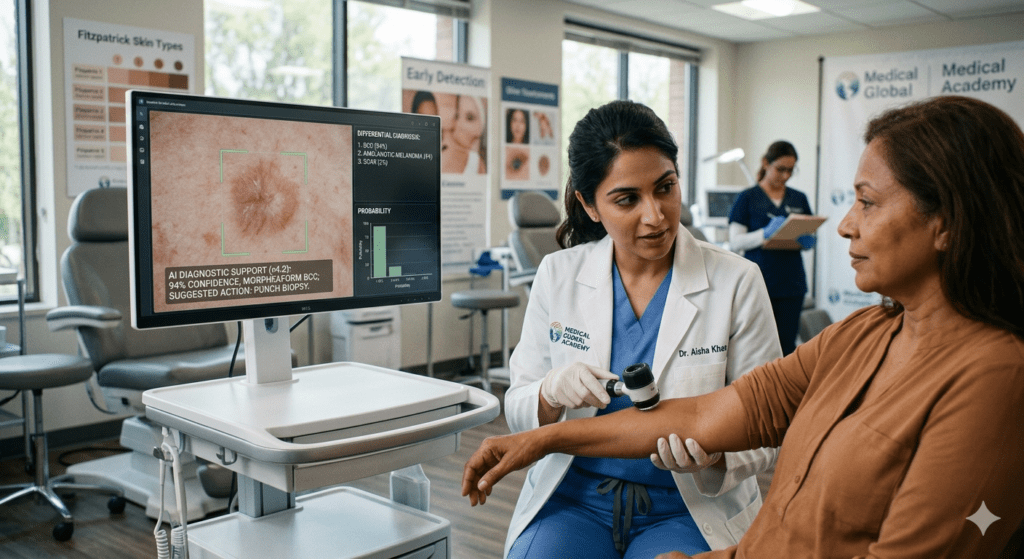
In 2026, the field of dermatology is no longer just about the human eye and a dermatoscope. We have entered the era of Augmented Dermatology, where Artificial Intelligence (AI) acts as a high-fidelity “second opinion.” For doctors pursuing a dermatology fellowship, the curriculum is undergoing its most significant transformation in decades. This blog explores exactly how AI is reshaping the fellowship experience and what every aspiring specialist needs to know to stay competitive. The AI Revolution in Dermatology Fellowship Curricula The old system of see one, do one, teach one is being modernize. AI literacy has become a standard competency in fellowship programs that no longer rely on clinical intuition but on precision based on data. 1. From Visual Pattern Recognition to Algorithmic Literacy In the past, a dermatology fellowship took thousands of hours to practice memorizing the visual patterns. In spite of this being a vital requirement, AI Literacy Modules can also be found in the curriculum in 2026. Learning about Black Box Logic: Fallows now needs to learn how Convolutional Neural Networks (CNNs) differentiate lesions. Appraising AI Tools: Training now includes the ability to critically evaluate AI software using frameworks like CLEAR Derm (Checklist for Evaluation of Image-Based AI Reports in Dermatology). 2. Enhanced Diagnostic Precision with “Human-in-the-Loop” Fellowship programs are shifting from “Man vs. Machine” to “Man + Machine.” The existing statistics indicate that AI is capable of outshining novice physicians by 15-20 percent in the accuracy of melanoma diagnosis. Live Feedback: Premium fellowship programs adopt AI-driven microscopes and dermatoscope extensions, which offer immediate diagnostic recommendations when interacting with patients. Safety Nets: AI has been adopted as a triage instrument, and the busy clinic environment has been assisting fellows to focus on the cases that have high risk, thus minimizing the mismanagement of the malignant lesions by over 50 percent to almost zero. New Technical Skills for the Modern Fellow A dermatology fellowship in 2026 demands a new toolkit. If you are entering a program today, you aren’t just a clinician; you are a data interpreter. Digital Pathology and Genomics Dermatopathology training has been revolutionize. AI algorithms now handle “banal” cases—identifying clear-cut benign lesions—allowing fellows to focus their cognitive energy on rare, complex, and ambiguous slides. Furthermore, fellows are now taught to correlate AI-driven histopathological patterns with genomic data to predict how a patient will respond to specific biologics. Cosmetic & Surgical Simulation The integration of Virtual Reality (VR) and AI-guided feedback in surgical fellowships (like Mohs surgery) allows fellows to practice complex flaps and grafts with objective performance metrics. AI analyzes the precision of a fellow’s incision and suturing, providing a score that helps track procedural competency over time. Navigating the Challenges: Ethics and Bias It’s not all perfect. A major part of the new curriculum is dedicated to the limitations of AI: Algorithmic Bias: Fellows are train to recognize when an AI might fail, particularly on darker skin tones (Fitzpatrick types IV-VI), where historical data sets have often been lacking. Data Privacy: With the rise of AI scribes and ambient clinical intelligence, fellows must master the ethics of patient consent and data security. The Shift in Administrative Training One of the greatest benefits to the 2026 fellow is the reduction of burnout through Ambient Clinical Intelligence. AI Scribes: Instead of staring at an EHR screen, fellows can maintain eye contact with patients while AI listens and auto-populates clinical notes. Smart Triage: Learning how to manage “AI-first” patient intake—where patients upload photos via a secure portal before the visit—is now a standard part of practice management training. Conclusion The dermatology fellowship of today is preparing doctors for a tomorrow where technology and empathy coexist. While AI can process pixels at lightning speed, it cannot replicate the human touch, the nuanced conversation of a terminal diagnosis, or the surgical finesse required for a delicate reconstruction. With institutions such as the Medical Global Academy in the forefront, the medical field (Dermatologist) is on track to achieve the new frontier of technology and master the new tools, which are highly specialize and fill with international understanding and insights, require to be known as the modern dermatologist. FAQs 1. Will dermatologists lose their jobs to AI with a fellowship? No. AI is not a replacement, it is an augmentation tool. It takes care of data processing and pattern identification, but final decision-making is still carry out by a dermatologist, particularly in a complicated or unclear situation. 2. Am I require to have the solution to how to succeed in a fellowship by knowing how to code? No. You do not necessarily have to be a programmer, however, you will need AI Literacy the capacity to comprehend how such tools operate, the restrictions, and the interpretation of their outputs. 3. Do the board exams rely on AI tools? By 2026, numerous board certification organizations are adding the “AI-Assisted Case Studies” to exams to assess the degree to which a candidate can collaborate with digital diagnostic aids. 4. What is the benefit of AI in skin rare diseases? A wider educational virtual database can be offer by AI scanning global databases of rare conditions. With which a fellow may never have any experience at their local clinic.