
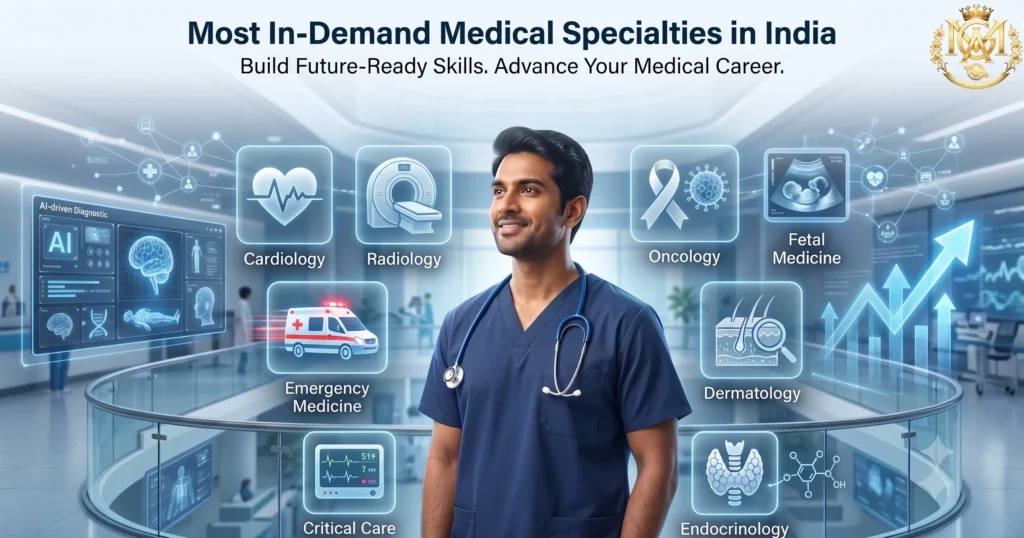
Most In-Demand Medical Specialties in India: Complete 2026 Demand Guide
Most In-Demand Medical Specialties in India (2026 Guide) India’s healthcare landscape is changing rapidly. An aging population, rising lifestyle-related diseases, increasing awareness of preventive healthcare, and advances in medical technology have significantly transformed the demand for specialist doctors. While MBBS remains the foundation of a medical career, healthcare institutions today increasingly seek doctors with specialized clinical expertise to manage complex medical conditions and deliver quality patient care. However, choosing a specialty should not be based solely on popularity. A specialty becomes “in demand” when there is a growing need for skilled professionals who can address specific healthcare challenges, improve patient outcomes, and meet the evolving needs of hospitals and communities. Whether you are planning your postgraduate education or exploring advanced clinical training after MBBS, understanding current healthcare trends can help you make informed career decisions. In this guide, we’ll explore the medical specialties that are experiencing the highest demand in India, the factors driving this growth, and how doctors can prepare for future opportunities in an evolving healthcare system. What Makes a Medical Specialty High in Demand? The demand for a medical specialty is shaped by much more than the number of doctors practicing in that field. It reflects the healthcare needs of the population, disease patterns, technological advancements, and the availability of trained specialists. As India’s healthcare system continues to expand, hospitals, diagnostic centers, and specialty clinics require doctors who possess advanced clinical knowledge and the ability to manage increasingly complex medical conditions. Specialties that address common chronic diseases, emergency care, cancer treatment, and critical illnesses naturally experience higher demand because they directly respond to some of the country’s most pressing health concerns. Several factors contribute to the growing need for specialists across different branches of medicine. Growing Burden of Chronic Diseases India has witnessed a significant rise in non-communicable diseases such as cardiovascular disease, diabetes, chronic kidney disease, cancer, obesity, and respiratory disorders. These conditions often require long-term specialist care, regular monitoring, and multidisciplinary treatment. As the number of patients living with chronic illnesses continues to increase, the need for specialists in fields such as Cardiology, Endocrinology, Nephrology, Oncology, and Critical Care Medicine continues to grow across both public and private healthcare sectors. Aging Population and Changing Healthcare Needs People are living longer than ever before, and with increasing life expectancy comes a higher prevalence of age-related health conditions. Older adults are more likely to require specialized care for heart disease, neurological disorders, joint problems, kidney disease, cancer, and multiple chronic conditions. This demographic shift is increasing the demand for specialists who can provide comprehensive, long-term care while working collaboratively with multidisciplinary healthcare teams. Lifestyle Disorders and Preventive Healthcare Urbanization, sedentary lifestyles, unhealthy dietary habits, stress, and environmental factors have contributed to a sharp increase in lifestyle-related diseases across India. Healthcare is gradually shifting from treating diseases after they occur to preventing them through early diagnosis, regular screening, and timely intervention. This has strengthened the role of specialists involved in diagnostics, preventive medicine, imaging, and chronic disease management. As awareness grows among patients, specialists who can identify diseases early and provide evidence-based treatment are becoming increasingly important. Advances in Medical Technology Modern medicine is evolving rapidly with innovations such as artificial intelligence, robotic-assisted surgery, advanced imaging, minimally invasive procedures, molecular diagnostics, and precision medicine. These technologies have expanded the role of many specialties, particularly Radiology, Emergency Medicine, Critical Care, Fetal Medicine, and Interventional specialties, where advanced diagnostic tools and image-guided procedures are now part of routine clinical practice. Doctors who remain updated with emerging technologies and evidence-based practices are better positioned to meet future healthcare demands. Specialist Shortage Across India Although India produces thousands of medical graduates each year, access to specialist healthcare remains uneven. Many rural districts, Tier-2 and Tier-3 cities, and government healthcare facilities continue to face shortages of trained specialists in critical areas such as Emergency Medicine, Radiology, Oncology, Critical Care, and several superspecialties. As healthcare infrastructure expands beyond metropolitan cities, hospitals are actively seeking specialists who can deliver high-quality care across diverse clinical settings. This growing gap between patient demand and specialist availability is creating new opportunities for doctors willing to pursue advanced training and specialized clinical expertise. Top 10 Most In-Demand Medical Specialties in India The demand for medical specialists continues to evolve alongside changing disease patterns, healthcare infrastructure, and patient expectations. While every medical specialty contributes significantly to patient care, some branches are witnessing faster growth because they address critical healthcare needs and support advanced diagnosis and treatment. The following specialties are among the most in-demand medical fields in India, offering doctors diverse clinical opportunities across hospitals, specialty centers, academic institutions, and private practice. Cardiology Cardiology remains one of India’s most sought-after medical specialties due to the rising incidence of cardiovascular diseases. Heart disease continues to be one of the leading causes of illness and mortality, increasing the need for specialists who can diagnose, manage, and treat complex cardiac conditions. Cardiologists work in multispecialty hospitals, cardiac institutes, emergency departments, and catheterization laboratories. As preventive cardiology, interventional cardiology, and advanced cardiac imaging continue to expand, the demand for skilled cardiologists is expected to remain strong for years to come. Emergency Medicine Emergency Medicine has become an essential specialty as hospitals focus on providing immediate care for trauma, accidents, strokes, cardiac emergencies, and other life-threatening conditions. Emergency physicians are trained to make rapid clinical decisions while coordinating care across multiple specialties. They work in emergency departments, trauma centers, disaster response units, and critical care settings. With increasing road traffic injuries, urban healthcare demands, and expanding emergency services, this specialty continues to experience significant growth throughout India. Radiology Radiology has become the backbone of modern diagnosis. Almost every medical specialty depends on imaging for accurate diagnosis, treatment planning, and disease monitoring. Radiologists work in hospitals, diagnostic centers, cancer institutes, and interventional radiology units, interpreting imaging studies such as X-rays, CT scans, MRI, ultrasound, and PET scans. The integration of artificial intelligence, advanced imaging technology, and image-guided interventions is further increasing the need for skilled