

Medical Global Academy

August 11, 2026

Working doctor representing high-salary medical career pathways without NEET-PG
Learning blogs

How to Build a High-Salary Medical Career Without NEET-PG

Quick Answer NEET-PG is one route to specialisation — not the only one. Fellowship programs, university-awarded PG Diplomas, and Certificate courses allow working doctors to build recognised specialty credentials, increase their earning capacity, and move into consultant-track roles without a competitive entrance exam. The key difference: these programs require you to already be a qualified medical graduate, and Fellowships require a minimum of 4 years post-qualification experience. If you have the degree and the experience, NEET-PG is optional — not mandatory — for career advancement. Every year, thousands of MBBS graduates and working doctors look at NEET-PG and calculate the cost: months of full-time preparation, one high-stakes exam, no guarantee of the branch or seat you want, and a 3-year residency that means pausing your career and your income. NEET-PG is a legitimate route. But it is not the only route to a higher salary, a specialty credential, and a consultant-level career. This guide covers the alternatives — specifically, what kind of income and career scope fellowship programs, PG Diplomas, and Certificate courses can realistically open, and how to evaluate them against the NEET-PG pathway for your own situation. If you want to compare salaries across specialties first, read our highest paying doctors in India guide. If you want to understand which course format gives the best ROI, read our highest paying medical courses after MBBS comparison. This guide focuses on one question: how do you build a high-salary medical career if NEET-PG isn’t your path? 3 Alternative pathways compared 1–2 yr Typical completion time No exam No NEET-PG required What this guide covers Why NEET-PG is not the only path to higher income The three non-NEET pathways: fellowship, PG diploma, certificate Which high-salary specialties are accessible without NEET-PG What NEET-PG gives you that alternatives don’t — and vice versa How to choose the right non-NEET pathway for your situation Frequently asked questions Why NEET-PG is not the only path to a higher medical income The assumption that “specialisation = NEET-PG” is worth examining. It is true for certain career goals — if you want an MD or MS degree, a government residency seat, or admission to superspeciality programs like DM or MCh, NEET-PG is the gateway. But the goal most working doctors actually have is simpler: they want to earn more, treat a specific type of patient more effectively, and strengthen their clinical profile. Fellowship programs, PG Diplomas, and Certificates can achieve all three — and often faster, at lower opportunity cost, without pausing clinical income. The trade-off is credential type. A fellowship is not equivalent to an MD — but it is not trying to be. It builds focused clinical depth in a specific subspecialty and signals that depth to employers and patients. In high-demand areas like interventional cardiology, laparoscopic surgery, dermatology, and emergency medicine, fellowship credentials have real market weight. The three non-NEET pathways explained Fellowship programs A fellowship is a structured, specialty-focused training program that typically runs for one year. MGA’s fellowship programs are CPD accredited with international recognition through applicable UK accrediting bodies. They require a minimum of 4 years of post-qualification experience, meaning they are designed for doctors who are already practicing — not fresh graduates. What a fellowship gives you: Deep specialty-specific training, a CPD-accredited credential that strengthens your CV, access to subspecialty clinical knowledge not covered in MBBS training, and positioning for consultant-track roles in the relevant specialty. What it does not give you: An MD or MS degree title. If government promotion or superspeciality admission requires an MD, a fellowship does not substitute for it. Salary impact: Typically strongest over 2–3 years post-completion, as the credential is leveraged in private hospital roles, consultant positions, or private practice. See high-earning fellowship examples below. PG Diploma programs A PG Diploma is a university-awarded academic qualification, typically running for one year. MGA’s PG Diploma programs are awarded by partner universities and carry academic credential weight for CV, consultant career applications, and non-clinical career paths. What a PG diploma gives you: A formal university qualification, structured academic content, an assignment-based assessment, and a credential that works for both clinical and non-clinical advancement. Who it suits best: Doctors building toward consultant career profiles, academic roles, or professional environments where a formal university credential carries more weight than a clinical fellowship certificate. Certificate programs A certificate program runs for 3 to 12 months and delivers focused, skill-level training in a specific clinical area. It is the fastest of the three formats and carries the lowest time and opportunity cost. What a certificate gives you: A practical, focused skill upgrade in one clinical area — enough to noticeably improve how you manage a category of patient and signal competency to employers or patients. Who it suits best: Doctors who need a specific skill added to their practice quickly — a GP adding diabetology competency, a physician adding basic cardiac assessment, or a clinician testing interest in a specialty before committing to a full fellowship. High-salary specialties accessible without NEET-PG Interventional Cardiology One of the highest-earning subspecialties in Indian medicine, with strong demand from both corporate hospital groups and private practice. MGA’s Fellowship in Interventional Cardiology provides CPD-accredited training for doctors with the required clinical background. Salary ceiling for experienced interventional cardiologists in private practice: ₹25–40+ LPA. Aesthetic Medicine & Cosmetology Cosmetic and aesthetic medicine is one of India’s fastest-growing private practice areas. Entry is possible through a Certificate in Aesthetic Medicine for faster skill building, progressing to a Fellowship in Cosmetic Surgery for deeper clinical scope. Private aesthetic clinic owners in metro cities regularly report strong returns. No NEET-PG required for either pathway. Emergency Medicine Emergency medicine demand in Indian hospitals is rising sharply. A Fellowship in Emergency Medicine is a direct route to emergency department consultant roles without NEET-PG. Salary range: ₹10–20 LPA in corporate hospital emergency departments. Dermatology & Skin Care Dermatology scope — both clinical and cosmetic — makes it one of the most sought-after PG branches. For doctors who cannot or do not
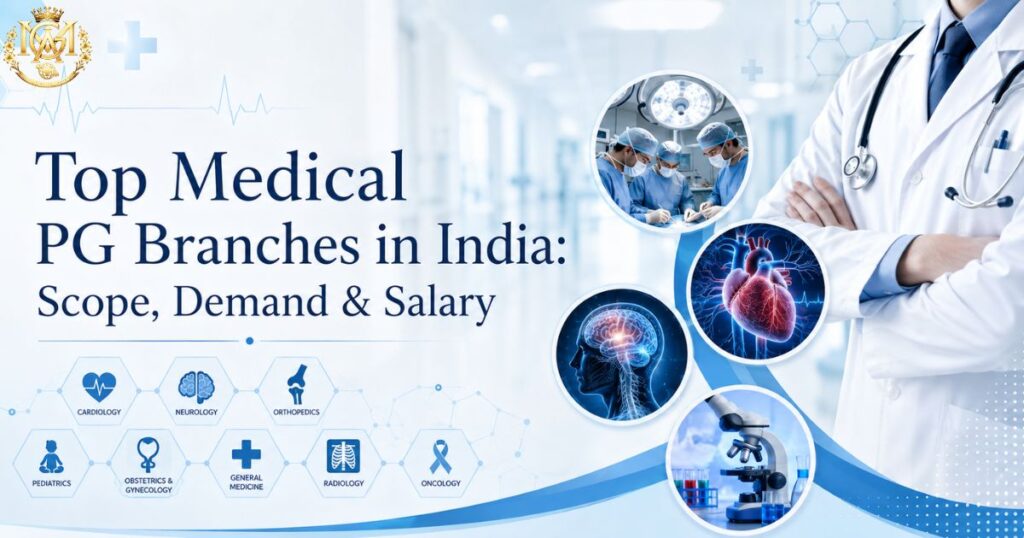
Doctor researching the top medical PG branches in India for specialization
Learning blogs

How to Choose the Best Medical PG Branch in India: Complete Guide

Quick Answer There is no single “best” PG branch in India — but there are clear patterns. Cardiology, Orthopedics, and Dermatology consistently offer the strongest combination of market demand, private practice scope, and earning potential. Psychiatry and Emergency Medicine are growing faster than their current reputation suggests. Pathology and Radiology suit doctors who prefer structured, non-OPD-heavy careers. The right branch is the one where your clinical interest meets market reality — not just the one at the top of a salary table.   If you have already decided that you want to specialise — but haven’t yet fixed on a branch — this is the guide you are looking for. Most articles answer: “Which PG branch is best?” That question rarely has a useful answer because it conflates salary, demand, lifestyle, and aptitude into a single ranking. This guide separates those factors. For each major PG branch, it covers what the scope actually looks like in practice, where demand is rising or saturating, and what salary range doctors in that branch typically reach across career stages. Read it as a research document for your own decision, not as a ranking to follow blindly. Where you already know which branch you want, MGA’s specialization decision guide and fellowship programs after MBBS can help you take the next step. 10+ Major PG branches compared 37% Keyword difficulty (high efficiency) 3 factors Scope · Demand · Salary What this guide covers How to read scope, demand, and salary across PG branches High-demand branches: Cardiology, Surgery, Orthopedics Strong private practice branches: Dermatology, Ophthalmology, Obstetrics & Gynecology Growing branches: Psychiatry, Emergency Medicine, Radiology Structured, non-clinical-heavy branches: Pathology, Microbiology Quick-reference comparison table How to match a branch to your career goal Frequently asked questions How to read scope, demand, and salary across PG branches Three variables matter when comparing PG branches. Scope means what career paths open up after the degree — private practice, corporate hospital roles, academics, research, or non-clinical opportunities. Demand means how many positions exist relative to the number of doctors entering the branch. Salary means the realistic earning range across career stages — not peak numbers reported in business news. A branch can have a high salary ceiling but low scope outside metro cities. A branch can be in strong demand but only in the government sector. Understanding all three together produces a more honest picture than salary alone. The ranges used in this guide reflect patterns reported across MGA’s specialization guides and published salary data. They are illustrative, not guaranteed. Actual earnings vary by city, sector, experience, and practice model. High-demand branches: Cardiology, Surgery, Orthopedics MD / DM Cardiology Scope: Consultant roles in corporate and government hospitals, catheterisation lab practice, private OPD, and subspecialties including interventional and electrophysiology. High scope across metros and Tier-2 cities. Demand: Very high. Cardiovascular disease is India’s leading cause of mortality. Both government hospitals and private chains are actively expanding cardiac departments. Salary range: ₹8–18 LPA at junior consultant level; ₹20–40+ LPA with interventional skills and experience. Important note: DM Cardiology requires completing MD Internal Medicine first, extending the timeline to 5–6 years post-MBBS. Doctors seeking a faster entry into cardiac practice often add a Fellowship in Interventional Cardiology alongside or after their PG. MS General Surgery Scope: Broad — from general surgical practice to subspecialisation in oncosurgery, laparoscopy, bariatrics, and colorectal surgery. Strong government and private sector scope. Demand: Consistently high. Surgery is a foundational specialty with reliable demand across facility types and geographies. Salary range: ₹7–15 LPA at entry; ₹18–35 LPA with subspecialisation and private practice. Surgical entrepreneurship possible by 8–10 years. Subspecialisation pathway: Many MS Surgery graduates add laparoscopic fellowship training for competitive advantage. MGA’s Fellowship in Laparoscopic Surgery is designed for this progression. MS Orthopedics Scope: Surgical orthopaedic practice, sports medicine, joint replacement, trauma surgery, spine surgery. Very strong private practice viability. Demand: Very high, rising with an aging population, road trauma, and sports medicine interest. Salary range: ₹8–20 LPA at consultant entry; ₹25–50 LPA with subspecialisation in joint replacement or spine. Private practice potential: Among the highest of any surgical branch for independently established surgeons. Strong private practice branches: Dermatology, Ophthalmology, OBG MD Dermatology Scope: Clinical dermatology, aesthetic procedures, cosmetology, private clinic ownership. Exceptional private practice scope with cosmetic demand growing in Tier-1 and Tier-2 cities. Demand: High and growing. India’s skincare and aesthetic market is expanding, adding commercial demand beyond medical dermatology. Salary range: ₹8–18 LPA in clinical roles; ₹20–50+ LPA with cosmetic practice and own clinic. Lifestyle factor: Relatively predictable schedule with limited emergency calls. One of the more lifestyle-friendly surgical-adjacent branches. MS Ophthalmology Scope: Clinical eye care, cataract surgery, retinal practice, LASIK and refractive surgery, glaucoma management. Strong private hospital and own-clinic scope. Demand: Steady. India has a significant burden of preventable blindness, sustaining consistent demand across government and NGO sectors alongside private practice. Salary range: ₹7–15 LPA at entry; ₹18–35 LPA with surgical subspecialisation. MD / MS Obstetrics & Gynecology (OBG) Scope: Clinical obstetrics, gynaecological surgery, fertility medicine, laparoscopic gynecology, fetal medicine. Private maternity practice and hospital consultant roles. Demand: High and stable. Reproductive health and maternal care sustain consistent demand, particularly in urban and semi-urban private sectors. Salary range: ₹7–16 LPA in employed roles; ₹20–45 LPA with private maternity practice. Subspecialisation in fertility or fetal medicine adds to ceiling. Growing branches: Psychiatry, Emergency Medicine, Radiology MD Psychiatry Scope: Clinical psychiatry, psychotherapy, corporate wellness, telemedicine, de-addiction medicine, academic roles. Non-OPD opportunities are expanding rapidly. Demand: Growing faster than most doctors expect. Mental health awareness has created a supply gap — psychiatrists are in short supply relative to need. Telemedicine has expanded reach beyond urban centres. Salary range: ₹6–14 LPA in clinical roles; growing significantly with private practice and corporate health contracts. Underrated factor: Lower competition for seats, better work-life balance than most surgical branches, and strong non-clinical career options. MD Emergency Medicine Scope: Hospital emergency departments, trauma centres, critical care, pre-hospital care. Government and corporate hospital roles dominating. Demand: Rising sharply as hospitals formalise emergency departments

Scroll to Top