Diagnostic vs Therapeutic Endoscopy: Indications, Skill Requirements and Referral Thresholds
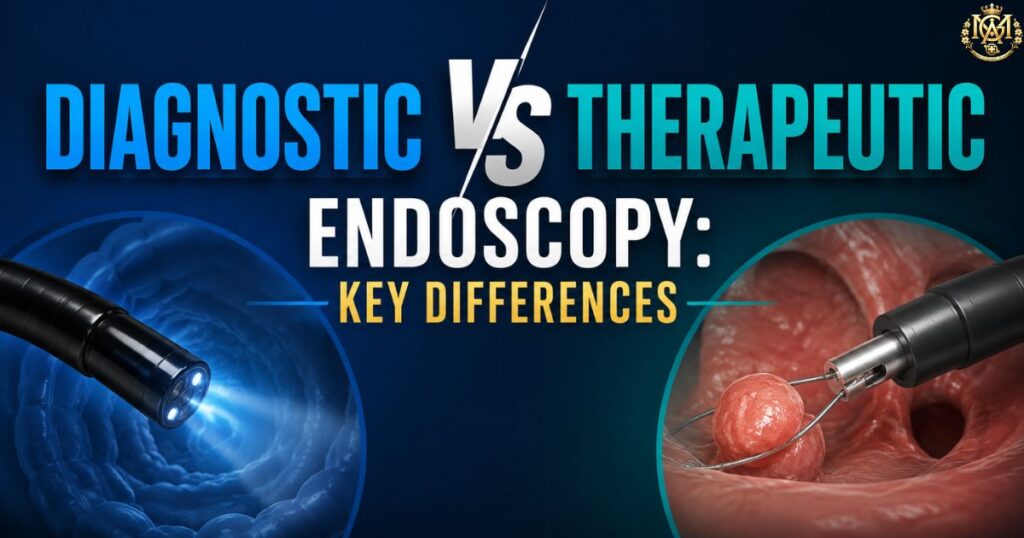
Quick Answer Diagnostic endoscopy uses the endoscope to visualise the gastrointestinal tract and identify pathology — its output is a finding and a report. Therapeutic endoscopy uses the same instrument to treat what has been found — its output is an intervention. The distinction matters clinically because therapeutic procedures require additional skills, equipment, dedicated time, specialist backup, and in many cases a higher-acuity facility. Most referrals from general practice and general medicine are for diagnostic endoscopy; the decision to escalate to therapeutic endoscopy is usually made after the diagnostic findings are known. Every doctor who manages GI patients refers for endoscopy. Not every doctor who refers understands precisely what they are requesting — or when diagnostic endoscopy alone is insufficient and therapeutic capability becomes the clinical requirement. That gap matters in practice. A referral that should specify urgent therapeutic endoscopy capability such as an acute upper GI bleed is not the same referral as a routine diagnostic OGD for dyspepsia. Sending the wrong referral to the wrong setting delays definitive management. This article is for general physicians, surgeons, and family medicine doctors who refer GI patients for endoscopy but want a clearer clinical framework for the referral decision. Doctors who want to extend their own endoscopy knowledge beyond the referral level can explore MGA’s Fellowship in GI Endoscopy. 2 types Diagnostic · Therapeutic Key skill Knowing which referral to make Overlap Many procedures start diagnostic, turn therapeutic What this article covers Defining diagnostic endoscopy: what it is, what it does Defining therapeutic endoscopy: what distinguishes it Upper GI: diagnostic indications vs therapeutic triggers Lower GI: diagnostic indications vs therapeutic triggers The overlap problem — procedures that start diagnostic and become therapeutic Referral thresholds: what to specify when you refer Frequently asked questions Defining diagnostic endoscopy: what it is, what it does Diagnostic endoscopy is the use of a flexible endoscope to directly visualise a segment of the gastrointestinal tract. Its purpose is to find, characterise, and document pathology. The endoscopist looks, biopsies if indicated, and reports findings. No therapeutic intervention is performed during the procedure itself. The output of a diagnostic endoscopy is information: the mucosal appearance at sites examined, the presence and characteristics of lesions, and the correlation of visual findings with the clinical question that prompted the referral. That information then guides the management decision — which may include a separate therapeutic procedure, medical treatment, surveillance, or discharge. Diagnostic endoscopy encompasses upper GI endoscopy (OGD) for oesophageal, gastric, and duodenal evaluation, and colonoscopy or flexible sigmoidoscopy for colonic and terminal ileal evaluation. Capsule endoscopy used for small bowel evaluation is diagnostic only. Defining therapeutic endoscopy: what distinguishes it Therapeutic endoscopy — also called interventional endoscopy or operative endoscopy — uses the same endoscopic access to treat pathology rather than only identify it. An instrument passed through the working channel of the endoscope performs the therapeutic action while the endoscopist maintains visual control. What distinguishes therapeutic from diagnostic endoscopy in practical terms is not just the procedure performed — it is the requirement set that surrounds the procedure. Diagnostic endoscopy requires Endoscopist with scoping competence Standard endoscopy unit setup Conscious sedation or no sedation Basic monitoring Biopsy forceps if sampling needed Therapeutic endoscopy additionally requires Endoscopist trained in specific therapeutic technique Additional accessories — clips, snares, balloons, cautery Higher-acuity monitoring and backup Surgical backup availability for complications Often: anaesthesia support for deeper sedation This distinction has direct relevance to referral — a facility capable of diagnostic endoscopy is not automatically capable of therapeutic endoscopy. Referring an acute upper GI bleed to a unit without haemostatic capability is a clinical mismatch that delays treatment. Upper GI endoscopy: diagnostic indications vs therapeutic triggers When diagnostic OGD is appropriate Indication What you are looking for Priority Dyspepsia with alarm symptoms Malignancy, ulcer, Barrett’s oesophagus Urgent — within 2 weeks Unexplained dysphagia Malignancy, stricture, motility disorder Urgent Unexplained iron-deficiency anaemia Upper GI source of chronic blood loss Elective to semi-urgent Suspected peptic ulcer disease Active ulcer, H. pylori status, healing Elective to semi-urgent Persistent vomiting without explanation Gastric outlet obstruction, mucosal pathology Semi-urgent Surveillance — Barrett’s oesophagus Dysplasia surveillance Elective (interval-based) When the therapeutic threshold is triggered in upper GI Clinical Scenario Therapeutic Procedure Required Facility Requirement Active upper GI haemorrhage Endoscopic haemostasis — adrenaline injection, thermal coagulation, haemostatic clips Therapeutic unit with anaesthesia and surgical backup Peptic ulcer with high-risk appearance Haemostatic therapy (dual modality preferred) Therapeutic unit — urgent Oesophageal or gastric varices with active bleeding Band ligation (oesophageal), injection sclerotherapy (gastric) Specialist GI unit with variceal expertise Oesophageal stricture causing dysphagia Balloon or bougie dilation Therapeutic endoscopy unit Biliary obstruction (suspected CBD stone, cholangitis) ERCP with sphincterotomy and stone extraction ERCP-capable centre — specialist procedure Lower GI endoscopy: diagnostic indications vs therapeutic triggers When diagnostic colonoscopy is appropriate Indication What you are looking for Priority Rectal bleeding (no obvious anorectal source) Colorectal malignancy, polyps, IBD, angiodysplasia Urgent to semi-urgent by age and features Altered bowel habit, unexplained Colorectal malignancy, IBD Semi-urgent if alarm features present Unexplained iron-deficiency anaemia Right-sided colonic malignancy, angiodysplasia Semi-urgent Positive faecal occult blood test Adenomatous polyp, early colorectal malignancy Within 4–6 weeks Known or suspected IBD Disease extent, activity, biopsy for histology Elective to semi-urgent Surveillance — previous polyp or malignancy Recurrence, new polyps Elective (interval-based) When the therapeutic threshold is triggered in lower GI Clinical Scenario Therapeutic Procedure Required Key Consideration Colonic polyp identified on diagnostic colonoscopy Snare polypectomy or EMR depending on polyp size and morphology May be performed in same sitting or listed for separate therapeutic session Lower GI haemorrhage from angiodysplasia Thermal coagulation, haemostatic clips, injection Requires therapeutic capability — urgent referral Colonic stricture Balloon dilation or stenting Specialist therapeutic endoscopy unit The overlap problem: procedures that start diagnostic and become therapeutic One of the most practically important aspects of this distinction is that many procedures that begin as diagnostic become therapeutic intraoperatively. Example 1: A patient referred for diagnostic OGD for dyspepsia is found on scoping to have a gastric