
Cancer is a life altering diagnosis and surgery is the most significant aspect of treatment that is taken by many patients. Here a Surgical Oncologist becomes very important. A surgical oncology is a physician who deals with the treatment of cancer using surgery to remove the tumor. Their job does not only involve accomplishing operations but it involves providing a second opportunity to life to patients.
They deal with accuracy, attention and medical expertise to make sure that cancer is removed safely. Surgical oncologists also belong to a bigger cancer care unit comprising medical and radiation oncologists, nurses, and others in health care provision. It is through their collaboration, they develop a treatment plan that can deliver the best to the patients.
It is a tough profession and at the same time a noble and well esteemed profession in the medical sector.
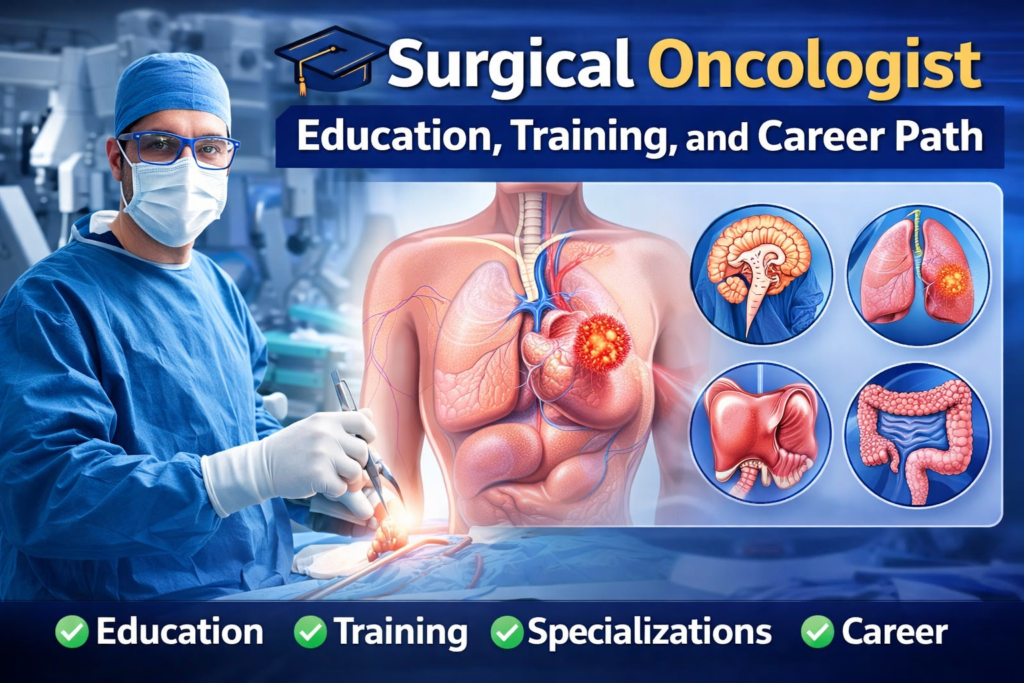
Who is a Surgical Oncologist
A surgical oncologist is a surgical specialist who has been specially trained to cure cancer by surgery. Their major role is to eliminate cancerous tumors without damaging the rest of the healthy tissue. Surgery in most situations is the best mode of treatment particularly when the cancer is at the initial stages.
They start their work even preceding surgery. They assist in the diagnosis of cancer through biopsies, or removal of a small sample of tissue in order to test it. Once they are diagnosed, they strategically decide on how to do the surgery depending on the nature, size, and the location of the tumor.
Their main tasks are some of the following:
- The safe and complete destruction of tumors.
- Conducting biopsies to ascertain cancer.
- Establishing the cancer level.
- Organizational planning and conducting cancer surgeries.
- Promoting postoperative patient care.
Their job should be patient, attentive and good surgical operation abilities.
Prerequisites to the Surgical Oncologist profession.
The career of becoming a surgical oncologist is not short and involves hard work. Normally, it requires some 10-14 years of education and training.
The process begins with an MBBS degree which lasts approximately 5.5 years. In this period, students get to know the basics of medicine, such as the human anatomy, diseases, and the essential surgery. This phase is the precursor towards the path of a doctor.
Once MBBS is completed, the next course is MS in General Surgery that lasts 3 years. In this case, physicians get to know how to carry out various forms of surgery and deal with victims in the operating theatre. They get practical experience and acquire vital surgical skills.
After completion of general surgery training, physicians proceed to super specialization in surgery oncology. It is achieved by MCh or DNB in Surgical Oncology that lasts another 3 years. At this time physicians are entirely interested in cancer surgery. They are taught new skills of removing tumors and treating cancer patients without complications.
Other doctors even go on to have fellowships in areas that are specialized such as robotic surgery, breast cancer surgery or even brain tumor surgery. This assists them to be masters of their field of choice.
Training and Real-Life Experience.
Training does not only involve book learning. The surgical oncologists take years to work in hospitals, to help the seniors, and in the process carry out surgery themselves. They get to know how to deal with complicated cancer cases, and make crucial decisions in the course of operation.
This form of training will assist them in building the necessary skills that include:
- Strong surgical precision
- Capacity to be under pressure.
- Quick decision-making
- Vast knowledge on cancer therapy.
With time, they are developed into competent and self-assured specialists.
Surgical Oncologists and their Work.
Different types of cancer may occur in various body parts and therefore surgical oncologists may be specialized in certain fields.
A surgical oncologist of the breast specializes in the treatment of breast cancer. They carry out such procedures as lumpectomy, where the tumor is removed only or mastectomy, where the breast is removed in case of need. They also check the lymph nodes to determine whether cancer is spread or not.
A surgical oncologist of the head and neck is one that treats cancers in the mouth, throat, and neck. They have very delicate work as they should not lose functions like speaking and swallowing.
A gastrointestinal surgical oncologist deals with stomach, liver, pancreatic, and intestinal cancer. They also carry out surgeries to clear tumors and to normalize the digestive system.
A thoracic surgical oncologist specializes in lung cancer, esophageal cancer, and chest tumors, particularly lung cancer and esophagus cancer. Such surgeries are complicated and they need skills.
Gynecologic surgical oncologists deal with female reproductive organ cancers like ovarian cancer, cervical cancer, and uterine cancer. They are aimed at the elimination of cancer in addition to general health.
A urologic surgical oncologist deals with urinary system cancer, such as kidney/bladder/prostate cancer. They are aimed at eliminating cancer without damaging the organs.
An orthopedic surgery oncologist is one who treats bone cancers. They even do surgeries on patients to remove tumors and enable them to move around.
A brain and spine neurosurgical oncologist will treat tumors of the brain and spine. Such surgeries are very delicate as they deal with the nervous system.
A pediatric surgical oncologist is a doctor who provides treatment to cancer in children. They are specially train in order to manage the physical and emotional needs of young patients.
A reconstructive surgical oncologist is an oncologist involve with the re-creation of body parts following a cancer surgery. They can use them to illustrate an example of breast reconstruction, which is conduct because of breast cancer surgery to regain the image and self-esteem.
Surgical Oncologist Procedures.
Depending on the condition of the patient, surgical oncologists carry out very diverse procedures. Biopsy is one of the common procedures that are use to ascertain the existence of cancer. The primary procedure is the tumor removal surgery in which cancerous growth is remove out of the body.
Minimally invasive and robotic surgery is also employ by modern surgeons in the treatment of cancer. The procedures have smaller incisions, less pain, and quicker healing. Reconstruction surgery is also aim at restoring the physical appearance of the patient, which becomes damage due to tumor removal.
Every process is well thought out so that there is an optimal result to the patient.
Job Opportunities and Development.
Surgical oncology is a great career. Once a surgical oncologist is train, he can either be employ in a government hospital, a private hospital, a cancer facility, or a medical college. Others are also involve in research and aid in the development of new treatments for cancer.
They have the option of becoming senior consultants, department heads or medical professors after experience. This profession provides professional development as well as personal gratification.
Surgical Oncologists have a role to play in healthcare.
Surgery oncologists are life-saving. Surgery is the most effective treatment in most instances, and the first one in cancer. Early identification and removal of tumors can help avoid the spread of cancer and increase its survival rates.
They also assist in physical and emotional healing of the patients. Through their work, patients and families have hope even when they are in hard times.
Conclusion
It takes graduation, training, and commitment to become a Surgical Oncologist, and it is among the most gratifying professions in the field of medicine. These professionals are prepare to cure cancer without harming patients and assist them in recovery, which has a tangible impact on the life of people. Surgical oncologists are of various types and deal with certain types of cancers, including breast, brain, lung, bone, and reproductive cancers. They are crucial in cancer treatment due to their expertise, accuracy, and commitment. Guidance and education is very significant to students who wish to take this career. Medical Global Academy is the organization that assists medical school students in making the right choice, knowledge acquisition, and career orientation to succeed in the sphere of surgical oncology and save people.
A list of Frequently Asked Questions (FAQs).
1. What is the work of a surgical oncologist?
A surgical oncologist is a physician who removes tumors surgically as a treatment of cancer. They also carry out biopsies, identify cancer and assist patients to recuperate after surgery.
2. What is the number of years require to become a surgical oncologist?
The duration of it is generally 10 to 14 years, which covers MBBS, MS in General Surgery and even super specialty such as MCh or DNB in Surgical Oncology.
3. How is the distinction between a surgical oncologist and a general surgeon?
There are numerous types of surgeries that a general surgeon engages in but a surgical oncologist only deals in cancer surgery and tumor removal.
4. Is it a good career in surgery oncology?
Indeed, surgical oncology is a respectable and satisfying profession. It has a good salary, career development, and saving lives.
5. Where do surgical oncologists practice?
Surgical oncologists are employ in hospitals, cancer centers, medical colleges, and research centers. Others also have their own practice.