
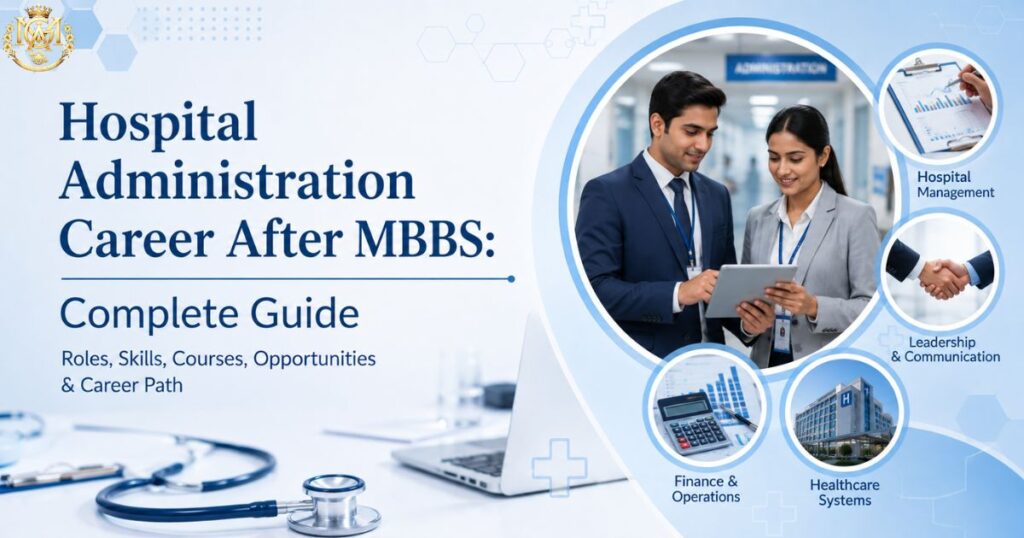
Ask most MBBS graduates what comes next, and the answer is almost automatic: MD, MS, or DNB. But postgraduate clinical training isn't the only direction available after MBBS. A hospital administration career after MBBS is a real option too. Some doctors find themselves more drawn to how a hospital actually runs — the operations, the systems, the leadership decisions behind the scenes — than to the next clinical rotation.
A hospital administration career after MBBS is a legitimate, practical direction for doctors who feel this pull. It's worth understanding clearly before you commit to it: what the work actually involves, why medical training gives you a real advantage, what qualifications matter, and how to know honestly whether this is the right move for you.
⚡ Quick Answer
Yes, a hospital administration career after MBBS is achievable — MBBS doctors regularly move into hospital administration and healthcare management. Some transition through hospital experience and internal opportunities alone; others pursue formal management education (MHA, MBA, or PGDM in Healthcare Management) to make the shift more structured. Your medical background is a genuine advantage here — but it's not a substitute for developing actual management skills, which is a different discipline from clinical medicine.
What Does a Hospital Administrator Actually Do?
A hospital administrator looks after the systems that keep a hospital functioning — not the treatment of individual patients, but the environment that makes good treatment possible. The exact scope depends heavily on hospital size: in a smaller facility, one person might cover several of these areas; in a large hospital, each is typically its own department with its own manager.
Operations & Patient Flow
Admissions, OPD and inpatient workflow, inter-department coordination, bed and facility management, staff scheduling, and inventory coordination — balancing patient care against real resource constraints.
Quality & Patient Safety
Working with clinical and support teams on patient safety, infection-control practices, documentation standards, and risk management. This includes accreditation requirements set by bodies like the National Accreditation Board for Hospitals & Healthcare Providers (NABH).
Finance & Technology
Budget planning, billing processes, hospital information systems, technology implementation, and vendor coordination — areas most doctors never studied deeply during MBBS.
HR & Coordination
Staff planning, department performance, and being the practical link between clinical teams, support services, and hospital leadership.
The underlying goal isn't simply "more patients, more efficiency" — a good administrator constantly balances patient care quality, staff capacity, and available resources against each other, which is a genuinely different kind of problem-solving than clinical diagnosis.
Why MBBS Doctors Are Well-Suited for Healthcare Management
An MBBS doctor already understands something a general management graduate typically takes years to learn: how healthcare actually works from the inside. You've seen patient journeys, emergency situations, treatment decisions, and clinical department dynamics firsthand — and that perspective is genuinely useful when making administrative decisions.
Improving patient flow, for instance, isn't purely a logistics problem — it directly affects waiting times, emergency response, staff workload, and patient safety. A doctor evaluating that problem brings context a career administrator might miss. Your experience working alongside nurses, technicians, consultants, and residents also builds a real foundation for team coordination, communication under pressure, and structured decision-making.
The honest caveat: being a good doctor doesn't automatically make you a good manager. Clinical training teaches you to ask "what's wrong with this patient, and what should I do?" Management asks a different set of questions entirely — why is this process failing, what resources does fixing it require, and how does this decision affect patients, staff, and the hospital as a system? Learning to think at that level is a genuine transition, not an automatic extension of clinical skill.
Qualifications You'll Need (MBA / PGDM in Healthcare Management)
Building a hospital administration career after MBBS usually starts with figuring out which qualification actually helps. There's no single mandatory qualification for every hospital administration role — requirements depend heavily on the organisation and the level of responsibility. An MBA isn't automatically required; some doctors move into administrative responsibility through hospital experience, internal opportunities, or targeted short courses. But if you're making a deliberate, structured transition out of clinical practice, formal management education generally makes that shift easier and opens doors faster.
Doctors generally consider three types of programmes:
| Programme | Main Focus |
|---|---|
| MHA | Hospital and healthcare administration specifically |
| MBA in Healthcare Management | Broader business and management training with healthcare application |
| PGDM in Healthcare Management | Practical management and healthcare operations, curriculum varies by institution |
The right option depends on your career goal — and, more importantly, on what a specific programme actually teaches. Don't select a course purely because "healthcare management" appears in the title; check the real curriculum. A genuinely useful programme should cover hospital operations, quality management, healthcare finance, HR, leadership, healthcare technology, and healthcare regulation in meaningful depth.
Beyond the degree itself, practical exposure strengthens your profile: hospital workflow understanding, basic finance literacy, data interpretation, team management experience, and comfort with healthcare technology all matter — and clinical experience genuinely contributes to several of these, since you've already seen hospital operations from the inside.
Career Path: From Hospital Administrator to Healthcare Leadership
Career growth in this field comes from a combination of experience, expanding responsibility, and developed management skill — not from a single credential unlocking a fixed ladder.
Entry-level: Early roles typically sit within operations, administration, quality, or healthcare projects. The focus at this stage is learning how the organisation actually works — its processes, its constraints, its people.
Operations and department management: With experience, responsibility typically shifts from handling individual administrative tasks to managing a department, process, or team — a stage that demands stronger leadership and independent decision-making.
Senior leadership: Experienced professionals move toward strategic responsibilities — resource planning, quality improvement at an organisational level, financial decisions, and broader healthcare strategy. This transition from doctor to healthcare leader is typically gradual: your MBBS gives you the healthcare knowledge, while accumulated management experience teaches you to apply it at an organisational level.
Beyond individual hospitals, healthcare management skills also open doors in health-tech companies, health insurance, pharmaceutical and medical technology organisations, and corporate healthcare groups — roles that are less directly clinical but still closely connected to healthcare delivery.
Healthcare Consulting as an Alternative Route
For doctors who enjoy solving varied problems more than running the same hospital day after day, healthcare consulting is worth considering. Consulting engagements vary by project, but typically involve analysing hospital operations, patient processes, service expansion plans, healthcare technology adoption, or organisational strategy for a client — with far more analysis, presentation work, and structured project delivery than bedside medicine.
Medical knowledge alone isn't sufficient here. Consulting demands comfort with data and spreadsheets, clear business communication, structured research, and the ability to work across very different teams on a project timeline. If you enjoy dissecting a healthcare problem and building a practical, presentable solution, this route is genuinely worth exploring — including at established consulting practices that run dedicated healthcare divisions.
Is This the Right Move for You?
Deciding whether a hospital administration career after MBBS suits you is probably the most important question here.
Healthcare management may suit you if you're energised by improving systems rather than treating individual patients — managing teams, planning at an organisational level, working with data and operations, and making decisions that affect the hospital as a whole rather than one case at a time. Your contribution to patient care becomes real but indirect, working at the system level rather than the bedside.
Clinical practice likely remains the better fit if direct patient contact — examining, diagnosing, treating — is what genuinely energises you day to day. In that case, postgraduate clinical training (MD, MS, or DNB) is probably the more natural next step, not a management degree.
There's no universally better path — only the one that matches the kind of work you actually want to be doing every day. And it isn't strictly binary: doctors who combine clinical experience with management responsibility often become particularly effective leaders, precisely because they can communicate credibly with both medical and administrative teams. The practical skill to build, regardless of which direction you lean, is the ability to think at a systems level without losing sight of the patient behind every process.
Frequently Asked Questions
Can an MBBS doctor become a hospital administrator?
Yes — a hospital administration career after MBBS is common, with doctors moving into hospital administration and healthcare management roles. The exact qualification and experience expected depends on the specific organisation and the seniority of the position.
Is an MBA necessary after MBBS for hospital administration?
Not for every role. Some positions can be entered through clinical experience and relevant administrative exposure alone. That said, formal management education tends to make a structured, deliberate transition into healthcare management considerably smoother.
Which is better after MBBS: MBA, MHA, or PGDM?
There's no single correct answer. MHA is more directly focused on hospital administration specifically; an MBA typically offers broader management training with healthcare application; PGDM programmes vary significantly by institution. Check the actual curriculum and practical exposure of the specific programme rather than relying on the title alone.
Can MBBS doctors work in healthcare consulting?
Yes, particularly once you develop skills in data analysis, business communication, project management, and healthcare operations. Clinical background gives you credible domain knowledge that pure business graduates often lack.
What jobs can an MBBS doctor get in healthcare management?
Common areas include hospital administration and operations, quality management, healthcare project management, healthcare consulting, digital health and health-tech, health insurance, and roles within broader healthcare organisations such as pharmaceutical or medical technology companies.
Still Deciding Between Management and Clinical Specialisation?
If clinical specialisation still appeals to you alongside — or instead of — a management track, MGA's CPD-accredited Fellowship programmes, with international recognition through applicable UK accrediting bodies, are a focused way to build your CV while you decide.
Explore Fellowship ProgrammesRelated Reading
Career after MBBS — the complete overview this guide is part of
Career growth pathways after MBBS — how different first steps shape long-term direction
Non-clinical careers after MBBS — other directions beyond clinical practice
This article provides general, India-focused career guidance for MBBS graduates exploring hospital administration and healthcare management. Compensation, role structure, and qualification requirements vary significantly by organisation, city, and individual experience — this guide describes career direction and general expectations only, not specific figures. Medical Global Academy does not currently offer MBA, MHA, or PGDM programmes; this article is provided as independent career guidance.
Which Post-MBBS Course Format Is Right for You?
Answer three quick questions and we'll match you to the format that fits your goals — Certificate, PG Diploma, or Fellowship.