
Interventional Radiology (IR) is among the most rapidly developing and also the most exciting subspecialties of modern medicine. In case you have already MD in Radiology and are considering pursuing a Fellowship in Interventional Radiology as this would allow you to explore new and highly specialized skills, better career prospects, and higher earnings.
Here is the step-by-step guide of what you must know about the Fellowship in Interventional Radiology following the MD Radiology, know, how long it covers, what you can do with it, what skills you need to have, and so on.
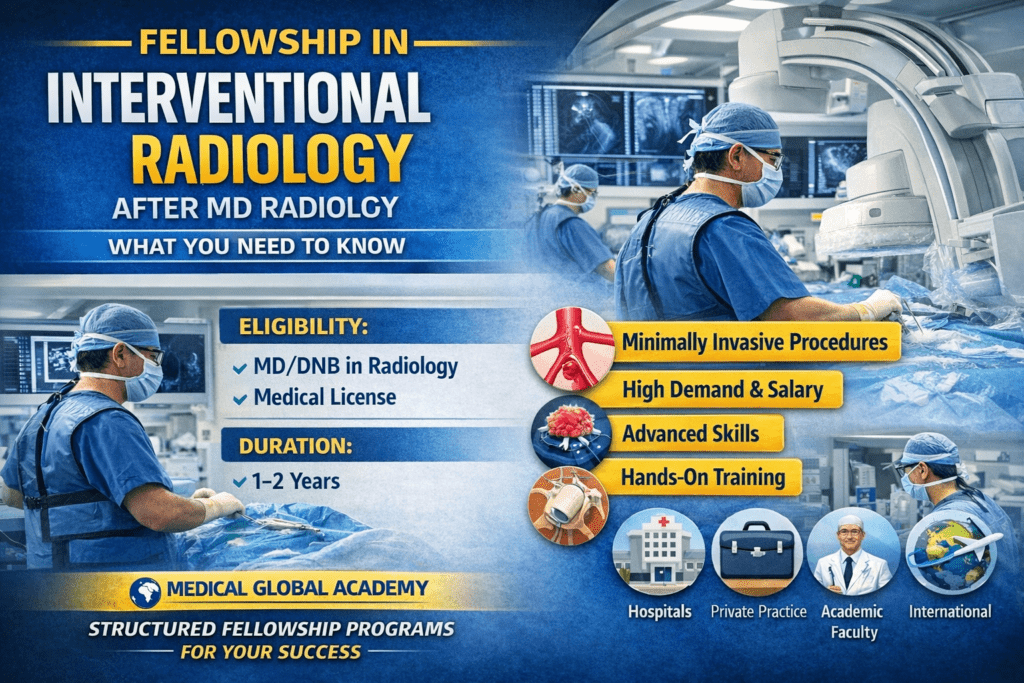
What is Interventional Radiology
Interventional Radiology is a medical subspecialty, which relies on imaging, including X-ray, CT scan, MRI, and ultrasound to carry out patients with minimal invasive diagnostic and treatment procedures.
In contrast to the old fashioned surgery, the IR technique applies the tiny incisions with the help of catheters, wires and the imaging guidance. This results in:
- Less pain
- Faster recovery
- Minimal blood loss
- Shorter hospital stay
The most frequent Interventional Radiology procedures are:
- Angioplasty and stenting
- Embolization
- Biopsies
- Drain placements
- Tumor ablation
- Thrombolysis
- Vascular access procedures
IR is a field that incorporates professional skills in radiological diagnostics with the skills of a procedure, thus positioning it among the most living branches of medicine with those after MD Radiology.
Why Choose Fellowship in Interventional Radiology After MD Radiology
Once a doctor has completed MD Radiology, they have to decide between pursuing diagnostic radiology or transitioning to some form of procedural subspecialty, such as Interventional Radiology.
And this is the reason why lots of radiologists are going to IR:
1. High Demand Specialty
Interventional Radiologists are on a rising demand as there has been an increasing preference to minimal invasive operations.
2. Higher Earning Potential
In most cases, IR specialists are much better compensated than general diagnostic radiologists particularly in independent practice and in corporate hospitals.
3. Clinical Involvement
The IR doctors are not just the people who interpret the images as opposed to the diagnostic radiologists who are primarily involved in the treatment of the patients.
4. Advanced Skill Development
IR acquires technical skills, decision-making skills and procedural expertise.
Interventional radiology Fellowship eligibility
In order to become a Fellowship in Interventional Radiology, you usually require:
- MD or DNB in Radiology
- Valid medical registration
- Single knowledge of vascular and imaging techniques.
- Interest in procedural work
In some cases, the institutions will demand:
- Entrance examination
- Interview
- Prior hands-on experience
Fellowship Interventional Radiology Duration
The time taken typically is between:
- 1 year (most common)
- 2 (advanced structured programs) years.
There are also short certificate programs, though they might not expose them to all the exposure as a full fellowship.
Training Structure Curriculum
An organized Fellowship in Interventional Radiology encompasses theoretical, as well as practical training.
Core Training Areas
Vascular Interventions
- Peripheral angioplasty
- Stenting
- AV fistula management
- Thrombolysis
Non-Vascular Interventions
- Biopsies
- Drainage procedures
- Nephrostomy
- Biliary interventions
Oncology Interventions
- TACE (Transarterial Chemoembolization)
- RFA (Radiofrequency Ablation)
- Microwave ablation
Emergency Interventions
- Trauma embolization
- GI bleeding management
Pain and Palliative Procedures
- Vertebroplasty
- Nerve blocks
Training includes
- Supervised procedures
- Case discussions
- Academic presentations
- Research exposure
- Complication management
What It Takes to be a successful interventional radiologist
In order to achieve success in IR, technical knowledge is not enough.
Essential Skills:
- Very good hand-eye coordination.
- Good anatomical skills.
- Decision-making when under pressure.
- Skills in communicating with patients.
- Knowledge of complications.
- Cooperation with doctors and surgeons.
IR demands mental and operational superiority.
After Interventional Radiology Fellowship Career Scope
Once a fellowship ordeal is over, career choices would be:
1. Corporate Hospitals
Huge multi-specialty hospitals are also aggressive in recruiting IR specialists.
2. Government Hospitals
A great deal of teaching hospitals possess separate IR departments.
3. Private Practice
It is possible to create a referral-based IR.
4. Academic Career
Become faculty in Radiology IR specialization in medical colleges.
5. International Opportunities
Middle East countries, UK, Australia among others provide good opportunities to the trained IR specialists (based on the licensing requirements).
The after-fellow Interventional Radiology salary
Wage is based on location, experience and type of hospital.
In India:
- Experience: Above average radiology packages.
- Developed IR professional: Much greater profits.
- Independent arrangement: Quality is based on referral network.
The salaries in India are very low when compared to international rates.
Fellowship vs Certificate vs PG Diploma in Interventional Radiology
In the case of many doctors, such options are confusing.
Fellowship
- 1–2 years
- Formal practical education.
- Recognized and valued
PG Diploma
- 1–2 years
- Academic-focused
- Inadequate practical experience in certain programs.
Certificate Course
- Short duration
- Basic exposure
- Equivalent to fellowship Not synonymous.
To achieve serious career development in the field of IR, it is typically desired to have a structured fellowship.
Practical Problems of Interventional Radiology
And although IR is not only rewarding, it does have its challenges:
- Long procedure hours
- Radiation exposure
- High stress cases
- Responsibility in complications control.
- Emergency calls
It is not a career that a person who favors a reporting based radiology career partakes.
The Future of Interventional Radiology
The rapidly growing field of Interventional Radiology is attributed to:
- Growing cancer burden
- Raising the number of vascular diseases.
- Minimally invasive treatment demand.
- Technological advancements
The IR will become an essential treatment pillar alongside medicine and surgery.
The Question is How to Select the Right Fellowship Program
In choosing Fellowship in Interventional Radiology, it is important to consider:
- Case volume
- Hands-on exposure
- Faculty experience
- Infrastructure (Cath lab, DSA suite)
- Academic support
- Alumni outcomes
Always select a program that offers a real life experience of the actual procedure as opposed to observational training only.
Conclusion
Post MD Radiology fellowship in Interventional Radiology is a superb step to the career which would enable the doctors to cease image reporting and instead treat the patients using minimally invasive treatments. It has high demand, high earning power, higher level of procedural skills and growth in the long term. Nevertheless, it involves commitment, expertise, and willingness to work on complicated cases. The selection of a proper training institute is very important to obtain the correct hands-on exposure and confidence. Medical Global Academy is one of the institutions, which offer well-organized fellowship programs that emphasize both practical training, academic excellence and career development to enable radiologists to have a thriving future with Interventional Radiology.
FAQs
1. Should one have a Fellowship in Interventional Radiology after MD Radiology
No, but very much so, should you wish to practice as a full time Interventional Radiologist.
2. How long is the Fellowship in Interventional Radiology
The majority of fellowships take a year, and others can take up to 2 years.
3. Is it possible to begin private practice after doing the IR fellowship
Yes but it is imperative to establish a referral network and tie-ups with hospitals.
4. Is Interventional Radiology Risky
Similar to any other procedure specialty, IR is a risky undertaking, yet with adequate training, complications can be minimized.
5. Fellowship or Certificate in Interventional Radiology; which is better
Fellowship organised is usually superior since it offers more thorough practical training and superior career identification.