
There is a fast changing environment in the healthcare market, and as the burden of cancer cases worldwide continues to rise, the demand of well trained oncologists in the market has never been higher. A Fellowship in Oncology is meant to prepare physicians with a high-level of clinical practice, expertise, and practical training in cancer care. This fellowship is an avenue to professional excellence as well as personal fulfillment of medical professionals wishing to have a successful and meaningful career.
This blog will focus on the major advantages of Fellowship in Oncology, as well as all the information a doctor should be aware of prior to deciding to get this specialization.
What Is an Oncology Fellowship
Fellowship in Oncology is a specialized training program that is short term; it concentrates on the treatment, diagnosis and management of different types of cancer. It is usually followed up after MBBS or postgraduate medical degrees including MD/MS/DNB.
The fellowship is based on several domains, such as:
- Oncology: Med. (chemotherapy, immunotherapy)
- Radiation Oncology
- Surgical Oncology
- Palliative Care
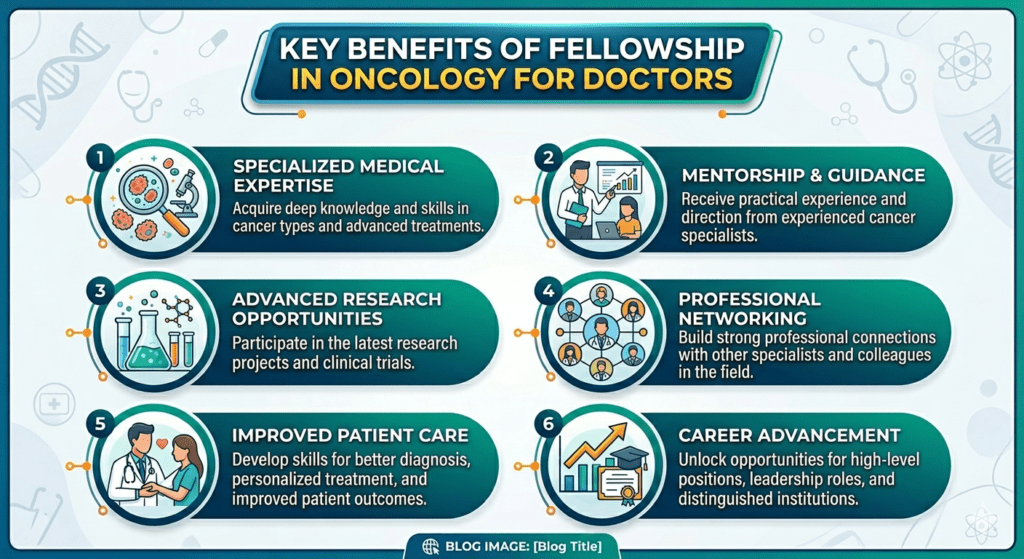
The main advantages of Fellowship in Oncology among Doctors
1. Higher Specialization and Professionalism
The possibility to acquire in-depth specialization is one of the greatest advantages of a Fellowship in Oncology. Physicians go past general practice and become specialists in the treatment of complex cases of cancer. Such specialization improves clinical decision making and outcomes in patients.
2. Career Growth and High Demand
The world is experiencing increased cases of cancer which are culminating into the high demand of oncology experts. Having graduated a Fellowship in Oncology, physicians are able to pursue opportunities in:
- Multi-specialty hospitals
- Cancer research institutes
- Oncology clinics
- Academic institutions
This will guarantee a predictable career progression and a secure employment future.
3. Enhanced Earning Potential
The ability to earn is a direct influence of specialization in a doctor. Oncology practitioners may be given:
- Higher salary packages
- Improved incentives in the private hospitals.
- Private practice opportunities.
Fellowship in Oncology may be of great benefit in terms of finances.
4. Clinical Training
This fellowship is not as theoretical as other courses, but it gives more emphasis on exposure. Physicians are provided with practical experience in:
- Diagnosing cancer stages
- Administering chemotherapy
- Treatment complications management.
This practical training develops belief and proficiency.
5. Introduced to Hi-tech Technologies
Oncology is the most technologically-developed branch of medicine. Doctors are taught during the fellowship about:
- Targeted therapy
- Immunotherapy
- Precision medicine
- State of the art imaging and diagnostics.
This keeps the professionals informed on the latest medical improvements.
6. Research and Innovation opportunities
Research based careers are allowed through a Fellowship in Oncology. Doctors can:
- Be involved in clinical trials.
- Publish research papers
- Make a donation towards new treatment of cancer.
This suits the people who are interested in academic and research oriented positions.
7. International Career Opportunities
Efficiency in oncology is globally known. Doctors who have completed a Fellowship in Oncology can:
- Enroll in international qualifications.
- Global healthcare system employment.
- Work with international oncology teams.
- This offers international movement and publicity.
8. Multidisciplinary Collaboration
The process of cancer treatment must be a team effort. The physicians collaborate with the following in the course of the fellowship:
- Surgeons
- Radiologists
- Pathologists
- Palliative care experts.
This improves total patient management competencies.
9. Recognition and Credibility: Professional
Oncology specialization is a sure way of improving the reputation of a doctor. It:
- Builds trust among patients
- Increases the level of trust in the medical fraternity.
- Places physicians as leaders in cancer treatment.
10. Professional and emotional satisfaction
The work with cancer patients is complicated, but very fulfilling. Doctors:
- Be significant in life saving.
- Offer hope and care to patients and families.
- Feel a high level of mission.
Fellowship in Oncology Eligibility Criteria
Applicants in the Oncology field should be Doctors with at least:
- MBBS degree (mandatory)
- MD/MS/DNB (desired in most programs)
- Valid medical registration
Clinical experience is also a requirement of some programs.
Duration and Course Structure
- Duration: 1 to 2 years
- Mode: Online, offline or hybrid.
Curriculum includes:
- Theoretical modules
- Clinical case discussions
- During practice at hospitals.
Openings in Oncology After Fellowship.
Career opportunities after the fellowship
- Consultant Oncologist
- Clinical Researcher Associate.
- Inpatient Specialist in Oncology hospitals.
- Academic faculty
- Private practitioner
Challenges to Consider
Although the benefits are high, doctors should also be conscious of:
- Stressful work climate.
- Long working hours
- On-going learning needs.
These obstacles are however overshadowed by the long term payoffs.
Conclusion
Fellowship in Oncology is a revolutionary move in which a physician intending to major in cancer treatment would undertake. It offers progressive learning, practical education, international exposure and good career opportunities. As the demand of oncology experts increases, this fellowship guarantees career development and contribution to the life of patients.
Medical Global Academy provides well-organized fellowship programs that aim to equip physicians seeking a high-quality and career-oriented program to provide practical training, professional mentoring, and knowledge related to the industry. The difference between a successful and unsuccessful oncology career can be in the choice of the right institution.
FAQs
1. Who is eligible to apply for a Fellowship in Oncology?
Medical practitioners having an MBBS degree may apply but postgraduate is usually desirable.
2. How long is a Fellowship in Oncology?
The majority of the programs take 1 to 2 years.
3. Does the fellowship have clinical training?
Yes, the majority of the programs offer practical clinical exposure.
4. How much is the pay following a Fellowship in Oncology?
Salary is variable (as a general practice) but usually higher, based on experience and location.
5. Is it possible to have a Fellowship in Oncology online?
Certain institutes also have an online or hybrid form of training though practical training is mandatory.