
Medical Global Academy

August 28, 2026

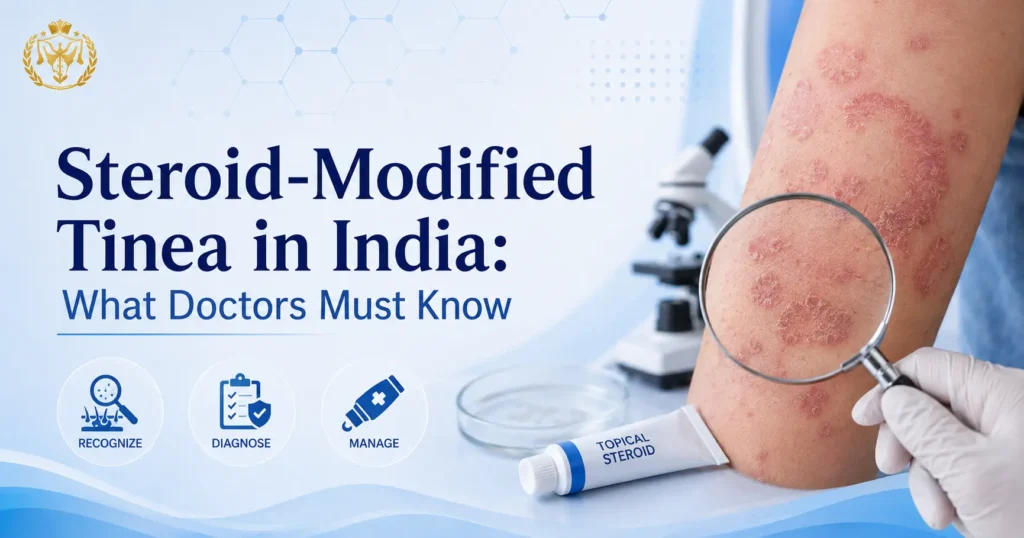
Clinical comparison of classic tinea ringworm versus steroid-modified tinea in India — showing pale, poorly-defined lesions with blurred borders characteristic of OTC steroid cream misuse
Learning blogs

Steroid-Modified Tinea in India: The Silent Epidemic Every Doctor Should Understand

🩺 CLINICAL DERMATOLOGY MGA Clinical Education Series  ·  8 min read A patient walks into your OPD with a widespread, pale, mildly itchy skin rash on the trunk and groin. He has seen a pharmacist, used a cream, felt better for a week — and now it is back, larger and harder to define. This scenario plays out in dermatology OPDs and general physician clinics across India every single day. The culprit, in many of these cases, is not a new or unusual pathogen. It is an old fungal infection that has been allowed to change its face — because of a tube of OTC cream. This article explains what steroid-modified tinea is, why India is at the centre of a documented dermatology crisis, how these altered infections present clinically, why they are harder to clear, and what the published evidence says every treating doctor should do differently. 🔍 Quick Reference Condition: Steroid-modified tinea / Tinea incognito Cause: OTC topical steroid (or steroid–antifungal–antibiotic triple combination) applied to an undiagnosed dermatophyte infection Effect: Atypical clinical appearance, missed diagnosis, wider spread, treatment resistance Key Indian literature: IJDVL — Verma, Panda et al. 2021 (3-part series); IADVL–ITART Consensus 2020; Dutta, Rasul & Boro, IJDVL 2017 Doctor’s role: Clinical recognition, KOH confirmation, patient education, pharmacist communication 🔬 What Is Steroid-Modified Tinea (Tinea Incognito)? Tinea incognito — now more accurately called steroid-modified tinea in Indian clinical literature — refers to a dermatophyte infection whose typical clinical appearance has been altered by the application of a topical corticosteroid (or a calcineurin inhibitor). The term was first reported in 1968 by British dermatologists Dr Adrian Ive and Dr Ronnie Marks, who described patients with fungal infections masked by topical steroid use presenting as seborrheic dermatitis, eczema, or psoriasis-like eruptions. The mechanism is well understood: topical corticosteroids suppress local skin immunity — specifically, they downregulate antigen-presenting cell function, reduce IL-12 and Th1 activation, and shift the immune response toward a Th2 profile. The dermatophyte encounters a local immune environment that has been instructed to stand down. The inflammation that normally produces the classic raised, scaly, well-defined ring fades. The infection spreads laterally and sometimes deeper, but looks far less angry than it should. As published in Journal of Clinical Medicine (Zacharopoulou et al., 2024, PMC11172699), the more topical steroid that is applied, the more extensive and unrecognisable the fungal infection becomes. A critical nuance noted by Verma SB and colleagues in IJDVL (2021, doi: 10.25259/IJDVL_301_20) is that in the Indian epidemic, a strict “tinea incognito” — where the infection is completely unrecognisable — is less common than steroid-modified tinea, where an active border is often still visible despite morphological distortion. The IJDVL authors argue that “steroid-modified tinea” is therefore the more accurate term for the majority of Indian cases. 🏥 How an OTC Cream Habit Became a National Dermatology Concern India’s climate — high humidity, high ambient temperature across much of the country, and monsoon seasons that last months — creates conditions strongly favourable to dermatophyte growth and spread. Tinea corporis, tinea cruris, and tinea faciei are among the most common superficial infections seen in both urban and rural OPDs. In this environment, an itchy circular rash is a predictably common presentation. The problem is what happens next. Fixed-dose combination (FDC) creams containing a potent topical corticosteroid (typically clobetasol propionate or betamethasone dipropionate), an antifungal agent, and an antibacterial agent are widely available over the counter in India. Research published in the Indian Journal of Dermatology, Venereology and Leprology (Dutta, Rasul & Boro, IJDVL 2017) found that pharmacists were responsible for recommending these combination creams in the majority of tinea incognito cases — 78% of patients in that study were using products recommended by a pharmacist. Patients used these preparations for durations ranging from six weeks to twelve years without medical supervision. Why do patients keep using them? The steroid component produces rapid, visible relief within a few days. Itch decreases, redness fades. Patients interpret this as a cure. When the cream is stopped, the itch returns worse than before — because the fungus has been spreading unchecked beneath a suppressed immune response. The patient reaches for the tube again. The cycle repeats. A landmark 2021 three-part IJDVL series by Verma SB, Panda S, Nenoff P and colleagues described the situation as an “unprecedented epidemic-like scenario” of dermatophytosis in India, attributing the crisis directly to indiscriminate use of FDC corticosteroid creams and the emergence of a novel, partially terbinafine-resistant species — Trichophyton indotineae (formerly classified as T. mentagrophytes ITS genotype VIII) — which the WHO Fungal Priority Pathogens List (2022) has since acknowledged as a global concern. 📊 What the Published Research Documents • The prevalence of superficial dermatophytosis in different regions of India ranges from 36.6% to 78.4% — a range described by experts as constituting a national epidemic (topical antifungal-corticosteroid FDC review, Indian Journal of Pharmacology). • A cost-of-illness analysis published in Clinical and Experimental Dermatology (Jagadeesan et al., 2023) found that patients using topical steroids for dermatophytosis in India incur approximately 40% higher treatment costs than steroid-naive cases. • The IADVL Task Force Against Recalcitrant Tinea (ITART) Consensus 2020 noted a six- to seven-year pattern of unprecedented increase in recurrent, chronic, and steroid-modified dermatophytosis involving glabrous skin. • A study from Western Uttar Pradesh (Thakur et al., Journal of Dermatology and Cosmetology, 2018) conducted across 100 steroid-modified tinea cases identified lack of qualified dermatologists in rural areas as a compounding factor — a gap that directly increases irrational corticosteroid use. 👁️ Clinical Recognition: How Steroid-Modified Tinea Presents Differently The diagnostic challenge is that steroid-modified tinea no longer looks like textbook ringworm. The classic well-defined, raised, scaly, erythematous ring with central clearing is modified or absent. Recognising the altered patterns is the first clinical skill every doctor managing skin conditions in India needs to develop. Feature Classic Tinea (Untreated) Steroid-Modified Tinea Border Well-defined, raised, scaly Blurred, less elevated, less scaly Central clearing Present (classic ring shape) Often absent — study data shows 94.1% of steroid-modified
CPD accreditation for doctors in India — what it means, how it differs from CME and PG qualifications, and how to evaluate a credible program
Learning blogs

CPD Accreditation for Doctors in India: What It Means, Why It Matters and How to Choose a Program

Quick Answer CPD accreditation means a learning program has been assessed and approved by a recognised accrediting body — confirming its educational standards, faculty credibility, and clinical relevance. In India, CPD requirements are not uniformly mandated at the national level, but are increasingly tied to hospital credentialing, NMC’s evolving re-registration framework, and professional differentiation. A CPD-accredited fellowship certificate is different in nature from a university-awarded PG Diploma — understanding that difference is what helps you choose the right credential for your actual career goal. Most doctors encounter “CPD accredited” as a label on a course brochure without a clear sense of what that label actually guarantees — or who assigned it. Some programs carry accreditation from internationally recognised bodies with rigorous assessment criteria. Others carry badges from organisations that exist primarily to provide those badges. The label looks the same on a certificate; the substance behind it does not. This article explains what CPD accreditation is, how it differs from both CME and formal postgraduate qualifications like MD, MS, and PG Diplomas, what it unlocks practically in an Indian doctor’s career, and how to evaluate whether a CPD program is genuinely worth your time and fees. It is written for doctors who are already working — not for students trying to understand what CPD is in the abstract. CPD ≠ CME Different scope, different credential weight 3 credentials CPD certificate · PG Diploma · Fellowship — compared below NMC Framework for CPD in Indian medical practice is evolving What this article covers What CPD accreditation actually means — and what it doesn’t CPD vs CME — why the distinction matters in Indian practice What NMC’s evolving CPD framework means for practising doctors What CPD unlocks in practice — credentialing, career, and clinical authority CPD certificate vs Fellowship vs PG Diploma — which credential fits which goal How to evaluate whether a CPD program is credible Frequently asked questions What CPD Accreditation Actually Means — and What It Doesn’t Accreditation is an external quality mark. When a learning program is described as CPD accredited, it means a third-party body has reviewed the program’s curriculum, faculty credentials, assessment methods, and learning outcomes and confirmed that they meet defined educational standards. The accrediting body takes professional responsibility for that assessment. What accreditation does not mean: it does not automatically mean the program is government-approved, NMC-recognised, or equivalent to a postgraduate degree. These are separate categories with separate recognition criteria. A CPD-accredited program from a credible international body is a meaningful professional credential — but it is a different kind of credential from a university-awarded PG Diploma or an NMC-recognised MD/MS degree, and it should not be presented or understood as equivalent to either. The quality of accreditation varies significantly by the accrediting body. A program accredited by the CPD & Training Council (UK) — a body with defined international recognition in CPD standards — carries different weight than accreditation from a domestic body created specifically to issue certificates. Before enrolling in any CPD program, identify the accrediting body and verify independently that it is a recognised professional standards organisation, not a commercial certification provider. MGA’s accreditation: Fellowship programs at Medical Global Academy are accredited by the CPD & Training Council with international continuing medical education recognition. This is a professional CPD credential — not a university degree, not an NMC-recognised postgraduate qualification. The distinction matters for how you use the credential and what it demonstrates on a CV or in a hospital credentialing process. CPD vs CME — Why the Distinction Matters in Indian Practice CME (Continuing Medical Education) and CPD are used interchangeably in most Indian contexts — including by many medical associations. They are related but not identical, and understanding the difference helps you evaluate what a specific program is actually offering. Factor CME CPD Scope Primarily clinical knowledge updates Broader — clinical, professional, leadership, research, ethics Typical format Conferences, lectures, grand rounds Courses, workshops, teaching, mentorship, research, publications Learning goal Updated clinical knowledge Holistic professional development and career-long competency Credential output CME certificate / credit hours CPD certificate, fellowship credential, or structured learning record Relationship CME is a subset of CPD CPD includes CME and extends beyond it The practical implication: if a hospital credentialing process or employer asks for CPD records, attending an IMA conference generates CME credits that typically count. Completing a structured fellowship program generates CPD accreditation that carries deeper professional weight — it demonstrates sustained, assessed learning in a defined clinical area rather than attendance at a single event. What NMC’s Evolving CPD Framework Means for Practising Doctors India does not currently have a single, nationally uniform mandatory CPD requirement for all practising doctors. Requirements vary by State Medical Council — some states have introduced or are introducing renewal-linked CPD expectations; others have not formalised this. This landscape is actively evolving. The National Medical Commission has been developing a framework for continued medical education and professional development as part of broader regulatory modernisation. The direction of travel — toward structured CPD as part of ongoing medical registration maintenance — is consistent with international best practice in medical regulation. Doctors who have established CPD habits and documented learning records will be better positioned as this framework develops than those who begin scrambling when mandatory requirements arrive. Beyond national regulation, corporate hospitals and large healthcare networks in India have their own internal credentialing and re-credentialing processes that already incorporate CPD expectations — fellowship credentials, structured course completion, and documented specialty learning are factors in consultant appointment decisions at major private hospital groups independently of any state council requirement. Practical advice: Do not wait for CPD to become mandatory before building a record. The doctors who benefit most from structured CPD are those who treat it as an ongoing professional habit rather than a compliance task they manage at renewal deadlines. Verify current requirements directly with your State Medical Council — do not rely on generalised claims from any online source, including this one. What CPD Unlocks in

Scroll to Top