
Medical Global Academy

August 31, 2026

Medical Officer vs Junior Resident after MBBS: clinical job comparison and career path
Learning blogs

Medical Officer vs Junior Resident: Which Clinical Job First After MBBS?

Completing MBBS and internship is a major transition. For many doctors, the next question is not simply “What job can I get after MBBS?” but “Which clinical role will give me the best start to my career?” Two commonly considered options are Medical Officer (MO) and Junior Resident (JR). Both can provide hands-on patient-care experience, but they differ in purpose, structure, supervision, departmental exposure, employment conditions and long-term career relevance. The important point is that there is no universally better role. A Junior Resident position in a high-volume teaching hospital may offer structured specialty exposure, while a Medical Officer position may provide broader responsibility and immediate employment. The actual job description matters more than the designation alone. Medical Officer vs Junior Resident: What’s the Difference? What Is a Medical Officer? A Medical Officer is a licensed doctor responsible for providing clinical services within the scope defined by the employer and appointment. Medical Officers may work in: Government hospitals Private and corporate hospitals Primary and community health facilities Emergency services Clinics Public-health programmes Institutional healthcare settings Their responsibilities can include patient assessment, initial management, documentation, referrals, emergency care and coordination with other healthcare professionals. The role can therefore be quite broad. A Medical Officer working in a busy emergency department may have a very different working day from one working in a primary-care or public-health setting. What Is a Junior Resident? A Junior Resident generally works within a hospital-based clinical hierarchy and combines patient-care responsibilities with professional learning. However, the term Junior Resident is not used identically everywhere. Some institutions use it for doctors enrolled in postgraduate training, while others recruit non-PG Junior Residents on fixed-term appointments. This distinction is particularly important when evaluating a job advertisement. A non-PG JR position should not automatically be treated as equivalent to being enrolled in an MD/MS/DNB programme. Medical Officer vs Junior Resident at a Glance Factor Medical Officer Junior Resident Primary focus Clinical service Clinical service + structured learning Typical setting Hospital, clinic, health facility or programme Usually hospital/department based Specialty exposure Depends on posting Often department-specific Supervision Depends on employer Usually within a clinical hierarchy Tenure Permanent, contractual or fixed-term Often defined by appointment/notification Career value Clinical experience and employment Clinical exposure and potential preparation for specialization The designation alone does not tell you the quality of the experience. Who Is Eligible for Medical Officer and Junior Resident Jobs After MBBS? MBBS and Internship Requirements For most clinical appointments after MBBS, doctors need to have completed their medical qualification and the required internship. The compulsory rotating internship is an important transition between medical education and independent professional practice. Completion of internship is also commonly linked to the registration requirements applicable to medical practice. Medical Registration Requirements Doctors should verify the registration requirements specified in the particular recruitment notification or appointment. For an MBBS graduate, this generally means having the appropriate medical registration required to practise and meeting any registration conditions specified by the employer. Age and Experience Requirements There is no single age or experience rule covering every Medical Officer or Junior Resident position. A fresh MBBS graduate may be eligible for some entry-level positions, while other Medical Officer vacancies can ask for previous clinical experience. Similarly, Junior Resident recruitment can have institution-specific conditions regarding internship completion, previous residency and other eligibility criteria. Therefore, always read the actual recruitment notification rather than relying on a generic eligibility statement. How Eligibility Can Differ by Institution Government medical colleges, central institutions, state health departments and private hospitals can use different recruitment systems. Before applying, check: MBBS recognition requirements Internship completion date Registration requirements Age limit Previous JR experience Required experience Selection method Appointment tenure Department allocation What Does a Medical Officer Do? The Medical Officer’s exact responsibilities depend on the institution and posting. Patient Assessment and Initial Management Medical Officers commonly assess patients, take relevant clinical histories, perform examinations, identify urgent problems and initiate appropriate management within their role. In emergencies, the doctor must recognize deterioration quickly, initiate appropriate emergency measures and escalate to senior or specialist support when required. OPD and Emergency Responsibilities Depending on the posting, an MO may work in outpatient services, emergency departments or both. Typical responsibilities may include: Initial patient assessment Clinical documentation Basic investigations and interpretation Initial treatment Emergency stabilization Referral to appropriate specialists Follow-up planning The key difference is that an MO’s responsibilities are determined by the actual job description and facility, rather than by the title alone. Inpatient Clinical Responsibilities Where Medical Officers are involved in inpatient services, responsibilities may include reviewing admitted patients, monitoring clinical progress, coordinating investigations, communicating with specialists and maintaining appropriate medical records. Referrals and Coordination With Specialists A Medical Officer may often serve as an important link between the patient and specialist team. Good referral practice requires communicating the relevant clinical history, examination findings, investigations, reason for referral and urgency clearly. Documentation and Medical Records Clinical documentation is not simply administrative paperwork. Accurate and timely records support: Continuity of care Communication between clinicians Clinical decision-making Quality improvement Audit and research Medico-legal accountability For a young doctor, developing disciplined documentation habits early is an important professional skill. Public Health and Community-Based Roles Medical Officer positions can also provide exposure to community medicine and public-health programmes, particularly in government and community-based settings. This can include preventive healthcare, screening, health education, programme implementation and coordination with public-health teams. What Does a Junior Resident Do? Department-Based Patient Care Junior Residents generally work within a specific hospital department or clinical service. This can provide exposure to a defined patient population and allow the doctor to become familiar with departmental workflows, investigations, treatment protocols and procedures. Inpatient and Emergency Duties JRs may participate in: Admissions Ward rounds Patient monitoring Emergency duties Clinical documentation Investigations Treatment coordination Night duties The workload varies significantly between hospitals and departments. Ward Rounds and Case Presentations Ward rounds are an important part of hospital-based clinical learning. A resident may need to review the patient’s current condition, investigations, treatment response and outstanding
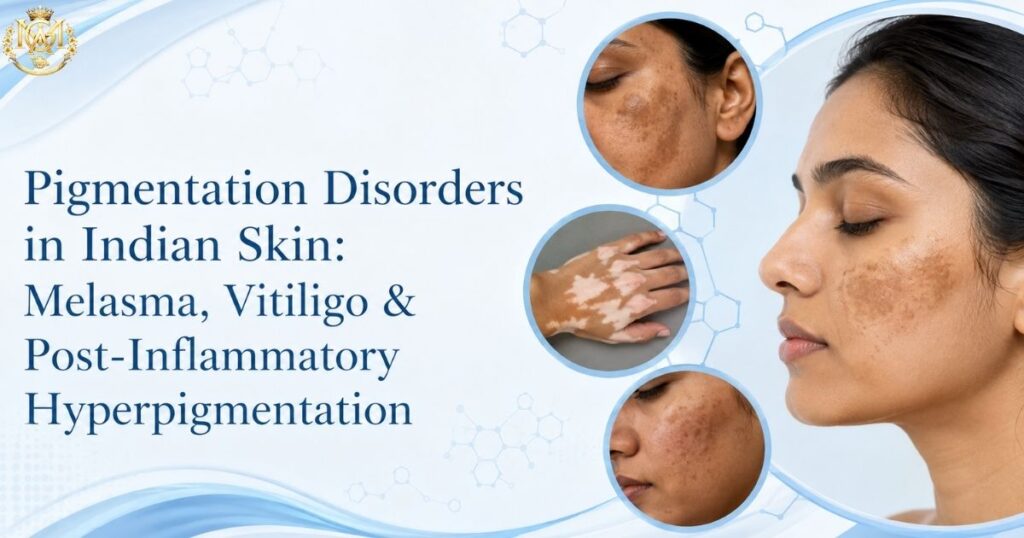
Clinical comparison of melasma, vitiligo and post-inflammatory hyperpigmentation presentations in Indian skin showing symmetrical facial patches, depigmented lesions and localized dark marks
Learning blogs

Pigmentation Disorders in Indian Skin: Melasma, Vitiligo & Post-Inflammatory Hyperpigmentation

Pigmentation Disorders in Indian Skin: Melasma, Vitiligo & Post-Inflammatory Hyperpigmentation Pigmentation Disorders in Indian Skin require a different clinical approach because pigmentation can present differently and carry a higher risk of treatment-related complications in Fitzpatrick IV–VI skin. Melasma, vitiligo, and post-inflammatory hyperpigmentation are common concerns in Indian dermatology practice, and understanding their presentation, general management principles, and referral thresholds is important for doctors treating skin of colour. This guide covers how these three conditions present specifically in Indian skin, general management principles, and when referral to a dermatologist is warranted. Why Pigmentation Disorders Present Differently in Indian Skin Skin of colour — generally defined as Fitzpatrick types IV through VI — has a higher baseline melanocyte activity than lighter skin types. This means the same inflammatory trigger that might cause temporary redness in fair skin often produces visible, sometimes persistent pigmentation change in darker skin. This has two practical consequences that shape everything else in this guide. First, pigmentation disorders in Indian patients tend to be more visually prominent and psychologically distressing, because pigmentary change is more noticeable against darker skin. Second, treatments that work well in Fitzpatrick I–III skin carry meaningfully higher risk in IV–VI skin. Laser and light-based treatments in particular carry a documented higher risk of triggering post-inflammatory hyperpigmentation when used in darker skin types, which is why treatment protocols need to be adapted rather than directly transferred from Western dermatology literature. Understanding this distinction is the starting point for managing all three conditions covered below. Melasma: Presentation, Triggers, General Management Melasma is one of the most common pigmentation complaints in Indian dermatology clinics, disproportionately affecting women, though it does occur in men as well. It presents as symmetrical, brownish-grey patches typically on the cheeks, forehead, upper lip, and chin. Common Triggers Sun exposure is the single most consistent aggravating factor, made worse by India’s high UV index for most of the year. Hormonal factors — pregnancy, oral contraceptives, hormone replacement therapy — are strongly associated triggers, which is why melasma is sometimes referred to as the “mask of pregnancy.” Genetic predisposition plays a role too; a family history of melasma is common among affected patients. General Management Principles Photoprotection is the foundation of any melasma management plan, and it isn’t optional — without consistent sun protection, other treatments have limited durability. Broad-spectrum sunscreen with both UVA and UVB coverage, reapplied through the day, is a baseline recommendation for every patient. Topical depigmenting agents are typically first-line treatment, used under proper dermatological guidance to balance efficacy against irritation risk, since irritation itself can worsen pigmentation in darker skin. Procedural treatments such as chemical peels and laser therapy are generally considered second-line, used after topical approaches have been tried, and require particular caution in Fitzpatrick IV–VI patients due to the elevated risk of triggering post-inflammatory hyperpigmentation as a side effect of the treatment itself. This is a case where the treatment for one pigmentation disorder can inadvertently cause another. Melasma is a chronic, relapsing condition. Setting realistic expectations with patients early — that the goal is improvement and control rather than permanent cure — prevents frustration and reduces the temptation to pursue aggressive procedural treatments that carry higher risk in darker skin. Vitiligo: Presentation, Patient Counselling, When to Refer Vitiligo presents as well-demarcated, depigmented (not hypopigmented) patches caused by autoimmune destruction of melanocytes. In Indian skin, the contrast between depigmented patches and surrounding normal skin is stark, which makes the condition highly visible and, in many cases, socially significant in ways that go well beyond the medical impact. Recognising Vitiligo Vitiligo typically appears first on the face, hands, feet, and areas prone to friction or trauma — a phenomenon known as the Koebner response, where new lesions develop at sites of skin injury. Patches are usually symmetrical and can be segmental (following a specific body region) or non-segmental (widespread and progressive). Unlike post-inflammatory hyperpigmentation or melasma, vitiligo patches lack all pigment rather than simply appearing lighter. Patient Counselling Vitiligo carries disproportionate social stigma in the Indian context, sometimes affecting marriage prospects, social participation, and mental health. Effective counselling addresses this reality directly rather than only the dermatological aspect. Patients benefit from understanding that vitiligo is not contagious, not related to poor hygiene, and not caused by anything the patient did. Setting expectations around treatment timelines matters as much as the treatment itself. Repigmentation, when it occurs, is a slow process measured in months, not weeks, and outcomes vary considerably by body site — the face tends to respond better than hands and feet. When to Refer Any patient with suspected vitiligo warrants dermatology referral for confirmation and to rule out differential diagnoses such as pityriasis versicolor or post-inflammatory hypopigmentation, which can appear similar to an untrained eye. Rapidly progressive disease, involvement of exposed areas (face, hands) with significant psychosocial distress, and paediatric onset are all situations that benefit from earlier specialist involvement, given the range of treatment options — topical, phototherapy-based, and in select cases procedural — that a dermatologist can offer. Post-Inflammatory Hyperpigmentation: The Most Under-Discussed Condition Of the three conditions in this guide, post-inflammatory hyperpigmentation (PIH) receives the least dedicated attention in general dermatology education, despite being extremely common in Indian clinical practice. PIH occurs when any skin inflammation — acne, eczema, insect bites, trauma, or a cosmetic procedure — triggers excess melanin production during the healing process, leaving a darker mark behind after the original problem resolves. Why PIH Is More Common and More Persistent in Darker Skin Because darker skin has more active melanocytes, almost any inflammatory skin event carries a real risk of leaving pigmented marks behind. This is true of common conditions doctors see daily — acne, insect bites, eczema flares, even minor cuts and abrasions. Published research on PIH cases in skin-of-colour populations shows a large proportion occurring in patients with Fitzpatrick type III and IV skin, with trauma and cosmetic procedures like laser therapy and chemical peels as leading precipitating factors — a pattern that maps closely onto Indian

Comparison of medical specializations by work-life balance showing low call-frequency fields like dermatology and radiology versus high-intensity fields like emergency medicine and surgery
Learning blogs

Medical Specializations With the Best Work-Life Balance After MBBS

Medical Specializations With the Best Work-Life Balance After MBBS A schedule-based comparison for MBBS graduates who want to weigh call frequency and lifestyle predictability alongside clinical interest. Choosing a medical specialization with best work-life balance is one of the most practical career decisions an MBBS graduate can make. Salary, prestige, and academic interest matter — but for many junior doctors and residents, the deciding factor is simpler: how often will I be on call, how predictable will my hours be, and how much of my personal life will survive residency and beyond.. This guide compares each medical specialization with work-life balance in mind — schedule intensity rather than income or reputation.. It’s not about which field is “better.” It’s about matching your speciality choice to the life you want to build alongside your career. What “Work-Life Balance” Actually Means in Clinical Practice In medicine, work-life balance rarely means a fixed 9-to-5. It means something more specific: how predictable is your schedule, how often are you woken up at 2 AM, and how much of your week is spent on call versus in structured clinic hours. Three factors determine this more than anything else: Call frequency. How often are you the doctor who gets called in for an emergency, a delivery, or a deteriorating patient? Some specialities carry weekly call. Others carry it rarely, if ever, once training ends. OPD versus IPD mix. Outpatient-heavy specialities run on scheduled appointments. Inpatient-heavy specialities involve managing admitted patients whose condition can change at any hour. Emergency exposure. Some fields see true emergencies routinely — trauma, obstetric complications, acute cardiac events. Others see emergencies rarely, and when they do occur, there’s usually time to plan a response rather than react in the moment. None of these factors is fixed for life — a general surgeon’s schedule looks very different ten years into private practice than during residency. But the underlying nature of the speciality shapes your baseline reality for decades — postgraduate training frameworks are outlined by the National Medical Commission. Medical Specializations With Best Work-Life Balance: Low Call Fields Certain specialities are structurally less likely to involve overnight emergencies, simply because of what they treat and how they’re practiced. Dermatology Dermatology is almost entirely outpatient. Skin conditions, with rare exceptions like Stevens-Johnson syndrome or severe drug reactions, are not middle-of-the-night emergencies. Most dermatologists run scheduled clinic hours with minimal on-call responsibility once training is complete. This predictability is one reason dermatology is widely considered a medical specialization with best work-life balance among MBBS graduates who value lifestyle alongside clinical work. Radiology Radiology involves interpreting scans rather than direct bedside emergency response. While some radiologists take emergency reporting shifts (particularly in trauma centres), a large share of the workload — routine X-rays, ultrasounds, planned CT and MRI reporting — happens during structured hours. Teleradiology has further expanded flexible scheduling options within the field. Pathology Pathology is largely a laboratory-based speciality. Biopsy reporting, cytology, and diagnostic work happen on a scheduled basis rather than around emergency demand. Frozen section requests during surgery are the main exception, and even these are typically confined to daytime operating hours. For doctors who prefer diagnostic reasoning over direct patient management, pathology offers both intellectual depth and schedule predictability. Specializations With Predictable Schedules: Work-Life Balance in OPD-Based Fields Family Medicine Family medicine practice, particularly outside hospital-employed emergency settings, tends to run on appointment-based clinic hours. The scope is broad — you’ll manage everything from chronic disease follow-up to minor acute complaints — but the setting is usually a clinic, not a ward. This makes for a schedule that’s demanding in variety but manageable in predictability. Physical Medicine and Rehabilitation PMR focuses on functional recovery — post-stroke rehabilitation, musculoskeletal injury management, chronic pain, and disability care. This is fundamentally an outpatient and planned-therapy speciality. True emergencies are rare, and most patient interactions are scheduled well in advance. It’s a field that rewards doctors who enjoy longitudinal patient relationships without the unpredictability of acute care. A useful pattern across all these fields: schedule predictability tends to correlate with how much of the specialty’s work can be scheduled in advance versus how much depends on unpredictable disease onset. Skin conditions, imaging requests, lab samples, and rehabilitation plans can almost always wait for a clinic slot. Cardiac arrests, obstructed labour, and acute abdomens cannot. High-Intensity Specialities: What You’re Trading Off On the other end of the spectrum are specialities where unpredictability isn’t an occasional feature — it’s the defining characteristic of the work. Emergency Medicine Emergency medicine runs on shift work by design, but the shifts themselves are relentless — rotating days, nights, and weekends with no predictable pattern. The trade-off is that once a shift ends, it genuinely ends. There’s no take-home call. For some doctors, this shift structure offers more defined boundaries than a specialty with unpredictable after-hours calls, even though the shifts themselves are demanding. Critical Care ICU medicine involves managing the most unstable patients in the hospital. Round-the-clock monitoring, frequent overnight decisions, and long shifts are standard. The intellectual and clinical intensity is significant, and so is the schedule intensity. General Surgery General surgery combines scheduled elective operating with unpredictable emergency cases — appendicitis, trauma, obstruction — that don’t wait for convenient hours. Call frequency during training and early practice is typically high, though it tends to moderate somewhat as surgeons build referral-based elective practices later in their careers. Obstetrics and Gynaecology Obstetrics has a defining characteristic no other field shares: babies arrive on their own schedule. Labour and delivery coverage means genuine round-the-clock unpredictability, particularly for doctors actively managing deliveries. The gynaecology side of the specialty is comparatively more scheduled, which is why some doctors in this field gradually shift their practice mix over time. None of this makes these fields worse choices. Many doctors are drawn precisely to the intensity, the acuity, and the immediate impact of emergency and critical decision-making. The point is simply that these specialities demand a different relationship with your schedule, especially in the

Scroll to Top