
Clinical Dermatology
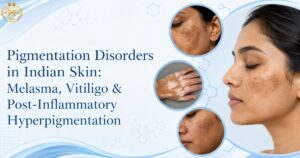
Pigmentation Disorders in Indian Skin: Melasma, Vitiligo & Post-Inflammatory Hyperpigmentation
Presentation, general management principles, and referral thresholds for the three pigmentation concerns doctors see most often in Fitzpatrick IV–VI skin.
Most dermatology textbooks and international guidelines are written from research conducted primarily on lighter skin types. This creates a genuine gap for doctors practising in India, where the vast majority of patients fall into Fitzpatrick skin types IV through VI. Pigmentation disorders — melasma, vitiligo, and post-inflammatory hyperpigmentation — don’t just look different in darker skin. They behave differently, respond differently to treatment, and carry a different psychosocial weight.
This guide covers how these three conditions present specifically in Indian skin, general management principles, and when referral to a dermatologist is warranted.
Why Pigmentation Disorders Present Differently in Indian Skin
Skin of colour — generally defined as Fitzpatrick types IV through VI — has a higher baseline melanocyte activity than lighter skin types. This means the same inflammatory trigger that might cause temporary redness in fair skin often produces visible, sometimes persistent pigmentation change in darker skin.
This has two practical consequences that shape everything else in this guide. First, pigmentation disorders in Indian patients tend to be more visually prominent and psychologically distressing, because pigmentary change is more noticeable against darker skin. Second, treatments that work well in Fitzpatrick I–III skin carry meaningfully higher risk in IV–VI skin. Laser and light-based treatments in particular carry a documented higher risk of triggering post-inflammatory hyperpigmentation when used in darker skin types, which is why treatment protocols need to be adapted rather than directly transferred from Western dermatology literature.
Understanding this distinction is the starting point for managing all three conditions covered below.
Melasma: Presentation, Triggers, General Management
Melasma is one of the most common pigmentation complaints in Indian dermatology clinics, disproportionately affecting women, though it does occur in men as well. It presents as symmetrical, brownish-grey patches typically on the cheeks, forehead, upper lip, and chin.
Common Triggers
Sun exposure is the single most consistent aggravating factor, made worse by India’s high UV index for most of the year. Hormonal factors — pregnancy, oral contraceptives, hormone replacement therapy — are strongly associated triggers, which is why melasma is sometimes referred to as the “mask of pregnancy.” Genetic predisposition plays a role too; a family history of melasma is common among affected patients.
General Management Principles
Photoprotection is the foundation of any melasma management plan, and it isn’t optional — without consistent sun protection, other treatments have limited durability. Broad-spectrum sunscreen with both UVA and UVB coverage, reapplied through the day, is a baseline recommendation for every patient.
Topical depigmenting agents are typically first-line treatment, used under proper dermatological guidance to balance efficacy against irritation risk, since irritation itself can worsen pigmentation in darker skin.
Procedural treatments such as chemical peels and laser therapy are generally considered second-line, used after topical approaches have been tried, and require particular caution in Fitzpatrick IV–VI patients due to the elevated risk of triggering post-inflammatory hyperpigmentation as a side effect of the treatment itself. This is a case where the treatment for one pigmentation disorder can inadvertently cause another.
Melasma is a chronic, relapsing condition. Setting realistic expectations with patients early — that the goal is improvement and control rather than permanent cure — prevents frustration and reduces the temptation to pursue aggressive procedural treatments that carry higher risk in darker skin.
Vitiligo: Presentation, Patient Counselling, When to Refer
Vitiligo presents as well-demarcated, depigmented (not hypopigmented) patches caused by autoimmune destruction of melanocytes. In Indian skin, the contrast between depigmented patches and surrounding normal skin is stark, which makes the condition highly visible and, in many cases, socially significant in ways that go well beyond the medical impact.
Recognising Vitiligo
Vitiligo typically appears first on the face, hands, feet, and areas prone to friction or trauma — a phenomenon known as the Koebner response, where new lesions develop at sites of skin injury. Patches are usually symmetrical and can be segmental (following a specific body region) or non-segmental (widespread and progressive). Unlike post-inflammatory hyperpigmentation or melasma, vitiligo patches lack all pigment rather than simply appearing lighter.
Patient Counselling
Vitiligo carries disproportionate social stigma in the Indian context, sometimes affecting marriage prospects, social participation, and mental health. Effective counselling addresses this reality directly rather than only the dermatological aspect. Patients benefit from understanding that vitiligo is not contagious, not related to poor hygiene, and not caused by anything the patient did.
Setting expectations around treatment timelines matters as much as the treatment itself. Repigmentation, when it occurs, is a slow process measured in months, not weeks, and outcomes vary considerably by body site — the face tends to respond better than hands and feet.
When to Refer
Any patient with suspected vitiligo warrants dermatology referral for confirmation and to rule out differential diagnoses such as pityriasis versicolor or post-inflammatory hypopigmentation, which can appear similar to an untrained eye. Rapidly progressive disease, involvement of exposed areas (face, hands) with significant psychosocial distress, and paediatric onset are all situations that benefit from earlier specialist involvement, given the range of treatment options — topical, phototherapy-based, and in select cases procedural — that a dermatologist can offer.
Post-Inflammatory Hyperpigmentation: The Most Under-Discussed Condition
Of the three conditions in this guide, post-inflammatory hyperpigmentation (PIH) receives the least dedicated attention in general dermatology education, despite being extremely common in Indian clinical practice. PIH occurs when any skin inflammation — acne, eczema, insect bites, trauma, or a cosmetic procedure — triggers excess melanin production during the healing process, leaving a darker mark behind after the original problem resolves.
Why PIH Is More Common and More Persistent in Darker Skin
Because darker skin has more active melanocytes, almost any inflammatory skin event carries a real risk of leaving pigmented marks behind. This is true of common conditions doctors see daily — acne, insect bites, eczema flares, even minor cuts and abrasions. Published research on PIH cases in skin-of-colour populations shows a large proportion occurring in patients with Fitzpatrick type III and IV skin, with trauma and cosmetic procedures like laser therapy and chemical peels as leading precipitating factors — a pattern that maps closely onto Indian clinical practice, where acne-related PIH in particular is one of the most frequent presenting complaints.
General Management Approach
The most important management principle for PIH is prevention rather than treatment — controlling the underlying inflammatory condition (treating acne effectively, for instance) reduces the chance of PIH developing in the first place. Once PIH has developed, most cases resolve gradually on their own over months, though the timeline is often longer than patients expect and longer than in lighter skin types.
Consistent sun protection is essential during the resolution period, since UV exposure prolongs and worsens PIH significantly. Topical lightening agents can help accelerate the process in appropriate candidates, again under dermatological guidance given the same irritation-to-pigmentation risk noted with melasma treatment.
Procedural interventions such as lasers and peels can help but require particular caution, since these very treatments are among the most common triggers of new PIH when used aggressively or inappropriately in darker skin. This is the central irony general physicians should understand: the treatment can become the disease.
Sun Protection and Indian Climate Considerations
Sun protection deserves its own discussion because it underpins the management of all three conditions above, and India’s climate makes it both more important and more challenging than in temperate regions.
Most of India experiences high UV index levels for the majority of the year, not just during summer months. This means “seasonal” sun protection advice common in Western dermatology guidance doesn’t translate well — Indian patients generally need consistent, year-round photoprotection.
Practical adherence is a genuine challenge. Heat and humidity make heavier sunscreen formulations uncomfortable for daily wear, and outdoor occupational exposure is common. Recommending lightweight, non-greasy formulations and practical measures like broad-brimmed hats, umbrellas during peak UV hours, and seeking shade tends to improve compliance more than sunscreen instruction alone.
There’s also a common misconception worth addressing directly with patients: darker skin does offer some natural UV protection compared to lighter skin, but this is nowhere near sufficient to prevent pigmentation disorders, and it does not eliminate the need for sunscreen.
Psychosocial Impact and Patient Communication
Pigmentation disorders are frequently dismissed as purely cosmetic concerns, but this framing undersells their real impact, particularly in a cultural context where skin tone carries significant social weight. Melasma affects self-confidence and, for some patients, professional presentation. Vitiligo can affect marriage prospects, social participation, and mental health, especially when it appears on visible areas at a young age. PIH, while typically temporary, can still cause meaningful distress during the resolution period, especially in patients already managing acne-related self-consciousness.
A few communication principles help across all three conditions. Acknowledge the visible impact rather than minimising it — telling a patient “it’s just cosmetic” often reads as dismissive of a genuine concern. Set realistic timelines early, since most pigmentation disorders improve gradually rather than resolving quickly, and mismatched expectations are a leading cause of patients seeking aggressive, higher-risk treatments or falling for unregulated over-the-counter products.
For patients showing signs of significant psychological distress — social withdrawal, anxiety specifically tied to their skin condition, or depressive symptoms — a mental health referral alongside dermatological care is appropriate and should not be treated as a separate, lower-priority concern.
Frequently Asked Questions
How can I tell melasma apart from post-inflammatory hyperpigmentation?
History is usually the most reliable differentiator. Melasma tends to be symmetrical, appears gradually without a preceding skin injury, and is strongly linked to sun exposure and hormonal factors. PIH almost always has an identifiable preceding event — acne, a cut, an insect bite, a procedure — and the pigmentation follows the exact shape and location of that original lesion.
Is vitiligo the same as leukoderma?
Leukoderma is a general term for skin depigmentation from any cause. Vitiligo is a specific autoimmune condition and one of many possible causes of leukoderma. Other causes include chemical leukoderma, post-inflammatory hypopigmentation, and certain infections. This distinction matters because treatment approaches differ significantly, which is why accurate diagnosis before treatment is important.
Can these conditions be completely cured?
Melasma is generally a chronic, relapsing condition managed rather than cured, particularly since sun exposure and hormonal triggers are often ongoing. PIH typically resolves on its own over time, though the timeline varies. Vitiligo outcomes vary considerably — some patients achieve significant repigmentation, others see partial response, and disease course can be unpredictable. Setting these expectations accurately from the first consultation prevents frustration later.
Why do treatments that work well in Western dermatology sometimes cause problems in Indian patients?
Much of the published dermatology literature and many treatment protocols were developed and tested primarily on Fitzpatrick I–III skin. Higher melanocyte activity in Fitzpatrick IV–VI skin means the same laser settings, peel concentrations, or aggressive treatment approaches carry meaningfully higher risk of triggering post-inflammatory hyperpigmentation. This is precisely why skin-of-colour-specific training and experience matter for doctors treating Indian patients.
Build Expertise in Skin-of-Colour Dermatology
Managing pigmentation disorders confidently requires training specific to the presentations, risks, and treatment nuances seen in Indian skin. MGA’s Fellowship in Dermatology builds this expertise for doctors ready to deepen their clinical practice.
Related Guides in This Series
→ Dermatology After MBBS: Career and Specialization Guide
→ Steroid-Modified Tinea in India: The Silent Epidemic
→ Eczema vs Psoriasis vs Fungal Rash: A Differential Diagnosis Guide
Closing Thoughts
Melasma, vitiligo, and post-inflammatory hyperpigmentation are among the most common reasons Indian patients seek dermatological care, yet they remain underserved by dermatology education that leans heavily on research from lighter skin populations. Recognising how these conditions present, behave, and respond to treatment differently in Fitzpatrick IV–VI skin isn’t a niche consideration — for doctors practising in India, it’s the clinical reality of daily practice.
Beyond the clinical management, these conditions carry a psychosocial weight that deserves equal attention. Patients navigating visible pigmentation changes are often dealing with more than a skin condition — thoughtful, honest communication is as much a part of good care as the treatment plan itself.
This article is intended for medical professionals and provides general educational information on pigmentation disorders in skin of colour. It does not constitute clinical advice, treatment protocols, or diagnostic recommendations. Specific treatment decisions, including medication selection and dosing, should be based on individual patient assessment by a qualified dermatologist.