
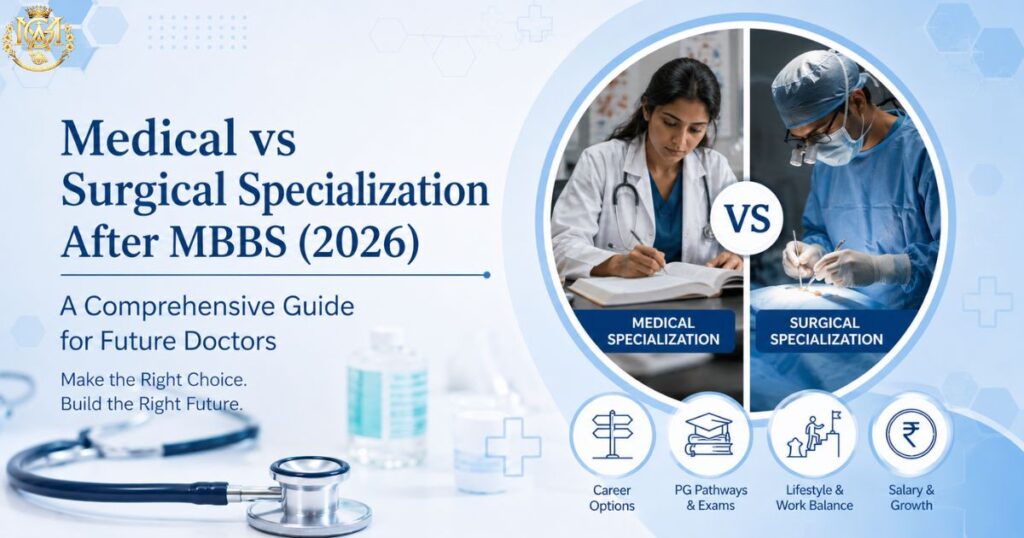
The choice comes down to temperament, not difficulty or prestige. If you enjoy diagnosing and managing conditions over time — often without an immediately visible endpoint — a physician-track (MD) branch usually fits better. If you're drawn to procedures with a defined intervention and a faster feedback loop on outcomes, a surgical-track (MS) branch typically fits better.
This is a different question from MD vs MS vs DNB, which compares qualification structure. This guide compares the clinical mindset each path actually demands.
Before you narrow down to a specific specialty, there's a more fundamental fork almost every MBBS graduate faces: do you want to be the doctor who diagnoses and manages, or the doctor who operates? This decision — physician track versus surgical track — usually comes earlier than "which specific specialty," and it shapes your entire training experience, day-to-day work pattern, and long-term career rhythm.
This guide compares the two paths honestly: what physician training actually looks like day-to-day, what surgical training actually looks like, the stress profile each demands, and a set of reflective questions to help you figure out which one genuinely fits you — not which one sounds more impressive at a family gathering.
The Fundamental Question: Diagnose & Manage, or Operate?
At its core, physician branches (MD) and surgical branches (MS) ask something different of you as a doctor.
Physician medicine is built around diagnostic reasoning over time. You gather evidence, form a working diagnosis, start a treatment plan, and then watch how the patient responds — often adjusting your approach across multiple visits or admissions. The endpoint is frequently gradual: a chronic condition brought under control, a complex diagnosis eventually confirmed, a patient stabilised and monitored rather than "fixed" in a single moment.
Surgery is built around decisive, procedural intervention. You assess, plan an operative approach, and then physically correct the problem — with a defined start and end to that specific intervention. The feedback loop is faster: you generally know within hours or days whether the operation achieved what it set out to do, even though full recovery and follow-up still take time.
Neither mindset is "harder" or more valuable than the other. They're different cognitive and emotional skill sets — sustained uncertainty tolerance versus decisive action under pressure — and most doctors are naturally more drawn to one than the other well before they can articulate why.
What Physician (MD) Training Actually Looks Like Day-to-Day
A typical day in physician-track training centres on wards and outpatient clinics rather than an operating theatre. Morning ward rounds involve reviewing each patient's overnight status, adjusting medications, and discussing evolving differential diagnoses with senior faculty. Outpatient department sessions bring a steady stream of new and follow-up patients, each requiring careful history-taking and clinical reasoning.
Diagnostic work is central: interpreting lab results, imaging, and clinical signs together to build and refine a diagnosis, sometimes over several days or weeks as the picture becomes clearer. Treatment is rarely "one and done" — it's titrated, monitored, and adjusted based on response. Physician trainees also typically carry a heavier academic and research load, since MD programmes place strong emphasis on dissertation work and structured case discussion.
The physical demands are real but different from surgery — long hours on your feet during rounds, but less of the sustained standing and manual precision that operating requires. The mental demand is sustained: holding multiple evolving cases in your head simultaneously, often across different organ systems.
What Surgical (MS) Training Actually Looks Like Day-to-Day
Surgical training revolves around the operating theatre, though it involves far more than just operating. Pre-operative assessment — confirming diagnosis, planning the surgical approach, discussing risks with the patient — happens before every case. Trainees progress gradually from observing to assisting to performing increasing portions of procedures under supervision.
Post-operative management is just as central as the operation itself: monitoring for complications, managing pain and wound care, and making judgment calls about when a patient is ready for discharge. Emergency and on-call surgical work adds genuine unpredictability — trauma, obstructed labour, or an acute abdomen doesn't wait for a convenient time, and surgical residents are trained to respond decisively regardless of the hour.
Morbidity and mortality conferences are a defining feature of surgical training — structured, often uncomfortable discussions where complications are reviewed openly to improve future practice. Physically, surgical training is demanding in a specific way: extended periods standing during long operations, precise manual dexterity under time pressure, and the stamina to remain sharp through emergency cases at any hour.
Common MD Branches vs Common MS Branches
Both tracks include a wide range of specific specialities, but a few branches illustrate the pattern clearly.
General Medicine, Dermatology, Radiology, Paediatrics, Psychiatry, Pathology, and Anaesthesiology. Focus: diagnosis, medical management, and longitudinal care within a defined system or across multiple systems.
General Surgery, Orthopaedics, ENT (Otolaryngology), Obstetrics & Gynaecology, and Ophthalmology. Focus: operative correction, procedural skill, and defined clinical interventions.
A few branches sit closer to the boundary — Obstetrics & Gynaecology, for instance, combines substantial medical management (antenatal care, hormonal conditions) with genuine operative work (deliveries, gynaecological surgery), which is worth considering if you're drawn to elements of both tracks.
Stress Profile & Decision-Making Style — Which Fits You?
The two paths don't just differ in daily tasks — they demand different relationships with stress and decision-making.
Physician-track stress tends to be sustained and diffuse. You're often managing several evolving cases simultaneously, holding uncertainty for days or weeks while a diagnosis becomes clearer, and making incremental decisions that compound over time. The emotional weight comes from ongoing responsibility for complex, sometimes ambiguous situations rather than a single high-stakes moment.
Surgical-track stress tends to be acute and intense. A difficult intraoperative moment demands immediate, decisive action — there's often no time to "sleep on it." The emotional weight comes from split-second consequential decisions and the direct, visible link between your hands and the outcome.
A useful gut-check: does uncertainty that unfolds gradually feel like an interesting puzzle to you, or a source of frustration? Do you want the ability to intervene immediately when something goes wrong, or are you comfortable adjusting a plan over the following days? Your honest answer says more about which track fits than any ranking of prestige or income ever will.
Self-Assessment Questions Before You Decide
Rather than a quiz, sit with these questions honestly — ideally after a few different internship rotations, once you've actually experienced both environments rather than imagined them.
- When you see a complex case on the ward, are you more energised by tracing the diagnosis, or by picturing the procedure that would fix it?
- Do you enjoy building long-term relationships with patients, or do you prefer a defined beginning and end to your involvement in a case?
- How do you genuinely feel about standing for hours in an operating theatre, compared with sitting through detailed case discussions and chart reviews?
- Does a diagnosis that evolves gradually over several visits feel like an interesting puzzle, or does it frustrate you?
- When something goes wrong, do you want the immediate, direct ability to intervene right then — or are you comfortable adjusting a treatment plan over subsequent visits?
- Which of your internship rotations did you find yourself staying late for out of genuine interest, not obligation?
If your answers point consistently in one direction, that's meaningful signal. If they're mixed, branches that blend both — like Obstetrics & Gynaecology, or even Emergency Medicine, which sits somewhat outside this MD/MS framework entirely — are worth exploring specifically because they don't force a hard either/or.
Frequently Asked Questions
Whether you lean physician or surgical, MGA's Fellowship, PG Diploma, and Certificate Programs help you build focused clinical expertise across high-demand specialties — structured around evening live classes so you can continue practising while you learn.
This article offers general guidance on the physician-versus-surgical decision for MBBS graduates in India. Individual experience varies by institution, department culture, and specific specialty. Seat availability, competitiveness, and training structure should be confirmed against current NEET-PG and institutional data before finalising your decision.
Which Post-MBBS Course Format Is Right for You?
Answer three quick questions and we'll match you to the format that fits your goals — Certificate, PG Diploma, or Fellowship.