
Medical Global Academy

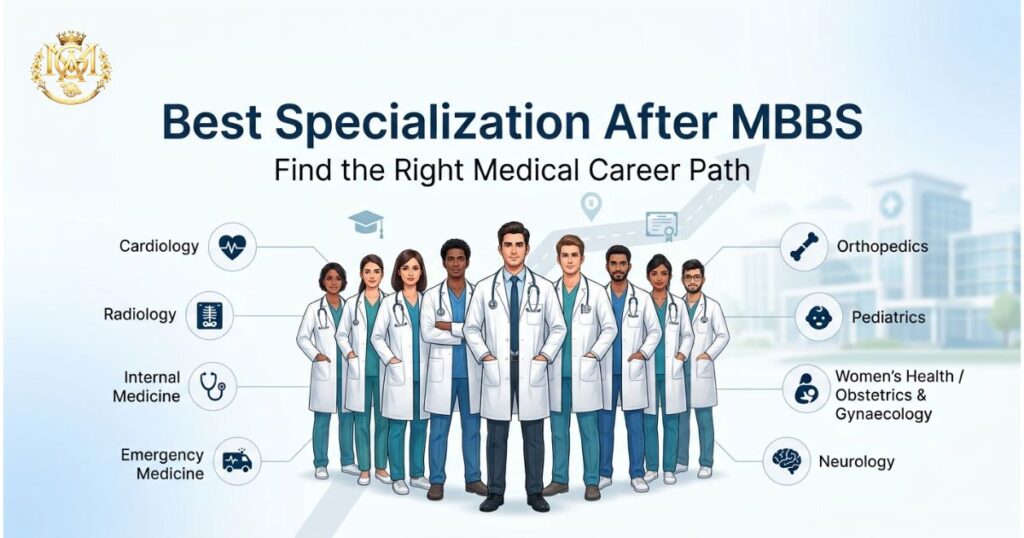
Best Specialization After MBBS in India

Best Specialization After MBBS in India

Best Specialization After MBBS in India (Complete Career Guide)

Choosing the best specialization after MBBS is one of the most important career decisions for any medical graduate. While an MBBS degree provides the foundation to practice medicine, specialization allows doctors to develop advanced expertise in a particular field, improve patient outcomes, and build rewarding long-term careers.

Today, healthcare is evolving rapidly. Advancements in diagnostic technologies, minimally invasive procedures, precision medicine, and multidisciplinary patient care have increased the demand for highly skilled medical specialists across India. Whether your interest lies in medicine, surgery, diagnostics, emergency care, or advanced clinical procedures, selecting the right specialization can significantly shape your professional journey.

However, choosing a specialty should never be based solely on salary or popularity. Factors such as clinical interest, lifestyle preferences, future demand, patient interaction, procedural work, and long-term career goals all play an important role in finding the right path.

In this guide, we’ll explore the most popular medical specializations courses after MBBS, compare career opportunities, discuss salary prospects, and help you understand which specialty may be the best fit for your future.

What is Medical Specialization After MBBS?

Medical specialization is the process of pursuing advanced education and clinical training in a specific branch of medicine after completing MBBS. Instead of practicing general medicine, doctors develop expertise in diagnosing and treating conditions related to a particular organ system, patient population, or medical discipline.

Specialization is typically pursued through postgraduate programs such as MD (Doctor of Medicine), MS (Master of Surgery), DNB (Diplomate of National Board), and later through super speciality courses or fellowship programs for further clinical expertise.

For example, a doctor interested in heart diseases may specialize in Internal Medicine before pursuing Cardiology, while another doctor passionate about women’s healthcare may choose Obstetrics & Gynaecology. Similarly, those interested in imaging may specialize in Radiology, whereas surgeons may pursue General Surgery, Orthopedics, or ENT.

Medical specialization allows doctors to provide focused patient care while building expertise in their chosen field.

Why Should You Choose a Specialization After MBBS?

Many MBBS graduates ask the same question:

“After MBBS, what next?”

While practicing as a general physician is one option, specialization opens the door to broader career opportunities and advanced clinical practice.

Choosing the right specialization helps doctors:

  • Develop expertise in a specific medical field.
  • Manage complex patient conditions with greater confidence.
  • Improve career opportunities in hospitals and healthcare institutions.
  • Build stronger academic and research profiles.
  • Increase long-term earning potential.
  • Stay aligned with evolving medical technologies and treatment protocols.

More importantly, specialization enables doctors to practice the branch of medicine they genuinely enjoy. Whether you prefer surgery, emergency care, diagnostics, preventive medicine, or long-term patient management, selecting the right specialty creates a fulfilling and sustainable medical career.

Types of Medical Specializations After MBBS

After completing MBBS, doctors can choose from a wide range of medical specialties based on their interests, clinical skills, and long-term career goals. Broadly, these specializations can be divided into three categories.

Category Focus Area Examples
Clinical Specializations Diagnosis and medical treatment Internal Medicine, Dermatology, Pediatrics
Surgical Specializations Operative and procedural care General Surgery, Orthopedics, ENT, Obstetrics & Gynaecology
Diagnostic & Imaging Specializations Disease diagnosis and interpretation Radiology, Pathology

Each specialization offers unique learning opportunities, patient interactions, and career pathways. Understanding these differences can help you make an informed decision before pursuing postgraduate medical education.

Top Medical Specializations After MBBS

Every medical specialty has its own scope, challenges, and career opportunities. Rather than asking which specialization is “best,” it’s more useful to understand which field aligns with your interests and future aspirations.

Cardiology

Cardiology is one of the most sought-after medical specialties, focusing on the prevention, diagnosis, and treatment of heart and blood vessel disorders. With the rising burden of cardiovascular diseases in India, trained cardiologists continue to be in high demand across hospitals and specialty heart institutes.

Doctors interested in procedures such as angiography, angioplasty, and advanced cardiac interventions often pursue Interventional Cardiology after postgraduate training.

Best for doctors who enjoy:

  • Critical patient care
  • Cardiac procedures
  • Long-term patient management
  • Technology-driven medicine

Related Program: Fellowship in Cardiology

Radiology

Radiology combines medicine with advanced imaging technologies to diagnose and monitor diseases. Modern radiologists work closely with almost every medical department by interpreting X-rays, CT scans, MRI, ultrasound, and other imaging studies.

The field has expanded significantly with the growth of Interventional Radiology, where specialists perform minimally invasive procedures using image guidance.

Best for doctors who enjoy:

  • Diagnostic medicine
  • Medical imaging
  • Technology
  • Precision-based decision making

Related Program: Fellowship in Radiology

Dermatology

Dermatology focuses on diseases affecting the skin, hair, and nails. In addition to managing medical skin conditions, dermatologists are increasingly involved in aesthetic medicine, cosmetic dermatology, and laser-based procedures.

Growing awareness of skin health has made dermatology one of the most competitive and rewarding specialties after MBBS.

Best for doctors who enjoy:

  • Outpatient practice
  • Cosmetic procedures
  • Long-term patient care
  • Lifestyle-friendly practice

Related Program: Fellowship in Dermatology

Emergency Medicine

Emergency Medicine is designed for doctors who thrive in fast-paced clinical environments. Specialists manage trauma cases, cardiac emergencies, poisoning, stroke, and other life-threatening conditions that require immediate intervention.

Strong decision-making skills, teamwork, and the ability to remain calm under pressure are essential for this specialty.

Best for doctors who enjoy:

  • Acute patient care
  • Fast clinical decisions
  • Trauma management
  • Emergency procedures

Related Program: Fellowship in Emergency Medicine

Critical Care Medicine

Critical Care specialists manage seriously ill patients admitted to Intensive Care Units (ICUs). They work with ventilators, advanced monitoring systems, organ support therapies, and multidisciplinary teams to provide comprehensive care for critically ill patients.

As tertiary care hospitals continue to expand, the demand for Critical Care specialists is steadily increasing.

Best for doctors who enjoy:

  • ICU practice
  • Advanced monitoring
  • Multidisciplinary teamwork
  • Managing complex medical cases

Related Program: Fellowship in Critical Care

Obstetrics & Gynaecology

Obstetrics & Gynaecology is one of the most diverse specialties in medicine, combining medical management, surgery, reproductive health, and preventive women’s healthcare. The field now extends beyond pregnancy and childbirth into subspecialties such as infertility management, fetal medicine, reproductive medicine, gynecologic oncology, urogynecology, and minimally invasive gynecologic surgery.

For doctors passionate about women’s health, it offers excellent opportunities for both clinical practice and further subspecialization.

Urology

Urology specializes in disorders affecting the urinary tract and male reproductive system. Urologists perform both medical and surgical management of kidney stones, prostate disorders, urinary tract diseases, and urological cancers.

Advances in laparoscopic and robotic surgery have made urology one of the fastest-evolving surgical specialties.

Related Program: Fellowship in Urology

Pathology

Pathology forms the foundation of modern medical diagnosis. Pathologists examine blood samples, tissues, biopsies, and laboratory investigations to help clinicians accurately diagnose diseases and guide treatment decisions.

Although patient interaction is limited compared to other specialties, pathology plays a critical role in every healthcare system.

Related Program: Fellowship in Pathology

Highest Paying Medical Specializations in India

While salary should never be the only factor when choosing a specialty, it often influences career planning. If you’re comparing the Doctor Salary in India across different specialties, remember that income varies based on experience, hospital type, city, subspecialization, and private practice.

Specialization Average Annual Salary*
Cardiology ₹20–50+ LPA
Radiology ₹18–40+ LPA
Dermatology ₹15–35+ LPA
Orthopedics ₹18–40+ LPA
Neurosurgery ₹25–60+ LPA
Obstetrics & Gynaecology ₹15–35+ LPA
Emergency Medicine ₹12–25+ LPA
Critical Care ₹15–30+ LPA

Salary ranges are approximate and may vary depending on qualifications, experience, location, employer, and private practice.

Although specialties such as Cardiology and Neurosurgery often command higher salaries, long-term success depends on clinical expertise, continuous learning, and the quality of patient care rather than income alone.

MD vs MS vs DNB – Which Should You Choose?

After MBBS, one of the biggest decisions doctors face is choosing between MD, MS, and DNB. All three are recognized postgraduate qualifications, but they differ in training environments and career pathways.

Qualification Best For Common Specialties
MD (Doctor of Medicine) Non-surgical specialties General Medicine, Dermatology, Radiology, Pediatrics
MS (Master of Surgery) Surgical specialties General Surgery, Orthopedics, ENT, Obstetrics & Gynaecology
DNB (Diplomate of National Board) Clinical & surgical specialties in accredited hospitals General Medicine, Surgery, Neurosurgery, Radiology

Doctors interested in physician-based specialties generally pursue MD, while those passionate about surgery often choose MS. DNB offers an alternative postgraduate pathway with training in accredited hospitals and is widely recognized across India.

Rather than asking “Which is better?”, focus on selecting the qualification that aligns with your preferred specialty and long-term career goals.

Which Specialization Has the Highest Future Scope?

Healthcare is constantly evolving, creating new opportunities for specialists with advanced clinical expertise. Some fields are experiencing particularly strong growth due to changing disease patterns, technological advancements, and increasing patient awareness.

Some of the fastest-growing medical specialties include:

  • Cardiology – Driven by the increasing prevalence of cardiovascular diseases.
  • Radiology – Rapid advancements in diagnostic imaging and Interventional Radiology.
  • Dermatology – Rising demand for both clinical and aesthetic skin care.
  • Emergency Medicine & Critical Care – Expansion of trauma centres and intensive care units.
  • Obstetrics & Gynaecology – Growing focus on infertility, fetal medicine, and women’s health.
  • Pathology – Increasing role in precision medicine and laboratory diagnostics.

As medicine becomes more specialized, doctors who continue learning through fellowship programs and advanced clinical training are often better prepared for future healthcare challenges.

Which Specialization is Best for You?

There is no single “best” specialization after MBBS. The right choice depends on your interests, strengths, lifestyle preferences, and the type of patients you want to treat.

Use this simple guide to narrow your options:

If You Enjoy… Consider Specializing In
Heart diseases & procedures Cardiology
Diagnostic imaging & technology Radiology
Skin, hair & cosmetic care Dermatology
Emergency & trauma care Emergency Medicine
Intensive care management Critical Care
Women’s healthcare Obstetrics & Gynaecology
Surgical procedures General Surgery or Urology
Disease diagnosis & laboratory medicine Pathology

Remember, the most successful doctors are those who genuinely enjoy their specialty and remain committed to continuous learning throughout their careers.

Advance Your Career with Fellowship Programs

Choosing a medical specialization is only the beginning of your professional journey. As healthcare advances, fellowship programs provide doctors with an opportunity to gain focused expertise, refine clinical skills, and stay updated with modern medical practices.

Medical Global Academy offers fellowship programs across several high-demand specialties to help doctors continue their professional development after choosing their area of interest.

Explore Fellowship Programs

Each program is designed to strengthen clinical knowledge through structured learning, expert mentorship, and practical exposure, helping doctors build confidence in their chosen specialty.

Frequently Asked Questions

  1. Which specialization is best after MBBS?

    The best specialization depends on your clinical interests, career goals, and preferred lifestyle. Popular choices include Cardiology, Radiology, Dermatology, Emergency Medicine, Obstetrics & Gynaecology, and Internal Medicine.

  2. Which doctor earns the highest salary in India?

    Highly specialized doctors such as Cardiologists, Neurosurgeons, Orthopedic Surgeons, Radiologists, and Cardiothoracic Surgeons are among the highest-paid medical professionals. Actual earnings depend on experience, hospital, city, and private practice.

  3. Which specialization has the highest demand?

    Cardiology, Radiology, Emergency Medicine, Critical Care, Dermatology, Obstetrics & Gynaecology, and Internal Medicine continue to experience strong demand due to changing healthcare needs and an increasing patient population.

  4. MD or MS – Which is better?

    Neither qualification is universally better. MD is suitable for non-surgical specialties, while MS is intended for surgical branches. The better option depends on the specialty you wish to pursue.

  5. DNB or MD – Which should I choose?

    Both qualifications are recognized in India. Your decision should depend on your preferred training environment, specialty, and career objectives rather than the qualification name alone.

  6. Which specialization is best for female doctors?

    There is no specialty restricted by gender. Many female doctors excel in Obstetrics & Gynaecology, Dermatology, Radiology, Pediatrics, Internal Medicine, Cardiology, and numerous surgical specialties.

  7. Which specialization has the best work-life balance?

    Dermatology, Radiology, Pathology, and certain outpatient-focused specialties are often associated with more predictable schedules. However, work-life balance varies depending on the workplace and individual practice.

Final Thoughts

Choosing the best specialization after MBBS is one of the most significant decisions in a doctor’s career. Rather than following trends or salary expectations alone, focus on selecting a specialty that aligns with your interests, strengths, and long-term professional aspirations.

Medicine offers countless opportunities for growth, and every specialization contributes uniquely to patient care. Once you’ve identified your preferred field, pursuing structured postgraduate education and fellowship training can further strengthen your clinical expertise and open new career opportunities.

Whether you aspire to become a cardiologist, radiologist, dermatologist, emergency physician, surgeon, or women’s health specialist, continuous learning remains the foundation of a successful medical career.


Leave a Comment

Your email address will not be published. Required fields are marked *

Scroll to Top