
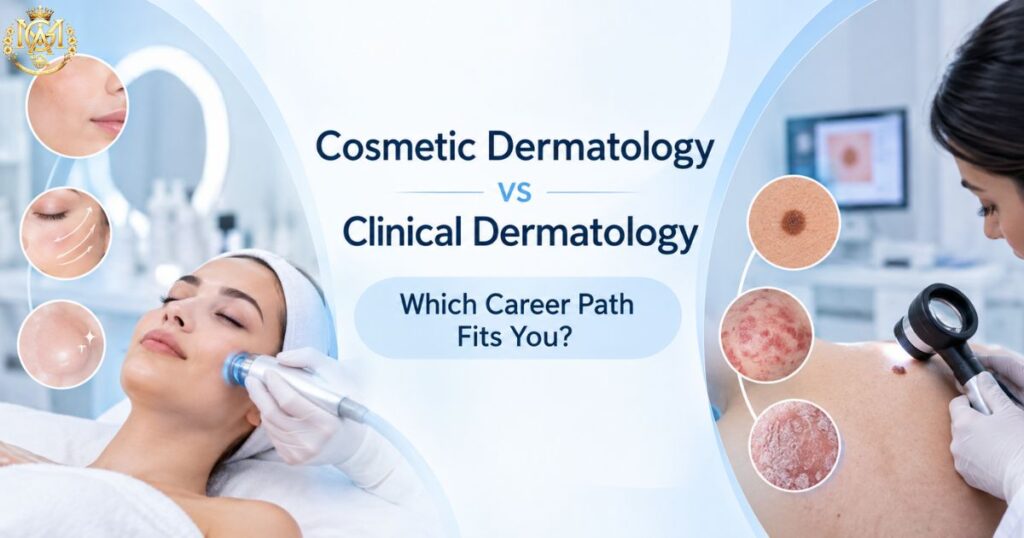
Both are tracks within dermatology — practised by the same MD Dermatology (or DNB) qualified, registered doctors. Clinical (medical) dermatology diagnoses and treats skin disease: eczema, psoriasis, infections, and cancer screening. Cosmetic dermatology addresses appearance-driven, largely elective concerns: lasers, fillers, chemical peels, and hair restoration. Neither requires a separate medical degree from the other — the divergence happens through the additional skills and focus a dermatologist chooses to build after qualifying.
They're also both distinct from "cosmetology" as a standalone field, which is not a medical qualification — more on that below.
If you're a dermatology-track doctor — or considering becoming one — you've likely noticed the field splits into two very different daily realities. One dermatologist spends their morning managing a chronic eczema flare and screening a suspicious mole. Another spends theirs performing laser resurfacing and discussing filler placement with a patient who has no underlying skin condition at all. Same qualification, genuinely different careers.
This guide compares cosmetic and clinical dermatology honestly — day-to-day work, training requirements, patient interactions, and which kind of doctor tends to thrive in each — without pushing you toward either.
Two Distinct Tracks Within the Same Specialty
Before comparing them, one clarification matters more than it might seem: cosmetic dermatology is not the same thing as "cosmetology." Cosmetology, as a standalone field, covers non-medical beauty and aesthetic services and does not require a medical degree. Cosmetic dermatology is different — it's practised by doctors who've completed MD Dermatology (or DNB), registered with the Medical Council or National Medical Commission, and then chosen to focus their clinical practice on appearance-driven, largely elective procedures rather than disease management.
This distinction gets blurred surprisingly often in course marketing and career content, where "cosmetology" and "cosmetic dermatology" are sometimes used almost interchangeably. They shouldn't be. Both clinical and cosmetic dermatology, as covered in this guide, require the same underlying medical qualification — the difference is in focus and additional skill-building afterward, not in whether you're a doctor at all.
Why does this matter beyond terminology? Scope of practice. A registered dermatologist performing a laser procedure or injectable treatment is operating within their medical licence, with the clinical training to recognise and manage complications. Aesthetic services offered outside a medical framework don't carry the same accountability structure. For patients, this distinction affects safety. For doctors considering a cosmetic-leaning career, it's worth understanding clearly — you're not choosing between "medicine" and "cosmetology," you're choosing which patients and which kind of medical practice you want to build within dermatology.
What Clinical (Medical) Dermatology Practice Looks Like Day-to-Day
The diagnostic reasoning here resembles other physician-track specialities. It involves building a differential diagnosis, ordering the right tests, and titrating treatment based on response. Clinical dermatologists also carry a genuine public health role. They must recognise when a skin finding signals something more serious, such as a drug reaction or an early malignancy. When that happens, acting on it promptly matters most.
This track also tends to involve more inter-disciplinary work than people expect. A clinical dermatologist regularly liaises with rheumatologists on autoimmune skin manifestations, with paediatricians on childhood eczema and viral exanthems, and with oncology teams on drug-related skin reactions during cancer treatment. The intellectual variety comes from the sheer range of systemic conditions that show up on the skin first — dermatology is sometimes called the specialty where the body's internal problems become externally visible.
What Cosmetic / Aesthetic Dermatology Practice Looks Like Day-to-Day
Cosmetic dermatology practice looks and feels different from the first consultation onward. Patients typically don't have an underlying disease. Instead, they're seeking specific aesthetic outcomes — smoother skin, reduced signs of ageing, hair restoration, or scar improvement. A typical day might include laser treatments, chemical peels, and botulinum toxin or filler procedures. Follow-up is structured around results and patient satisfaction rather than disease resolution.
The clinical skill required is genuinely different in emphasis. It calls for precise procedural technique, an aesthetic eye for facial proportion and symmetry, and the ability to manage patient expectations about realistic outcomes. Building a practice around elective procedures also means engaging with the business side of medicine. That's more direct than most clinical dermatology roles require — pricing, patient acquisition, and repeat-visit relationships.
The pace of this track also differs. Cosmetic dermatology sits closer to a rapidly evolving technology field than most of medicine — new laser platforms, injectable formulations, and energy-based devices arrive regularly, and staying current requires ongoing, deliberate learning beyond what a medical degree alone provides. Doctors who enjoy this track often describe it as intellectually engaging in a different way from disease management: less about ruling out serious pathology, more about technical mastery and consistently delivering a result the patient can see and feel confident about.
Training & Skill Requirements: Where They Diverge
Both tracks start from the identical base: MBBS, followed by MD or DNB Dermatology, Venereology & Leprosy, followed by registration to practise. Neither track requires — or is helped by — a separate, non-medical "cosmetology" qualification.
| Aspect | Clinical Track | Cosmetic Track |
|---|---|---|
| Base qualification | MD/DNB Dermatology | MD/DNB Dermatology (same) |
| Core skill built | Diagnostic reasoning, medical management | Procedural precision, aesthetic judgement |
| Common further training | Sub-specialty fellowships (paediatric derm, dermatopathology) | Structured aesthetic/laser procedure training |
| Ongoing learning focus | New disease-management protocols, emerging therapies | New devices, injectable techniques, procedural safety |
Where they genuinely diverge is in what a dermatologist chooses to build after qualifying. A doctor leaning clinical often pursues sub-specialty fellowships or deepens diagnostic expertise. A doctor leaning cosmetic typically seeks structured, procedure-focused training in specific techniques and devices, since procedural confidence and safety are central to that work.
Patient Type & Consultation Style Differences
The consultation itself feels different across the two tracks. Clinical dermatology consultations centre on a presenting complaint, examination findings, and a treatment plan grounded in diagnosis — the conversation is fundamentally medical. Cosmetic consultations centre on the patient's aesthetic goals, realistic expectation-setting, and a discussion of options, cost, and maintenance — the conversation carries more of a consultative, goal-oriented tone.
Neither is more or less "medical" in terms of the underlying qualification required — but the day-to-day communication style, patient relationship, and even the emotional register of the work differ meaningfully. Doctors who enjoy longitudinal, disease-focused relationships often find cosmetic consultations feel transactional by comparison; doctors who enjoy the client-facing, appearance-focused side of cosmetic work sometimes find pure disease management less energising.
Which Path Fits Which Kind of Doctor?
You're energised by working through a differential diagnosis, managing chronic disease over time, and the occasional genuine urgency of catching something serious early.
You enjoy precise procedural work, have an eye for aesthetic detail, and are comfortable with the more consultative, business-adjacent nature of elective practice.
Many dermatologists don't choose exclusively — a mixed practice combining medical dermatology with a cosmetic offering is common, particularly in private practice. The honest starting question is simply which kind of consultation genuinely energises you more, since that's a better predictor of long-term satisfaction than income potential or perceived prestige in either direction.
Frequently Asked Questions
Does cosmetic dermatology pay better than clinical dermatology?▼
What if I'm still not sure which path fits me?▼
That's genuinely common early in training. Structured exposure to both — through rotations, observerships, or a broader fellowship covering both clinical and procedural dermatology — often clarifies the decision more reliably than reasoning about it in the abstract.
Whichever direction genuinely fits you, structured training accelerates the transition from qualified dermatologist to confident practitioner.
Build structured procedural and aesthetic skills with MGA's Certificate in Dermatology.
Certificate in DermatologyDeepen diagnostic and clinical management expertise with MGA's Fellowship in Dermatology.
Fellowship in DermatologyDermatology after MBBS — the complete pillar guide this article is part of
Dermatologist salary in India — what genuinely drives earnings across both tracks
Trichology vs dermatology — another area where medical and non-medical fields get confused
This article provides general career guidance for doctors considering dermatology as a specialty. It does not constitute clinical, procedural, or regulatory advice. Requirements for cosmetic procedure training, certification, and scope of practice can vary and should be verified with the relevant medical council or specialty body before undertaking any procedural work.
Which Post-MBBS Course Format Is Right for You?
Answer three quick questions and we'll match you to the format that fits your goals — Certificate, PG Diploma, or Fellowship.