
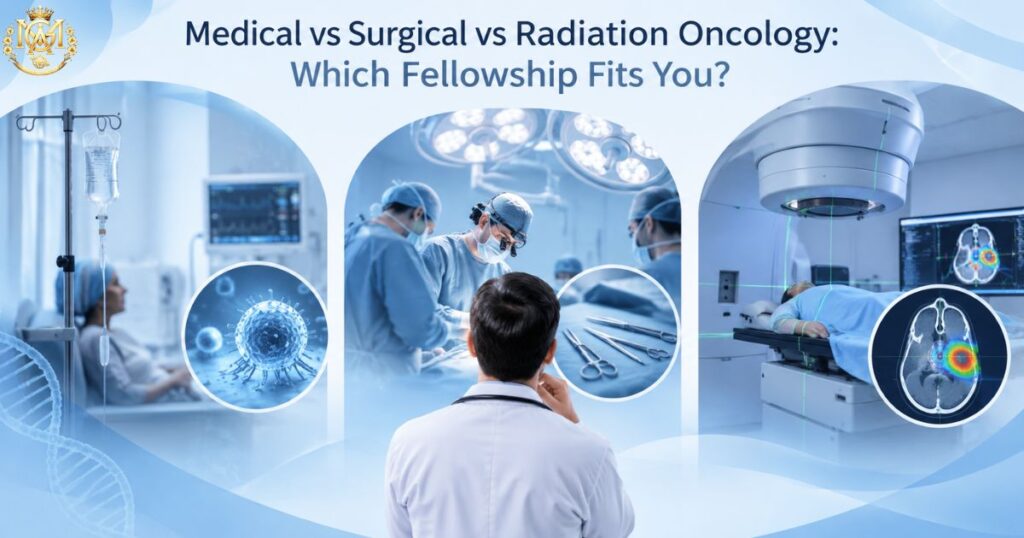
They differ in both clinical approach and where they sit on the qualification ladder. Radiation oncology (MD/DNB Radiotherapy) is a direct-entry specialty from MBBS via NEET-PG. Medical oncology (DM) and surgical oncology (MCh/DrNB) are both super-specialties entered via NEET-SS, requiring an intermediate MD or MS first. A medical vs surgical vs radiation oncology fellowship decision, for most doctors, really comes down to which underlying clinical approach — systemic drug therapy, operative removal, or radiation-based treatment — genuinely interests you.
This guide breaks down all three paths clearly, and points you toward focused fellowship options within each.
Cancer treatment in India rests on three distinct clinical pillars, and most doctor-facing content treats them as a single blur. A medical vs surgical vs radiation oncology fellowship decision isn't just about which sounds more prestigious — it's about which underlying approach to cancer care actually fits how you want to practise medicine, and which formal or fellowship-level pathway gets you there.
This guide walks through what genuinely separates the three, where each sits on India's postgraduate qualification structure, and how to think about fellowship options — including MGA's — within each.
The Three Arms of Oncology: What Actually Separates Them
Every cancer patient's treatment plan typically draws on some combination of three approaches. Medical oncology treats cancer systemically — chemotherapy, targeted therapy, immunotherapy, and hormonal treatments that circulate throughout the body. Surgical oncology removes tumours and affected tissue directly through operative technique. Radiation oncology uses targeted, high-energy radiation to destroy cancer cells in specific areas, either as a primary treatment or alongside surgery and systemic therapy.
What most comparisons miss is that these three paths are not at the same level of India's postgraduate qualification ladder — and that difference matters enormously if you're deciding where to focus.
| Path | Qualification | Entry Level | Route |
|---|---|---|---|
| Radiation Oncology | MD / DNB Radiotherapy | Direct from MBBS | NEET-PG |
| Medical Oncology | DM Medical Oncology | Super-specialty, requires MD/DNB first | NEET-SS |
| Surgical Oncology | MCh / DrNB Surgical Oncology | Super-specialty, requires MS/DNB first | NEET-SS |
Radiation Oncology: The Direct-Entry Path
MD/DNB Radiotherapy is a three-year postgraduate degree entered directly from MBBS through NEET-PG, alongside branches like General Medicine or Paediatrics — there's no intermediate qualification required. Training covers radiation physics, radiobiology, and the clinical management of cancer through radiotherapy, often combined with systemic chemotherapy knowledge.
This is worth knowing precisely because it's the fastest formal route into any of the three oncology arms. It's also, notably, one of the recognised feeder qualifications for DM Medical Oncology later — a doctor can complete MD Radiotherapy and subsequently pursue DM Medical Oncology through NEET-SS if their interest shifts toward systemic therapy.
Medical Oncology: The Systemic Therapy Super-Specialty
DM Medical Oncology is a three-year, NMC-recognised super-specialty entered via NEET-SS. Per NBE's eligibility bulletin, the feeder qualifications are an MD or DNB in General Medicine, Paediatrics, or Radiation Oncology — there's no direct route from MBBS. Training focuses on systemic cancer therapies, oncological emergencies, and supportive and palliative care.
For doctors already holding an eligible MD who want to build oncology-focused knowledge — whether preparing for NEET-SS, exploring the field before committing, or deepening existing practice — a skill-building fellowship in oncology can add real value. MGA's Fellowship in Oncology is designed for exactly this: structured exposure to oncology-focused clinical knowledge. It is not a substitute for DM Medical Oncology and does not confer DM-equivalent specialist status.
Surgical Oncology: The Operative Path and Its Sub-Specialty Fellowships
MCh/DrNB Surgical Oncology is a three-year super-specialty entered via NEET-SS, with feeder qualifications of MS or DNB in General Surgery, Orthopaedics, or Otorhinolaryngology (ENT), depending on the specific sub-specialty track. In practice, surgical oncology itself branches into distinct organ-system sub-specialities — a genuinely different clinical world depending on which tissue and cancer type you focus on.
This is where fellowship-level training becomes especially relevant. For MS-qualified surgeons who want focused, skill-building exposure to a specific surgical oncology sub-specialty — whether exploring interest before pursuing a formal super-specialty route, or deepening existing surgical practice — MGA offers fellowships across five distinct areas:
Focused training in the surgical management of breast malignancies, from diagnosis through reconstructive considerations.
Skill-building in the surgical approach to lung and chest malignancies, including staging and operative planning considerations.
Focused exposure to head and neck cancer surgery, relevant to surgeons from both General Surgery and ENT backgrounds.
Structured knowledge-building in the surgical management of gastrointestinal malignancies.
Focused exposure to the surgical and clinical dimensions of central nervous system tumours.
Each of these fellowships builds focused, skill-based knowledge for eligible doctors within its sub-specialty. None confers MCh- or DrNB-equivalent statutory specialist status — that recognition comes only through the formal super-specialty pathway via NEET-SS.
Which Path Fits Your Interests? A Decision Framework
Precision, physics, and treatment planning. Direct entry from MBBS appeals if you want to commit early without an intermediate MD/MS first.
Longitudinal patient relationships, systemic decision-making, and coordinating a patient's full cancer journey across treatment lines.
Operative technique and a defined, procedural intervention — with the added decision of which organ-system sub-specialty fits your surgical background.
If you're an MBBS graduate deciding early, radiation oncology's direct NEET-PG entry is worth weighing alongside General Medicine or MS branches. If you already hold an eligible MD or MS, the more relevant question is simply which clinical approach — systemic, operative, or radiation-based — you'd rather spend your career practising, since that determines both your super-specialty target and which fellowship, if any, is worth exploring in the meantime.
Frequently Asked Questions
Can I go straight from MBBS into medical or surgical oncology?▼
Does an MGA fellowship count toward DM or MCh eligibility?▼
Can a fellowship help me decide before committing to a super-specialty?▼
Whether your interest leans toward systemic therapy or a specific surgical oncology sub-specialty, MGA's skill-building fellowships help eligible doctors deepen oncology-focused knowledge — as a complement to, not a substitute for, the formal DM/MCh pathway.
Explore Fellowship in OncologyThis article provides general information as of September 2026 on oncology qualification pathways in India. NEET-PG and NEET-SS eligibility criteria, feeder qualifications, and seat availability can change and may vary by institution and cycle. Always verify current requirements directly with NBEMS and the National Medical Commission before making admission decisions. MGA's Fellowship in Oncology and its surgical oncology sub-specialty fellowships are educational programmes only and do not confer DM, MCh, or DrNB-equivalent statutory specialist status.
Which Post-MBBS Course Format Is Right for You?
Answer three quick questions and we'll match you to the format that fits your goals — Certificate, PG Diploma, or Fellowship.