
Acne vulgaris is consistently the most common single dermatological presentation in Indian OPDs. First-line management for a GP spans three tiers based on severity: comedonal acne is primarily a topical retinoid case; mild-to-moderate papulopustular acne adds topical antibacterials; and moderate-to-severe or nodulocystic presentations are the clear trigger for dermatology referral rather than escalation in primary care. Indian skin’s higher baseline melanin content means post-inflammatory hyperpigmentation (PIH) is a clinical concern even in mild acne — this affects both how aggressively you treat active lesions and which agents carry additional pigmentary risk.
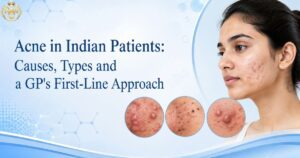
Walk into any dermatology OPD in India and you’ll find acne. Walk into any general practice OPD and you’ll find it too — patients presenting not because they think it’s serious but because they’ve tried three or four over-the-counter products for six months and nothing is working, or because they’re developing scarring they didn’t expect, or because someone told them there’s a tablet that will fix it.
Managing acne in a general practice setting doesn’t require dermatology training to do reasonably well at the first tier. It does require a clinical framework: knowing how to grade what you’re looking at, understanding what first-line management means and does not mean, recognising the patterns that need a dermatologist rather than an escalating course of antibiotics, and being specific about the pigmentation implications that matter more in Indian skin than in many published Western guidelines.
This article covers all of that in a clinical format — for doctors managing acne in OPD, not for patients looking up their symptoms. Doctors who want to build structured dermatology competency beyond this first-line framework can explore MGA’s programmes on dermatology after MBBS.
What this article covers
- Why acne is the most common dermatology presentation in Indian OPDs
- Grading acne severity — comedonal to nodulocystic
- First-line management principles a general physician can apply
- Common prescribing mistakes to avoid
- Acne in Indian skin — pigmentation and scarring considerations
- When to refer to a dermatologist
- Frequently asked questions
Why Acne Is the Most Common Dermatology Presentation in Indian OPDs
Acne vulgaris affects the pilosebaceous unit — the follicle, its associated sebaceous gland, and the surrounding dermal tissue. The four pathophysiological processes driving it are well established: increased sebum production, abnormal follicular keratinisation (comedogenesis), colonisation by Cutibacterium acnes (formerly Propionibacterium acnes), and the resulting inflammatory cascade.
Why it presents so commonly in Indian OPDs specifically comes down to a combination of factors:
- Age demographics: India has a large adolescent and young adult population — precisely the group in which androgen-driven sebum overproduction peaks. Most acne in this group is physiological in mechanism, not a sign of a hormonal disorder requiring investigation.
- Climate: Hot, humid conditions increase sweating and sebum secretion. Tropical acne — a more inflammatory form triggered by heat and humidity — is recognised as a distinct clinical variant, and overlaps substantially with the presentations seen in Indian summer months.
- Comedogenic cosmetics and topical product misuse: Oily hair oils and certain skin-lightening creams — both widely used across Indian demographics — are among the most common acneigenic topical products. Acne cosmetica and acne due to topical product misuse are more commonly encountered in Indian practice than most published guidelines address.
- Steroid misuse: The availability and widespread use of over-the-counter topical corticosteroid-containing products is a significant and growing contributor to steroid-modified acne and steroid acne presentations in Indian OPD — a pattern that is specifically documented in Indian dermatology literature (IJDVL).
Grading Acne Severity: Comedonal to Nodulocystic
Grading drives management. A GP who grades correctly at the first visit will make better treatment decisions, set more accurate patient expectations, and know more reliably when to refer. The most clinically practical grading framework for primary care is a three-tier system based on lesion type and extent.
| Grade | Lesion Types Present | Typical Distribution | Management Implication |
|---|---|---|---|
| Mild — Comedonal | Open comedones (blackheads), closed comedones (whiteheads), minimal or no papules | Nose, forehead, chin (T-zone) | Topical retinoid — first-line; patience required (8–12 weeks for response) |
| Mild to Moderate — Papulopustular | Comedones + inflammatory papules and pustules; few to moderate in number | Face ± upper trunk | Topical retinoid + topical antibacterial; systemic antibiotics if topical inadequate after 6–8 weeks |
| Moderate to Severe — Papulopustular / Nodular | Numerous papules/pustules + nodules (>5 mm); possible early scarring | Face, chest, back | Refer to dermatologist; systemic antibiotics may bridge the gap while awaiting appointment |
| Severe — Nodulocystic / Conglobate | Multiple large nodules and cysts, interconnected sinuses possible, significant scarring | Extensive face, trunk | Dermatology referral without delay — oral isotretinoin territory; not a GP management case |
Lesion types: knowing what you’re looking at
Non-inflammatory: Open comedones are blackheads — dilated follicular openings filled with oxidised keratin and sebum. Closed comedones are whiteheads — follicular plugs without a surface opening. Neither is inflamed, but both are precursors to inflammatory lesions if the follicle ruptures.
Inflammatory: Papules are solid, elevated, inflamed lesions <5 mm. Pustules contain visible purulent material. Nodules are >5 mm, deeper, and more densely inflammatory. Cysts are fluctuant nodules — the defining feature of nodulocystic acne.
Post-inflammatory: Not an acne lesion itself, but the aftermath — macules, PIH, and atrophic or hypertrophic scarring. In Indian skin, recognising PIH and early scarring as distinct from active lesions is important for both treatment sequencing and patient counselling.
First-Line Management Principles a General Physician Can Apply
The following principles are grounded in the Indian Dermatology guideline consensus and align with international acne management frameworks (American Academy of Dermatology, British Association of Dermatologists). No specific dosages are given here — these are prescribing-class principles, not a substitute for consulting a formulary or BNF equivalent.
Principle 1: Address the comedone, not just the pustule
The single most common first-line error in GP acne management is treating the visible inflammatory lesion while ignoring the comedonal base. Antibiotics — topical or oral — address the bacterial and inflammatory component of acne. They do not normalise follicular keratinisation. A retinoid (topical) is the agent that does. For most papulopustular presentations, a topical retinoid should be part of the regimen alongside any antibacterial, not added later as an afterthought.
Principle 2: Set timeline expectations correctly
Acne responds slowly. A topical retinoid will often cause an initial purging phase — increased lesion turnover in weeks 2–4 — before the net benefit appears. Most patients do not see meaningful improvement before 8–12 weeks of consistent use. Patients who are not counselled on this will abandon an effective treatment at week 4. Setting a clear 12-week review point and explicitly normalising early worsening is as important as the prescribing decision itself.
Principle 3: Limit oral antibiotic courses deliberately
Oral antibiotics have a role in moderate papulopustular acne where topicals are insufficient. That role has a time limit — sustained antibiotic monotherapy beyond three to four months without a non-antibiotic agent in the regimen is associated with antibiotic resistance in C. acnes. Combining with benzoyl peroxide significantly reduces resistance development. The endpoint for oral antibiotics in acne is always combination therapy transitioning to maintenance with non-antibiotic agents, not indefinite antibiotic continuation.
Principle 4: Skincare counselling is clinical, not cosmetic
A patient using a comedogenic face oil or a potent corticosteroid-containing fairness cream will not respond to even a correctly chosen acne treatment regimen. Product review — identifying and stopping acneigenic topical products — is part of first-line clinical management, not an optional lifestyle discussion. Ask specifically about hair oils (coconut oil is highly comedogenic at follicular level), topical steroid-containing creams, and sunscreen formulation (oil-free, non-comedogenic formulations are available and should be recommended alongside photosensitising topical retinoids).
Common Prescribing Mistakes to Avoid
| Mistake | Why It Happens | Clinical Consequence |
|---|---|---|
| Prescribing antibiotics as monotherapy | Quick, visible response to the inflammatory lesions; patient reports improvement early | Antibiotic resistance, relapse when antibiotics stopped, no comedonal clearance |
| Prescribing topical steroids for acne inflammation | Visible reduction in redness short-term; steroid-containing combination creams are widely available | Steroid acne, perioral dermatitis, rosacea-like flares, skin atrophy, rebound worsening |
| Not reviewing the patient’s topical product regimen | Product history not taken as part of acne consultation | Continued use of comedogenic products negates topical retinoid and antibacterial treatment |
| Managing nodulocystic acne in primary care | Reluctance to refer; attempting to escalate topical and oral antibiotics instead | Progressive scarring while effective treatment (oral isotretinoin, specialist-managed) is delayed |
| Counselling on duration inadequately | Time pressure in OPD; assumed the patient understands treatment takes time | Treatment abandonment at 4 weeks during initial worsening; patient concludes treatment is “not working” |
| Not addressing PIH alongside active acne | PIH treated as a separate cosmetic concern rather than a sequela of inflammation | Patient satisfaction remains low even when active lesions improve; PIH persists |
Acne in Indian Skin: Pigmentation and Scarring Considerations
Most published acne management guidelines are developed from research on Fitzpatrick type I–III skin. Indian patients predominantly present with Fitzpatrick types IV and V — and the clinical behaviour of acne, particularly its post-inflammatory sequelae, is meaningfully different in higher Fitzpatrick types.
Post-Inflammatory Hyperpigmentation (PIH)
PIH is the dark macule that follows any inflammatory acne lesion — including mild papulopustular lesions that would leave no visible mark in lighter skin. In Indian skin, PIH can persist for months to over a year after the active lesion resolves. For many Indian patients, the PIH is the primary visible concern rather than active acne lesions, and they present specifically requesting treatment for “marks” rather than breakouts.
The clinical implication is that acne control — reducing inflammatory lesions — is also PIH prevention. The most effective PIH treatment is preventing the inflammation that causes it. Topical retinoids address both active acne and PIH through their effects on epidermal turnover, giving them double utility in Indian practice that deserves emphasis in counselling.
Practical point: When a patient presents with predominantly PIH and minimal active lesions, the treatment goal shifts. Active acne management (retinoid, antibacterial) remains the foundation. Depigmenting agents are adjuncts, not the primary treatment. Sun protection is non-negotiable — UVA exposure significantly worsens PIH in darker skin types and must be framed as a clinical recommendation, not an optional skincare suggestion.
Scarring in Indian skin
Scarring in Indian patients can present as atrophic (ice-pick, rolling, boxcar) or hypertrophic/keloid — the latter more common in darker skin types than in Fitzpatrick types I–II. Keloid scarring in particular is a concern in certain anatomical locations (jaw, chest, upper back) and has implications for which physical treatments are appropriate at specialist level.
Established scarring is not a GP management matter — it is a dermatologist or aesthetic dermatology specialist case. Your role at primary care level is to prevent it by treating active inflammatory acne adequately and early, and to refer before significant scarring has accumulated — not after.
When to Refer to a Dermatologist
The referral threshold for acne should be lower than many GPs apply it. Acne causes scarring — and scarring is permanent. Waiting for a patient to “fail” multiple GP-managed courses before referring results in accumulated scarring that no subsequent treatment can fully correct. Err on the earlier side.
Refer to a dermatologist when any of the following are present:
- Nodulocystic acne — nodules >5 mm, cysts, or draining sinuses at any stage
- Scarring is present or developing — even one or two ice-pick scars indicate a severity that warrants specialist management
- Acne fulminans — sudden onset severe inflammatory acne with systemic features (fever, arthralgia): treat as urgent
- Female patient with signs of hyperandrogenism — irregular cycles, hirsutism, alopecia, or jaw-line-predominant adult acne (may indicate PCOS; workup and combined OCP consideration are appropriate before acne management)
- Failure of two adequate first-line courses — adequate means correctly chosen agents, at correct potency, for 12 weeks with patient adherence
- Significant PIH or post-acne dyspigmentation requiring procedural intervention (chemical peels, laser, topical combination therapy beyond first-line)
- Acne in neonates, infants, or pre-adolescents — requires investigation for underlying endocrine pathology
Build structured dermatology competency — beyond first-line
MGA’s Certificate in Dermatology covers acne, pigmentation disorders, fungal infections, eczema, psoriasis and procedural dermatology basics — structured for working MBBS doctors
Related guides and programs
Frequently Asked Questions
How do I distinguish PIH from active acne in Indian patients?
Active acne lesions are elevated, inflamed, and palpable — papules, pustules, or nodules. PIH is flat, non-inflamed, and hyperpigmented — a macule at the site of a resolved inflammatory lesion. The distinction matters for treatment: active lesions require antibacterial and retinoid agents; PIH requires continued acne control (to prevent new lesions from adding to the PIH burden) plus potentially a topical depigmenting agent, and always consistent sun protection.
A patient insists they want a “pimple injection.” What should I tell them?
Intralesional corticosteroids (used by dermatologists for large nodules or cysts) are an appropriate specialist procedure — not a GP office procedure. They carry a risk of subcutaneous atrophy and localised depigmentation in Indian skin types, which requires specialist judgement on concentration and injection technique. If the lesion warrants intralesional treatment, it is also a lesion that warrants specialist referral for overall management.
Can I start a topical retinoid in a patient who is using sunscreen regularly?
Yes — sunscreen use with a topical retinoid is not a contraindication; it is a requirement. Topical retinoids increase photosensitivity and should always be used with consistent broad-spectrum sun protection. In Indian OPD practice, framing sunscreen as a clinical component of the retinoid regimen — not a cosmetic preference — significantly improves compliance.
When does acne in an adult woman warrant hormonal investigation?
Adult female acne presenting with jaw-line or chin-predominant distribution, menstrual irregularity, hirsutism, or scalp hair thinning is a pattern consistent with hyperandrogenism — commonly PCOS in this population. These patients warrant hormonal assessment (LH/FSH ratio, testosterone, DHEAS, thyroid function) before or alongside acne management. Refer to a gynaecologist or endocrinologist for hormonal evaluation while initiating appropriate dermatological treatment, or refer to a dermatologist for combined acne and hormonal management.
Should I be investigating every teenage acne patient for hormonal disorders?
No. Most adolescent acne — even moderate papulopustular acne — is physiological, androgen-driven, and does not require hormonal investigation. Hormonal workup in adolescents is indicated when there are additional signs of endocrine pathology: early onset (<8 years), virilisation, galactorrhoea, cushingoid features, or acne associated with menstrual absence or significant irregularity in post-menarche patients.
Medical Global Academy — Editorial Team
This article is produced for educational purposes and is intended for qualified medical professionals. It provides a clinical framework for acne management in general practice and does not substitute for individual clinical judgement, institutional protocols, or specialist consultation. No drug dosages are given — consult current formulary guidance and prescribing references before clinical use. Last reviewed: August 2026.