
Quick Answer
For most MBBS doctors, general physicians, and emergency practitioners, ECG interpretation is the stronger first choice — it requires no equipment beyond what most clinics already have, applies to nearly every patient encounter involving chest pain or palpitations, and builds a diagnostic reflex you’ll use daily. Echocardiography is the better first choice specifically if you already work alongside an ultrasound machine or want to add bedside cardiac imaging to your practice. Many doctors eventually complete both — the sequencing question is really about which skill pays off faster in your specific setting.
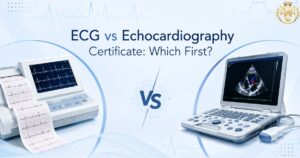
Cardiac skill-building is rarely an all-or-nothing decision. Most doctors don’t have the time or need for a full cardiology fellowship, but they do encounter chest pain, palpitations, and breathlessness often enough that a focused cardiac skill genuinely changes how confidently they manage a patient. The real question most doctors face isn’t “should I learn cardiology” — it’s “which specific skill should I build first.”
MGA’s Certificate in ECG Interpretation and Certificate in Echocardiography are two distinct answers to that question. This article compares them directly — what each actually teaches, what equipment and setting each assumes, and which one to prioritise based on your current practice. If you’re still exploring the full range of cardiology course formats available after MBBS, our cardiology courses after MBBS guide covers that broader landscape; this article is specifically about sequencing these two certificates.
What this guide covers
- What the Certificate in ECG Interpretation covers
- What the Certificate in Echocardiography covers
- Direct comparison: equipment, learning curve, and daily use
- Who should learn ECG interpretation first
- Who should learn echocardiography first
- Can you build both skills — and in what order?
- Frequently asked questions
What the Certificate in ECG Interpretation covers
The Certificate in ECG Interpretation is built around a single, focused competency: reading a 12-lead ECG accurately and confidently, in the time pressure of a real clinical encounter — not in the unhurried setting of a textbook.
Core content areas
ECG fundamentals and lead placement: Cardiac electrical conduction, the relationship between the 12 leads and cardiac anatomy, and correct electrode placement — the foundation that makes every subsequent reading accurate rather than technically flawed from the start.
Systematic reading method: A structured, repeatable approach to reading any ECG — rate, rhythm, axis, intervals, and morphology in a fixed sequence — designed to replace ad hoc pattern-spotting with a method that catches findings a rushed read misses.
Rhythm recognition: Identifying normal sinus rhythm and the common arrhythmias encountered in general and emergency practice — atrial fibrillation, atrial flutter, supraventricular tachycardia, ventricular ectopy, and heart blocks.
Ischemia and infarction patterns: Recognising ST elevation, ST depression, T wave inversion, and Q wave changes, along with the less obvious patterns that carry high clinical stakes — findings that are easy to miss under time pressure but change immediate management when caught.
Clinical correlation and escalation thresholds: When an ECG finding warrants immediate referral, when it can be managed and monitored, and when it’s a benign variant — the judgment layer that separates confident interpretation from technically correct but clinically unhelpful reading.
What the daily use looks like
ECG interpretation requires no equipment beyond a standard ECG machine — already present in most clinics, OPDs, and emergency departments. The skill applies immediately to any patient presenting with chest pain, palpitations, breathlessness, or syncope, making it one of the most frequently used cardiac skills in general practice.
View the Certificate in ECG Interpretation
Focused, applied cardiac skill training · Eligible doctors
What the Certificate in Echocardiography covers
The Certificate in Echocardiography is built around bedside cardiac ultrasound — a fundamentally different skill from ECG in that it involves image acquisition and spatial interpretation, not just waveform reading.
Core content areas
2D echo fundamentals and transducer technique: Basic ultrasound physics as applied to cardiac imaging, transducer positioning, and the standard transthoracic echocardiography (TTE) windows — parasternal, apical, subcostal, and suprasternal views.
Chamber assessment: Systematic evaluation of the four cardiac chambers — size, wall thickness, and gross structural assessment — building the visual vocabulary needed to recognise normal versus abnormal anatomy.
Basic valve assessment: Visual assessment of valve structure and motion, and recognising overt valvular abnormalities — a foundational level of valve evaluation rather than comprehensive Doppler-based quantification.
LV function and ejection fraction estimation: Visual (“eyeballing”) assessment of left ventricular contractility and a basic approach to estimating ejection fraction — one of the most clinically useful bedside echo skills, directly relevant to heart failure and acute cardiac presentations.
When to refer for formal echocardiography: Recognising the boundary between what a focused certificate-level skill can answer and when a comprehensive echocardiographic study from a cardiologist or trained sonographer is required.
What the daily use looks like
Echocardiography requires access to an ultrasound machine — a real practical constraint that ECG interpretation does not carry. The skill is most immediately useful in settings where cardiac imaging equipment is already available: hospitals, diagnostic centres, and clinics with point-of-care ultrasound capability.
View the Certificate in Echocardiography
Bedside cardiac imaging skill training · Eligible doctors
Direct comparison: equipment, learning curve, and daily use
| Factor | ECG Interpretation | Echocardiography |
|---|---|---|
| Equipment required | Standard ECG machine — near-universal availability | Ultrasound machine — not present in every clinic |
| Skill type | Waveform reading and pattern recognition | Image acquisition + spatial interpretation |
| Learning curve | Faster — no hand-eye probe coordination needed | Longer — image quality is skill-dependent |
| Frequency of clinical use | Very high — any chest pain/palpitation presentation | High where equipment exists, low otherwise |
| Standalone diagnostic value | High — often decisive on its own for acute presentations | High but frequently used alongside other findings |
| Typical settings | OPD, emergency department, rural/primary care | Hospitals, diagnostic centres, imaging-equipped clinics |
| Best first skill for | General physicians, emergency doctors, rural practitioners | Doctors already working alongside ultrasound equipment |
Course duration, fees, and specific eligibility should be verified on each course page, as these may be updated. This comparison reflects the general nature of each skill in clinical practice.
Who should learn ECG interpretation first
General physicians and family medicine doctors
If your OPD regularly includes patients presenting with chest discomfort, palpitations, or unexplained breathlessness, ECG interpretation is the skill you’ll use in almost every one of those consultations. It requires no capital investment in equipment and builds a diagnostic reflex that improves both triage speed and referral accuracy.
Emergency and critical care practitioners
In an emergency setting, ECG interpretation is frequently the single most time-critical skill in cardiac presentations — the difference between recognising a time-sensitive pattern immediately versus after a delay that matters. It is also the more universally available skill across emergency departments of varying resource levels.
Rural and primary care doctors
Doctors in settings without reliable access to ultrasound equipment or a nearby cardiology referral network benefit most from a skill that depends only on a machine they likely already have. ECG interpretation extends what a solo or small-team practice can manage independently before a referral becomes necessary.
Who should learn echocardiography first
Doctors already working alongside ultrasound equipment
If your practice setting already has an ultrasound machine — for obstetric, abdominal, or general point-of-care use — adding cardiac imaging competency is a natural extension rather than a new equipment investment. The marginal cost of building this skill is lower when the hardware barrier is already removed.
Doctors managing heart failure or structural presentations
For doctors whose caseload includes suspected heart failure, valvular disease, or structural cardiac concerns, echocardiography answers questions that ECG cannot — chamber size, wall motion, and valve structure are imaging findings, not electrical ones. Where this caseload is significant, echo may be the more immediately useful first skill despite the steeper learning curve.
Doctors in hospital or diagnostic centre settings
In a hospital or diagnostic centre where cardiac imaging is part of the expected service offering, echocardiography competency has direct professional and, potentially, service-line value that a solo OPD practice may not offer in the same way.
Can you build both skills — and in what order?
These are not competing skills — most doctors who build one eventually build the other, because ECG and echocardiography answer different clinical questions and together give a far more complete bedside cardiac assessment than either alone.
For most doctors without an existing equipment constraint, the practical sequencing recommendation is: ECG interpretation first. It has the lower barrier to entry, the faster learning curve, and the higher frequency of everyday clinical use — which means the skill starts paying off in patient care almost immediately after completion. Echocardiography then becomes a natural second step, particularly once ECG has sharpened the underlying pattern-recognition discipline that also benefits echo interpretation.
The exception is straightforward: if your practice setting already has ultrasound access and cardiac imaging is a more immediate gap than ECG competency, start with echocardiography instead. The sequencing logic should follow your actual clinical bottleneck, not a fixed rule.
Doctors who want a broader cardiology foundation before or alongside either certificate may also consider MGA’s Certificate in Essential Cardiology, which covers common cardiac conditions more broadly, or the Fellowship in Cardiovascular for doctors ready for a deeper, longer-format commitment.
Related programs and guides
Frequently asked questions
Should I learn ECG interpretation or echocardiography first?
For most general physicians, emergency doctors, and primary care practitioners, ECG interpretation is the more practical first skill — it requires no additional equipment, applies to nearly every chest pain or palpitation presentation, and has a faster learning curve. Echocardiography is the better first choice specifically if you already have access to ultrasound equipment or your caseload includes frequent heart failure or structural cardiac presentations.
Can I do both certificates?
Yes. These are complementary skills that answer different clinical questions — ECG assesses cardiac electrical activity, echocardiography assesses cardiac structure and function. Many doctors complete both over time. There is no requirement to choose only one permanently; the question addressed in this article is which to prioritise first, not which to choose exclusively.
Do I need prior cardiology experience for either certificate?
Both certificates are designed as focused skill-building programs for doctors without a cardiology subspecialty background. Check the specific eligibility requirements on the Certificate in ECG Interpretation and Certificate in Echocardiography course pages before applying.
Is echocardiography harder to learn than ECG interpretation?
Generally, yes, in terms of initial learning curve. ECG interpretation is a waveform-reading skill that most doctors can build reasonably quickly with structured practice. Echocardiography additionally requires image acquisition — correct transducer positioning and probe manipulation — which adds a hand-eye coordination component that takes longer to become reliable, independent of the interpretive knowledge involved.
How is this different from the broader cardiology courses after MBBS guide?
Our cardiology courses after MBBS guide covers the full landscape of options — certificates, fellowships, and the traditional DM Cardiology pathway. This article is narrower and more specific: it assumes you’ve already decided a short skill certificate is the right format, and helps you choose which of these two particular certificates to start with.
Medical Global Academy — Editorial Team
This article is produced by MGA’s academic team to help doctors sequence cardiac skill-building decisions. Program details including duration, fees, curriculum, and eligibility should be verified on individual course pages, as these may be updated periodically. This article does not constitute career or clinical advice. Last reviewed: August 2026.