
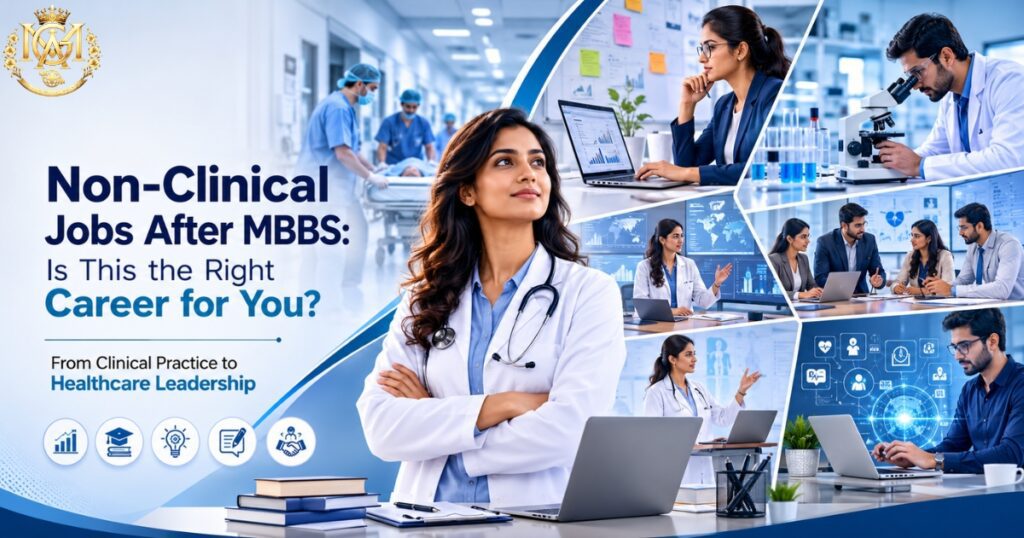
Non-Clinical Jobs After MBBS: Explore Medical Careers Beyond Clinical Practice
Completing an MBBS degree is a significant milestone, but it does not mean every doctor must spend their entire career in hospitals or direct patient care. While clinical practice remains a rewarding profession, it is not the only path available. Today, many MBBS graduates are exploring non-clinical careers that allow them to use their medical knowledge in research, healthcare management, medical communication, technology, public health, and the pharmaceutical industry.
The healthcare ecosystem has evolved rapidly over the past decade. Modern medicine now relies on professionals who can contribute beyond the bedside by improving healthcare systems, developing innovative therapies, creating medical content, managing hospitals, analysing healthcare data, and shaping public health policies. These roles require strong medical knowledge but involve little or no direct patient interaction.
Choosing a non-clinical career does not mean leaving medicine behind. Instead, it means applying your medical education in a different way to solve larger healthcare challenges. Many doctors choose this path because it offers diverse career opportunities, structured work environments, professional growth, and the chance to make an impact beyond individual patient care.
However, deciding whether a non-clinical career is the right choice requires careful evaluation of your interests, strengths, and long-term professional goals. This guide explores the different non-clinical jobs available after MBBS, explains how doctors can transition into these careers, discusses common challenges, and provides practical guidance for building a successful future beyond clinical practice.
What Are Non-Clinical Jobs After MBBS and Who Should Choose Them?
Non-clinical jobs are professional roles where doctors use their medical education without being primarily responsible for diagnosing or treating patients. Instead of working in outpatient departments, emergency rooms, or hospital wards, doctors contribute to healthcare through research, education, management, policy development, pharmaceutical innovation, digital health, and medical communication.
These careers remain closely connected to medicine but focus on improving healthcare systems, advancing scientific knowledge, supporting healthcare organisations, or developing new medical technologies.
For many MBBS graduates, non-clinical careers provide an opportunity to build a meaningful profession while pursuing interests beyond routine clinical practice.
Clinical vs Non-Clinical Careers
Before choosing a career path, it is important to understand the fundamental difference between clinical and non-clinical roles.
Clinical careers involve direct patient care, including diagnosis, treatment, procedures, and emergency management. Non-clinical careers, on the other hand, focus on healthcare systems, research, communication, education, administration, and innovation without routine patient consultations.
| Clinical Careers | Non-Clinical Careers |
| Direct patient care | Limited or no direct patient care |
| Hospital and clinic-based practice | Corporate healthcare, research, education, technology, policy |
| Emergency duties and shift work | Structured working hours in many roles |
| Clinical diagnosis and treatment | Healthcare management, innovation, communication, and strategy |
| Strong procedural exposure | Strong analytical, leadership, and communication responsibilities |
Both career paths contribute significantly to healthcare, but they require different interests, strengths, and long-term career goals.
Why Are More Doctors Exploring Non-Clinical Careers?
The healthcare industry has expanded far beyond hospitals. Today, pharmaceutical companies, healthcare technology organisations, research institutions, insurance providers, public health agencies, and medical education platforms actively seek professionals with medical expertise.
Many doctors choose non-clinical careers because they want to:
- Explore broader healthcare opportunities.
- Improve work-life balance.
- Reduce long-term burnout associated with demanding clinical schedules.
- Develop leadership and management skills.
- Contribute to healthcare innovation.
- Build careers in research, education, or healthcare technology.
For some doctors, the motivation is lifestyle. For others, it is a genuine interest in solving healthcare problems beyond individual patient care.
Who Should Consider a Non-Clinical Career?
A non-clinical career may be suitable if you:
- Enjoy analysing medical information more than performing clinical procedures.
- Have strong communication or writing skills.
- Are interested in research and scientific innovation.
- Want to work in healthcare management or leadership.
- Prefer structured working hours.
- Enjoy technology, digital health, or healthcare analytics.
- Want to influence healthcare systems at a larger scale.
Choosing a non-clinical career is not about avoiding medicine—it is about identifying where your strengths can create the greatest impact.
Common Misconceptions About Non-Clinical Careers
Many MBBS graduates hesitate to explore non-clinical careers because of common misconceptions.
“Leaving clinical practice means wasting my MBBS.”
Not true. Medical knowledge remains the foundation of every non-clinical role. Doctors continue contributing to healthcare through research, education, innovation, policy, and industry.
“Non-clinical careers offer limited growth.”
Modern healthcare has created significant demand for doctors in leadership, pharmaceutical medicine, health technology, and public health. Many professionals build highly successful long-term careers in these fields.
“Only doctors with additional degrees can switch.”
While higher qualifications such as an MBA, MPH, or MHA can strengthen career opportunities, many entry-level non-clinical positions value clinical knowledge, communication skills, and a willingness to learn.
Benefits of Choosing a Non-Clinical Career
Non-clinical careers offer several advantages for doctors who wish to explore opportunities beyond routine clinical practice.
Some of the key benefits include:
- Diverse career options across multiple healthcare sectors.
- Opportunities to influence healthcare at organisational or population levels.
- Better work-life balance in many roles.
- Structured career progression.
- Exposure to research, technology, and innovation.
- Opportunities for leadership and strategic decision-making.
Many doctors also find that non-clinical careers allow them to continue learning while applying their medical knowledge in new and meaningful ways.
Clinical vs Non-Clinical Careers at a Glance
| Feature | Clinical Career | Non-Clinical Career |
| Primary Focus | Patient diagnosis and treatment | Healthcare systems, research, management, communication |
| Patient Interaction | High | Limited or none |
| Workplace | Hospitals and clinics | Pharma, health-tech, research, education, corporate healthcare |
| Core Skills | Clinical reasoning, procedures, patient management | Leadership, communication, research, strategy, analytics |
| Long-Term Opportunities | Specialist, Consultant, Private Practice | Leadership, Healthcare Management, Medical Affairs, Research, Public Health |
Which Non-Clinical Career Opportunities Are Available After MBBS?
A medical degree opens opportunities far beyond hospitals and clinical practice. Today, doctors contribute to healthcare through research, pharmaceutical development, healthcare management, technology, education, policy, and scientific communication.
These careers allow MBBS graduates to apply their medical knowledge while working on healthcare challenges that affect larger populations, organisations, and healthcare systems.
Choosing the right career depends on your interests, strengths, and long-term professional aspirations.
Clinical Research
Clinical research plays an important role in developing new medicines, medical devices, and treatment protocols. Doctors working in this field contribute to the planning, monitoring, and evaluation of clinical studies while ensuring patient safety and regulatory compliance.
This career is well suited to doctors interested in scientific research, evidence-based medicine, and innovation.
Medical Writing
Medical writers transform complex scientific information into clear, accurate, and evidence-based content.
Their work may include:
- Scientific manuscripts
- Clinical study reports
- Regulatory documentation
- Continuing medical education material
- Patient education resources
- Medical website content
Doctors with strong analytical thinking and communication skills often find medical writing to be a rewarding career option.
Pharmacovigilance
Pharmacovigilance focuses on monitoring the safety of medicines after they reach the market.
Doctors in this field evaluate adverse drug reactions, assess safety data, contribute to regulatory reporting, and help improve patient safety through continuous drug monitoring.
Medical Affairs
Medical Affairs professionals act as scientific experts within pharmaceutical and healthcare organisations.
Their responsibilities include:
- Providing medical expertise.
- Supporting product education.
- Interacting with healthcare professionals.
- Reviewing scientific evidence.
- Contributing to medical strategy.
This role combines medical knowledge with communication and leadership skills.
Healthcare Management
Healthcare management is an ideal career for doctors who enjoy solving organisational challenges rather than providing direct patient care. Instead of treating individual patients, healthcare managers improve the quality, efficiency, and accessibility of healthcare services across hospitals, healthcare organisations, and medical institutions.
Doctors in healthcare management may be responsible for:
- Improving healthcare delivery systems.
- Planning hospital operations.
- Managing healthcare quality standards.
- Coordinating multidisciplinary teams.
- Supporting digital transformation projects.
- Developing patient safety initiatives.
This career combines medical knowledge with leadership, strategic planning, and problem-solving.
Hospital Administration
Hospital administration focuses on the operational and managerial aspects of healthcare institutions. Doctors working in administrative roles help ensure hospitals function efficiently while maintaining high standards of patient care.
Responsibilities may include:
- Hospital operations management.
- Clinical quality improvement.
- Resource planning.
- Budget coordination.
- Accreditation and compliance.
- Risk management.
- Healthcare policy implementation.
Doctors with strong leadership and organisational skills often find hospital administration a rewarding long-term career.
Public Health
Public health professionals work to improve the health of entire communities rather than individual patients.
Instead of diagnosing diseases in hospitals, they focus on:
- Disease prevention.
- Health promotion.
- Epidemiology.
- Community health programmes.
- National healthcare initiatives.
- Policy development.
- Population health research.
Doctors interested in preventive medicine and large-scale healthcare improvement often pursue careers in public health.
Health Informatics
Healthcare is becoming increasingly digital, creating new opportunities for doctors interested in technology.
Health informatics combines medicine, data, and information technology to improve healthcare delivery.
Doctors in this field contribute to:
- Electronic Health Record (EHR) systems.
- Clinical decision-support tools.
- Digital healthcare platforms.
- Artificial intelligence in healthcare.
- Healthcare data analysis.
- Telemedicine solutions.
Medical knowledge helps ensure that digital healthcare solutions remain clinically relevant and patient-focused.
Medical Education
Many doctors enjoy teaching as much as practising medicine.
Medical education offers opportunities to contribute through:
- Undergraduate teaching.
- Postgraduate training.
- Clinical skill development.
- Curriculum design.
- Continuing Medical Education (CME).
- Online medical education.
- Educational content development.
Teaching allows doctors to shape the next generation of healthcare professionals while remaining closely connected to medicine.
Health Insurance and Medical Advisor Roles
Health insurance organisations employ doctors to evaluate medical claims, review clinical documentation, support policy decisions, and ensure evidence-based healthcare practices.
Medical advisors also provide scientific guidance for insurance providers, healthcare organisations, and corporate healthcare programmes.
These roles require strong analytical skills, medical judgment, and knowledge of healthcare systems.
Digital Health and HealthTech
Digital healthcare has become one of the fastest-growing sectors within the healthcare industry.
Doctors contribute by working with:
- Telemedicine platforms.
- Healthcare applications.
- Artificial intelligence solutions.
- Digital diagnostics.
- Remote patient monitoring.
- Healthcare software development.
Medical professionals play an important role in ensuring technology improves patient care while maintaining clinical accuracy and safety.
Non-Clinical Career Opportunities After MBBS
| Career Path | Primary Responsibility | Patient Interaction | Career Growth |
| Clinical Research | Clinical trials and research | Low | Excellent |
| Medical Writing | Scientific communication | None | Excellent |
| Pharmacovigilance | Drug safety monitoring | None | Excellent |
| Medical Affairs | Scientific strategy | Limited | Excellent |
| Healthcare Management | Healthcare operations | Limited | Leadership roles |
| Hospital Administration | Hospital management | Limited | Senior administration |
| Public Health | Community health programmes | Low | Policy and leadership |
| Health Informatics | Digital healthcare systems | None | High-growth technology sector |
| Medical Education | Teaching and academic development | Moderate | Academic leadership |
| Health Insurance & Medical Advisor | Medical reviews and healthcare policy | None | Corporate leadership |
| Digital Health & HealthTech | Healthcare innovation and technology | Limited | Rapidly expanding field |
How Can Doctors Transition from Clinical to Non-Clinical Careers?
Moving into a non-clinical career is rarely an overnight decision. Most doctors transition gradually by identifying their interests, developing new skills, and gaining exposure to healthcare sectors beyond clinical practice.
A successful transition does not require abandoning your medical knowledge. Instead, it involves expanding your expertise so it can be applied in different healthcare environments.
Identify Your Career Interests
The first step is understanding which aspect of healthcare genuinely interests you.
Ask yourself:
- Do you enjoy research?
- Are you interested in writing?
- Do you like analysing healthcare data?
- Are you drawn to leadership and management?
- Do you enjoy teaching?
- Are you interested in healthcare technology?
Understanding your strengths helps narrow down the most suitable career path.
Build Transferable Skills
Clinical knowledge remains valuable, but many non-clinical roles also require additional professional skills.
These include:
- Scientific communication.
- Technical writing.
- Leadership.
- Project management.
- Critical thinking.
- Data interpretation.
- Presentation skills.
- Team collaboration.
These transferable skills often determine long-term career growth.
Strengthen Your Qualifications
Although an MBBS degree opens many opportunities, specialised qualifications can improve career prospects.
Depending on your chosen field, doctors may consider:
- Fellowship Programs.
- PG Diploma courses.
- Master of Public Health (MPH).
- Master of Hospital Administration (MHA).
- MBA in Healthcare Management.
- Clinical Research certifications.
- Digital health training.
Additional education should support your career goals rather than replace your clinical foundation.
Develop Professional Networks
Networking plays an important role in career development.
Connecting with healthcare professionals working in research, pharmaceutical companies, healthcare technology, medical education, and healthcare management provides valuable insights into industry expectations and emerging opportunities.
Professional relationships often open doors to mentorship, collaboration, and career advancement.
Plan Your Career Transition
Doctors do not always need to leave clinical practice immediately.
Many professionals begin by:
- Freelance medical writing.
- Research collaborations.
- Teaching.
- Short-term healthcare projects.
- Professional certifications.
- Part-time industry experience.
This gradual approach helps doctors gain confidence while exploring different career options.
Building a Non-Clinical Career
| Career Path | Skills to Develop | Helpful Qualifications |
| Clinical Research | Research methodology, GCP | Clinical Research Certification |
| Medical Writing | Scientific writing, communication | Medical Writing Training |
| Healthcare Management | Leadership, operations | MBA or MHA |
| Public Health | Epidemiology, policy | MPH |
| Digital Health | Technology, healthcare systems | Health Informatics Certification |
| Medical Education | Teaching, curriculum development | Fellowship or Education Training |
What Challenges Do Doctors Face When Switching to Non-Clinical Careers?
Transitioning from clinical practice to a non-clinical career is a significant professional decision. While these careers offer diverse opportunities and a different working environment, the transition often requires doctors to adapt to new responsibilities, develop additional skills, and redefine their professional identity.
Understanding these challenges early helps doctors prepare realistically and make informed career decisions.
Adjusting to a New Professional Identity
For many doctors, clinical practice is closely linked to their professional identity. Moving away from direct patient care can initially feel uncertain, especially after years of medical education and hospital training.
However, choosing a non-clinical career does not mean leaving medicine behind. Doctors continue to improve healthcare through research, innovation, education, healthcare management, policy development, and medical communication.
The impact simply shifts from treating individual patients to improving healthcare systems on a broader scale.
Learning New Professional Skills
Clinical expertise remains valuable, but non-clinical careers often require additional competencies.
Doctors may need to strengthen skills such as:
- Scientific communication
- Technical writing
- Project management
- Data interpretation
- Healthcare regulations
- Leadership
- Business communication
- Digital healthcare technologies
Continuous learning makes career transitions smoother and improves long-term growth.
Career Uncertainty
Many MBBS graduates are unfamiliar with the wide range of opportunities available outside hospitals.
Questions such as:
- Which career suits me?
- Will I grow professionally?
- Should I pursue another qualification?
- Can I return to clinical practice later?
are common during the transition.
Careful career planning and understanding industry expectations help reduce uncertainty and improve decision-making.
Salary Expectations
Many doctors assume that non-clinical careers offer lower salaries than clinical practice.
In reality, earning potential varies depending on the industry, experience, expertise, leadership responsibilities, and continuous skill development.
While entry-level salaries differ across sectors, many non-clinical careers provide structured growth opportunities and leadership roles over time.
Rather than comparing only starting salaries, doctors should consider long-term career progression, work-life balance, and professional satisfaction.
Staying Connected to Medicine
A common concern among doctors is losing touch with medicine.
Fortunately, most non-clinical careers continue to rely heavily on medical knowledge.
Doctors working in:
- Medical Affairs
- Clinical Research
- Public Health
- Medical Education
- Health Informatics
- Healthcare Consulting
continue applying evidence-based medicine while contributing to healthcare in different ways.
Common Challenges and Practical Solutions
| Challenge | Practical Solution |
|---|---|
| Uncertainty about changing careers | Explore different healthcare sectors before making a full transition. |
| Lack of industry knowledge | Learn through certifications, workshops, and professional networking. |
| Developing new skills | Build communication, leadership, research, and digital healthcare skills. |
| Salary concerns | Focus on long-term career growth rather than initial compensation alone. |
| Professional identity | Recognise that medical expertise remains valuable across healthcare industries. |
| Career planning | Set clear short-term and long-term professional goals. |
How Can MBBS Graduates Build a Successful Non-Clinical Career?
A successful non-clinical career is built through continuous learning, adaptability, and a commitment to applying medical knowledge in new ways. Doctors who remain curious, develop additional professional skills, and stay engaged with the evolving healthcare landscape often find rewarding opportunities beyond traditional clinical practice.
Continue Learning Throughout Your Career
Healthcare continues to evolve through scientific research, digital technology, healthcare policy, and innovation.
Doctors should actively participate in:
- Continuing Medical Education (CME)
- Professional workshops
- Conferences
- Healthcare certifications
- Industry seminars
- Research activities
Continuous learning keeps medical professionals competitive across different healthcare sectors.
Develop Strong Communication Skills
Communication is one of the most valuable skills in non-clinical careers.
Whether preparing scientific documents, managing healthcare projects, presenting research, or leading multidisciplinary teams, doctors who communicate effectively create greater professional impact.
Build Leadership and Strategic Thinking
Leadership extends beyond managing people.
Doctors should develop the ability to:
- Solve organisational problems.
- Analyse healthcare systems.
- Make evidence-based decisions.
- Lead multidisciplinary projects.
- Improve healthcare quality.
These skills become increasingly valuable as careers progress.
Stay Updated with Digital Healthcare
Healthcare technology is transforming every part of modern medicine.
Understanding areas such as:
- Artificial Intelligence in healthcare
- Electronic Health Records
- Telemedicine
- Digital health platforms
- Healthcare analytics
helps doctors remain prepared for future healthcare opportunities.
Pursue Focused Professional Development
Many doctors strengthen their expertise through Fellowship Programs, PG Diploma courses, and other structured learning opportunities that complement their medical education.
These programmes help professionals develop specialised knowledge while improving practical skills relevant to modern healthcare.
Build a Strong Professional Network
Networking creates opportunities for collaboration, mentorship, research, and career growth.
Engaging with healthcare professionals from research, healthcare management, pharmaceutical industries, medical education, and health technology broadens career perspectives while opening new professional opportunities.
How Medical Global Academy Supports Doctors
Medical careers continue to evolve beyond traditional clinical practice, making continuous learning more important than ever. Medical Global Academy supports doctors through Fellowship Programs and PG Diploma courses that help strengthen professional skills, expand medical expertise, and prepare healthcare professionals for evolving career opportunities. Whether pursuing clinical excellence or exploring broader healthcare roles, continuous education remains one of the strongest investments in long-term career success.
Frequently Asked Questions
Can I get a non-clinical job immediately after MBBS?
Yes. Many entry-level opportunities are available after MBBS in areas such as medical writing, clinical research, pharmacovigilance, healthcare management, and digital health. Some specialised roles may require additional training or certifications.
Which non-clinical job has the highest salary?
Salary depends on experience, industry, leadership responsibilities, and expertise. Healthcare management, Medical Affairs, healthcare consulting, health technology, and senior pharmaceutical roles often offer strong long-term earning potential.
Do I need an MBA or MPH for a non-clinical career?
Not always. An MBBS degree is sufficient for many entry-level opportunities. However, qualifications such as an MBA, MHA, MPH, Fellowship, or PG Diploma may strengthen career growth depending on your chosen field.
Can I return to clinical practice after working in a non-clinical role?
Depending on professional registration requirements and the duration of your career break, returning to clinical practice may be possible. Doctors should stay informed about applicable regulations and maintain their professional competencies where appropriate.
Is medical writing a good career after MBBS?
Yes. Medical writing is well suited for doctors with strong scientific knowledge and communication skills. It provides opportunities to contribute to research publications, regulatory documentation, medical education, and healthcare communication.
Which non-clinical career offers the best work-life balance?
Work-life balance varies by organisation and role. Many careers in medical writing, health informatics, healthcare management, public health, and pharmaceutical industries offer structured schedules compared with traditional hospital-based clinical practice.
Final Thoughts
Non-clinical jobs after MBBS demonstrate that a medical career is no longer limited to hospitals or direct patient care. Today’s healthcare ecosystem offers doctors opportunities to contribute through research, healthcare management, medical communication, digital health, public health, education, and pharmaceutical innovation.
Choosing a non-clinical path is not about stepping away from medicine—it is about applying medical knowledge in different ways to improve healthcare systems, support innovation, and create a broader impact. The best career is one that aligns with your strengths, interests, and long-term professional goals.
Whether you choose clinical practice or a non-clinical pathway, continuous learning, professional development, and adaptability will remain essential throughout your career. By investing in new skills while building on your medical foundation, you can create a rewarding career that contributes meaningfully to the future of healthcare.