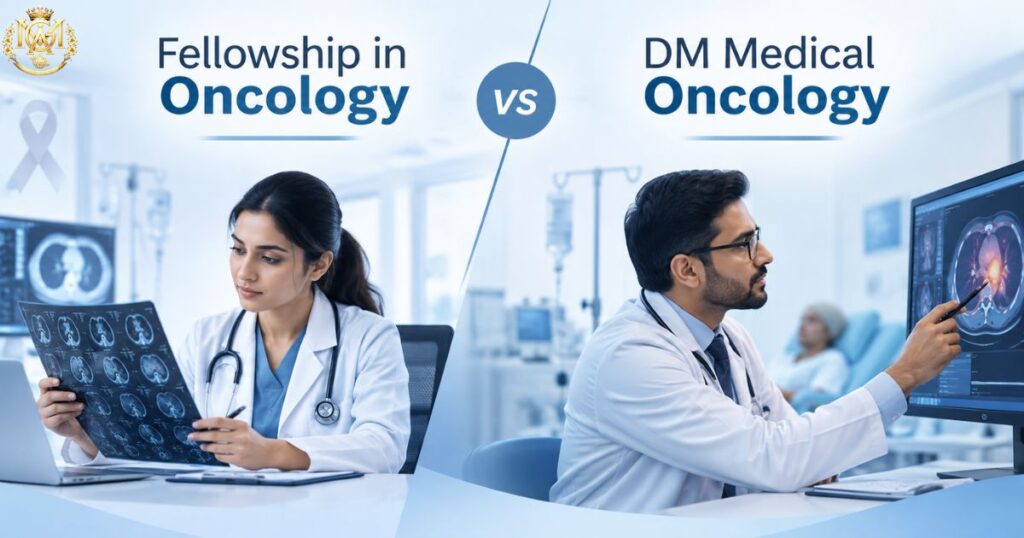
DM Medical Oncology is a formal, NMC-recognised super-specialty degree — a three-year statutory qualification entered through NEET-SS, open to doctors holding MD/DNB in General Medicine, Paediatrics, or Radiation Oncology. A fellowship in oncology, including MGA's, is a skill-building educational programme for eligible doctors — it builds oncology-focused knowledge but does not confer DM-level specialist status, statutory registration, or specialist recognition.
These serve genuinely different purposes. Neither is a substitute for the other, and this guide explains exactly why — including a real regulatory development in 2026 that shows this distinction has practical consequences, not just academic ones.
If you're an MD doctor weighing a future in oncology, you've likely come across both terms — DM Medical Oncology and fellowship in oncology — sometimes used almost interchangeably in course listings and social media posts. They are not interchangeable. One is a regulated, statutory specialist pathway; the other is educational upskilling. Confusing the two can shape a career decision on inaccurate footing, which is exactly why this distinction deserves a clear, direct explanation before you choose either path.
Fellowship in Oncology vs DM Medical Oncology: What Is the Difference?
| Factor | Fellowship in Oncology | DM Medical Oncology |
|---|---|---|
| Entry point | Eligible doctors as per the specific programme's criteria | MD/DNB in General Medicine, Paediatrics, or Radiation Oncology |
| Purpose | Additional oncology-focused knowledge and skills | Formal super-specialty medical education |
| Nature | Skill-building educational programme | Statutory, NMC-recognised specialist training |
| Admission route | Institutional selection process | NEET-SS (national entrance) + centralised counselling |
| Duration | Typically 1–2 years, varies by programme | 3 years |
| Statutory specialist status | Does not confer DM-equivalent status | Part of the recognised super-specialty pathway |
What Is a Fellowship in Oncology?
A fellowship in oncology is a structured educational programme designed to build oncology-focused clinical knowledge for doctors who are eligible under that specific programme's criteria. Depending on the institution, this typically includes exposure to chemotherapy principles, systemic treatment approaches, multidisciplinary tumour board participation, and case-based learning in cancer diagnosis and management.
The educational value here is real — doctors gain structured exposure to oncology decision-making they may not otherwise encounter. What a fellowship does not do is confer the statutory recognition, registration, or specialist title that comes with completing a super-specialty degree. It sits alongside formal training as a knowledge-building option, not a parallel route to the same destination.
What Is DM Medical Oncology?
DM Medical Oncology is a three-year, post-doctoral super-specialty degree recognised by the National Medical Commission. Entry is through NEET-SS (the national super-specialty entrance examination conducted by NBEMS), followed by centralised counselling. According to NBE's own eligibility bulletin, the feeder qualifications for DM/DrNB Medical Oncology are an MD or DNB in General Medicine, an MD or DNB in Paediatrics, or an MD/DNB in Radiation Oncology — a doctor cannot enter this pathway directly from MBBS or from an unrelated MD.
Training covers the systemic medical management of solid tumours and haematological cancers — chemotherapy, targeted therapy, immunotherapy, and hormonal therapy — alongside supportive and palliative care, and management of oncological emergencies. This is the pathway that leads to formal recognition as a medical oncologist in India.
Eligibility criteria and seat availability for DM Medical Oncology can vary by institute and change between NEET-SS cycles. Always verify current-year requirements directly with NBEMS before making admission plans.
Can an Oncology Fellowship Replace DM Medical Oncology?
No. This deserves a direct answer rather than a hedge. A fellowship in oncology and DM Medical Oncology serve different purposes, have different eligibility requirements, and carry different professional positioning. A fellowship can help an eligible doctor build oncology-focused knowledge. It does not grant the same specialist qualification or statutory status as DM Medical Oncology, and it should never be represented as doing so.
This isn't just a technicality — it now has direct practical consequences. In April 2026, changes to eligibility rules under Ayushman Bharat PM-JAY, India's national health insurance scheme, restricted empanelment for cancer treatment to oncologists holding NMC-recognised DM, MCh, or DrNB degrees, in several states. Reporting on the change described hundreds of experienced, fellowship-trained oncologists — including specialists trained at premier cancer centres — losing eligibility to treat patients under the scheme, regardless of years of clinical experience.
Implementation has varied by state, and the policy has drawn pushback from affected doctors, with some ambiguity over whether NHA (which empanels hospitals) or NMC (which sets doctor qualification standards) holds final authority here. The details are still evolving — but the direction is clear: statutory super-specialty degrees and fellowship training are being treated as genuinely different tiers by regulators, not interchangeable credentials. Always verify current empanelment and registration requirements with the relevant authority before making career decisions based on this development.
Fellowship in Oncology vs DM Medical Oncology: Which One Should You Choose?
You're an eligible doctor seeking additional oncology-focused knowledge, exploring whether oncology genuinely fits your long-term interests, or want structured exposure without claiming — or needing — specialist equivalence.
Your goal is formal, NMC-recognised medical oncology super-specialist status. You hold (or plan to complete) the required MD/DNB base qualification, and you're prepared for the competitive NEET-SS admission process and the full three-year training commitment.
A simple decision rule: if your current qualification is an eligible MD/DNB and your goal is formal specialist status, DM Medical Oncology through NEET-SS is the relevant route. If you're looking to build oncology-focused knowledge and skills without pursuing that statutory route right now, a fellowship serves a genuinely different, complementary purpose — not a shortcut to the same outcome.
Frequently Asked Questions
Final Verdict: Fellowship or DM Medical Oncology?
If your goal is formal, super-specialist medical oncology training with statutory recognition, the DM pathway through NEET-SS is the relevant route — and the one that current PM-JAY empanelment rules increasingly treat as the deciding factor for practising as a recognised cancer specialist. If you're an eligible doctor looking to build structured knowledge in oncology without pursuing that statutory route, a fellowship serves a genuinely different educational purpose.
Neither should be marketed, or chosen, as a substitute for the other. Understanding that distinction clearly — before you commit years to either path — is the single most useful thing this guide can offer you.
MGA's Fellowship in Oncology is a skill-building educational programme for eligible doctors — designed to deepen oncology knowledge, not to replace or substitute for DM Medical Oncology or any statutory super-specialty qualification.
Explore Fellowship in OncologyThis article provides general information as of September 2026 to help doctors understand the difference between fellowship-based oncology training and the statutory DM Medical Oncology pathway. NEET-SS eligibility criteria, feeder qualifications, seat availability, and regulatory/empanelment rules (including PM-JAY requirements) can change and may vary by state and institution. Always verify current requirements directly with NBEMS, the National Medical Commission, and the relevant state or national health authority before making admission or practice decisions. MGA's Fellowship in Oncology is an educational programme only and does not confer DM-level statutory specialist status, registration, or recognition.
Which Post-MBBS Course Format Is Right for You?
Answer three quick questions and we'll match you to the format that fits your goals — Certificate, PG Diploma, or Fellowship.