
Because a genuine gap exists between what's clinically available and what most oncologists routinely use. Published research confirms most oncologists recognise precision oncology's importance, yet significantly fewer report using comprehensive genomic testing regularly to guide treatment — with physician education named as a leading barrier. A precision oncology fellowship that builds genomic-guided and immunotherapy-based decision-making directly addresses that specific gap, rather than adding a generic trend topic to a curriculum.
Oncology in 2026 looks meaningfully different from oncology a decade ago — not because the fundamentals of cancer biology changed, but because how treatment gets chosen has changed. Genomic testing, targeted therapies, and immunotherapy have moved from research settings into routine clinical decision-making. The problem is that clinical practice hasn't caught up uniformly, and that gap is exactly what a well-designed precision oncology fellowship exists to close.
This gap matters more with each passing year, not less. New targeted agents and immunotherapy approvals now arrive on an almost monthly basis internationally. The pace of change means training completed even three or four years ago can leave a doctor behind current practice. A fellowship built specifically around this shift offers a way to catch up deliberately. That's better than piecing together knowledge from scattered conference updates and journal articles over time.
What Precision Oncology Actually Means in Practice
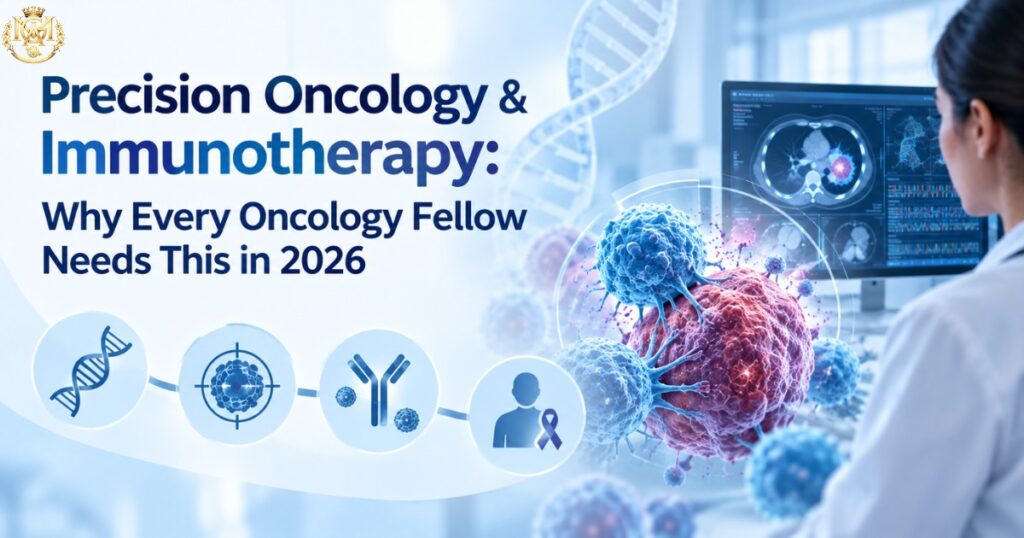
Precision oncology means selecting cancer treatment based on the specific molecular and genetic characteristics of a patient's tumour. It doesn't rely on a generalised protocol by cancer type alone. In practice, this involves genomic and molecular testing to identify actionable mutations. Targets like EGFR, HER2, BRAF, and ALK show up regularly across lung, breast, and colorectal cancers. The final step is matching the patient to a therapy designed for that specific molecular profile.Immunotherapy sits alongside this shift as its own transformation. Rather than directly attacking cancer cells, immunotherapy works by helping the patient's own immune system recognise and destroy them — an approach that has changed outcomes meaningfully in cancers where options were once limited.
What makes this genuinely different from earlier treatment advances is the degree of individualisation involved. A protocol-based approach treats patients with the same cancer type similarly. A precision approach treats two patients with the same cancer type quite differently if their tumours carry different molecular signatures. This shift changes not just which drug gets prescribed, but the entire diagnostic workup that precedes the decision. Molecular testing becomes a routine, early step rather than something reserved for complex or refractory cases.
The Real Gap: Why Adoption Lags Behind Availability
Here's the part that matters most for training. A 2025 clinical editorial on precision oncology implementation found that while most oncologists agree the field is important and clinically valuable, a significantly smaller share report using comprehensive genomic testing on a regular basis to actually guide treatment decisions. The gap wasn't a lack of belief in the science — it was physician education and adoption, cited as one of the leading barriers to bringing precision oncology fully into everyday practice.
This is a genuinely useful distinction for anyone choosing training: precision oncology isn't a knowledge gap because the science is unavailable — it's a gap because structured clinical training hasn't kept pace with how fast the underlying science has moved.
Immunotherapy's Growing Role in Standard Treatment
Immunotherapy has moved from a niche, last-resort option to a standard consideration across a growing list of cancer types. Checkpoint inhibitors and other immune-based approaches are now part of routine treatment discussions for many patients, often used alongside — not instead of — chemotherapy, targeted therapy, or surgery, depending on the specific case.
For oncology fellows and doctors training today, this means immunotherapy can no longer be treated as an advanced or optional topic covered briefly at the end of a curriculum. It's increasingly a core part of how treatment decisions get made day to day.
What This Means for Doctors Training in Oncology Today
Understanding what a molecular report actually means for treatment selection — not just ordering the test, but acting on it confidently.
Knowing when immunotherapy fits a patient's specific case, how it combines with other modalities, and what response monitoring looks like.
New targeted agents and immunotherapy approvals arrive regularly — training that builds a framework for ongoing learning matters more than memorising today's drug list.
Precision oncology decisions increasingly involve pathologists, genetic counsellors, and tumour boards — not a single physician working in isolation.
How MGA's Fellowship Addresses This
This is precisely why MGA's precision oncology fellowship includes a dedicated Precision Oncology & Research Module within its curriculum — built to address the specific adoption gap described above, not to add a generic trend topic for its own sake. The module focuses on genomic-guided treatment reasoning and immunotherapy application within real clinical decision-making, alongside the fellowship's broader oncology-focused training.
As with every MGA fellowship, this is a skill-building educational programme for eligible doctors. It does not confer DM Medical Oncology-equivalent statutory status, and it isn't a substitute for the formal super-specialty pathway — it's a way to build genuinely current, practice-relevant knowledge alongside or ahead of that pathway.
Frequently Asked Questions
MGA's precision oncology fellowship includes a dedicated Precision Oncology & Research Module, built for doctors who want oncology training that reflects how cancer treatment decisions are actually made in 2026.
Explore Fellowship in OncologyHow to Become an Oncologist After MBBS: Complete Career Roadmap
This article provides general educational information as of September 2026 on precision oncology and immunotherapy as clinical training areas. It does not constitute treatment guidance for any individual patient. MGA's Fellowship in Oncology is an educational programme only and does not confer DM, MCh, or DrNB-equivalent statutory specialist status. Clinical practice should always follow current, patient-specific guidance from qualified oncology specialists and institutional protocols.
Which Post-MBBS Course Format Is Right for You?
Answer three quick questions and we'll match you to the format that fits your goals — Certificate, PG Diploma, or Fellowship.