
Reviewed by the Medical Global Academy academic team | Last updated: July 31, 2026
Finishing MBBS is only the first milestone. The next decision — what higher study path to take — shapes the next several years of your career, and it is rarely a simple choice. Should you attempt NEET-PG for MD/MS? Consider DNB? Take a faster PG Diploma? Or build a practical skill through a fellowship while you keep working? This guide compares every major option for higher studies after MBBS so you can choose with a clear picture of entrance requirements, duration, recognition, and career fit.
This is a decision framework, not a simple listicle: rather than listing every course available, it explains how the major pathways differ and how to match one to your own goals, timeline, and risk tolerance.
WHAT ARE YOUR OPTIONS FOR HIGHER STUDIES AFTER MBBS?
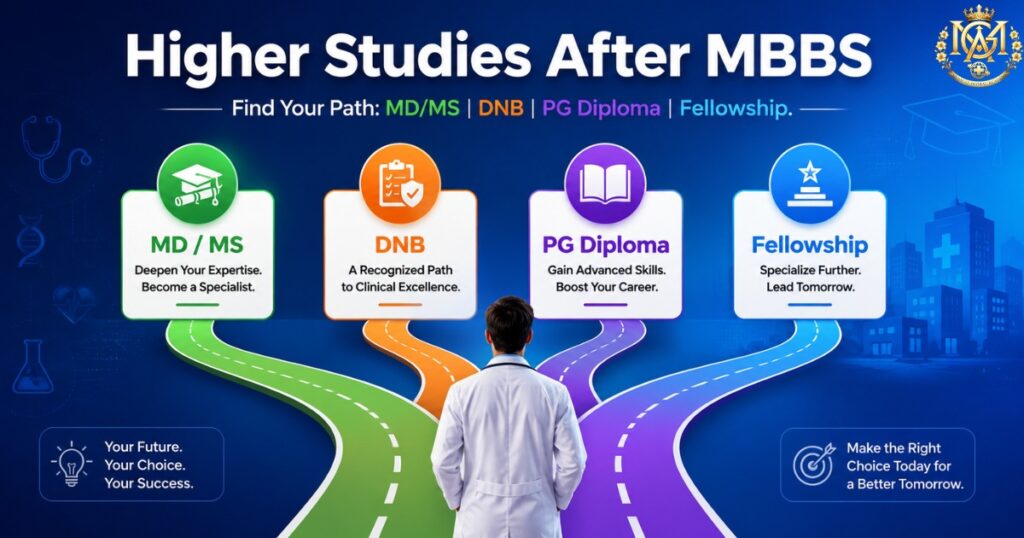
MBBS graduates in India generally choose among five broad paths:
- MD/MS — a 3-year postgraduate medical degree via NEET-PG, for full clinical specialisation.
- DNB — a 3-year NBEMS qualification, legally equivalent to MD/MS, also entered via NEET-PG.
- PG Diploma — a shorter, more focused postgraduate qualification (university diplomas via NEET-PG, or private CPD diplomas without an entrance exam).
- Fellowship courses — 6-24 month skill-certification programmes for a specific clinical skill, usually without an entrance exam.
- Non-clinical higher studies — MBA, MPH, PhD, or health-tech/data programmes for doctors moving toward management, public health, or research.
(Source: pathway structure cross-verified against NBEMS/NMC eligibility rules, detailed below.)
MD/MS VS. DNB VS. PG DIPLOMA VS. FELLOWSHIP: COMPARISON AT A GLANCE
The table below summarises how the four most-compared pathways differ on entry requirement, duration, official recognition, and who each one suits best.
MD / MS
| Entry Requirement | NEET-PG (mandatory) |
| Duration | 3 years |
| Recognition | Full postgraduate medical degree, NMC-recognised |
| Best For | Doctors set on a specific clinical specialisation |
DNB
| Entry Requirement | NEET-PG (mandatory) |
| Duration | 3 years |
| Recognition | Equivalent to MD/MS under the NMC Act, 2019 (Sec. 37) |
| Best For | Doctors open to hospital-based/DNB-accredited institutes |
PG Diploma
| Entry Requirement | NEET-PG (for NMC/university diplomas) |
| Duration | 2 years (university); shorter for private CPD diplomas |
| Recognition | University diplomas are NMC-recognised; private CPD diplomas are skill-certification, not medical degrees |
| Best For | Doctors who want faster, focused specialisation |
Fellowship
| Entry Requirement | Usually no entrance exam; MBBS + registration |
| Duration | 6-24 months |
| Recognition | CPD/skill certification, not an NMC postgraduate degree |
| Best For | Doctors adding a practical skill without a multi-year residency |
(Sources: National Board of Examinations in Medical Sciences (NBEMS) (https://natboard.edu.in/) on NEET-PG as the mandatory common entrance test for MD/MS/PG Diploma admissions; National Medical Commission Act, 2019, Section 37 (https://www.indiacode.nic.in/bitstream/123456789/11820/1/A2019_30.pdf), on DNB’s equivalence to MD/MS.)
OPTION 1: MD/MS — FULL POSTGRADUATE SPECIALISATION
MD (Doctor of Medicine) and MS (Master of Surgery) are India’s traditional 3-year postgraduate degrees, undertaken at a medical college or university. Admission requires clearing NEET-PG, which the NBEMS confirms is the single mandatory entrance test for MD/MS/PG Diploma seats nationwide — no state or institutional exam substitutes for it. MD/MS remains the most recognised route into a clinical specialty and is generally required for senior academic and many government positions.
OPTION 2: DNB — DIPLOMATE OF NATIONAL BOARD
DNB is awarded by NBEMS and, since the National Medical Commission Act, 2019 (Section 37), is legally recognised as equivalent to MD/MS. DNB is also entered through NEET-PG and typically takes 3 years, usually at accredited hospitals rather than traditional medical colleges. Acceptance of DNB-qualified doctors for faculty roles, fellowships, and consultant positions has grown significantly in recent years, particularly in corporate and private hospital networks.
OPTION 3: PG DIPLOMA AFTER MBBS
This is where terminology gets confusing, and it is worth being precise. A university-awarded PG Diploma (offered by a medical college/university and listed under NMC regulations) is a formal, NEET-PG-gated postgraduate qualification, generally shorter than MD/MS. Separately, many private academies — including Medical Global Academy — offer PG Diploma-branded CPD (continuing professional development) programmes in specific skills such as ultrasonography, dermatology, or nephrology. These are valuable for building practical, hands-on competence and do not require NEET-PG, but they are skill-certification credentials, not a substitute for an NMC-recognised postgraduate medical degree.
OPTION 4: FELLOWSHIP COURSES AFTER MBBS
Fellowship programmes are typically 6 to 24 months, focus on one clinical skill area (e.g., fetal medicine, internal medicine, laparoscopy, arthroplasty), and generally do not require an entrance exam — most accept any MBBS graduate with a valid registration. Like private CPD diplomas, fellowships are skill-certification programmes rather than NMC postgraduate medical degrees. They suit doctors who want to build a specific, practice-ready skill alongside — rather than instead of — their existing MBBS registration, without committing to a multi-year residency.
OPTION 5: NON-CLINICAL HIGHER STUDIES AFTER MBBS
Not every MBBS graduate wants to stay purely clinical. Common non-clinical paths include an MBA in Healthcare/Hospital Management, an MPH (Master of Public Health), a PhD for a research career, or emerging programmes in health-technology and health-data analytics. These typically have their own separate entrance and eligibility processes distinct from NEET-PG, and are best suited to doctors aiming for management, policy, public health, or research roles rather than direct patient care.
HOW TO CHOOSE: A SIMPLE DECISION FRAMEWORK
Instead of asking “which course is best,” ask these questions in order:
- Do you want to practise as a recognised specialist (surgeon, physician, radiologist, etc.)? If yes, MD/MS or DNB via NEET-PG is the direct route.
- Are you open to re-attempting NEET-PG, or do you want to start building skills now? If you want to start now, a focused PG Diploma or fellowship lets you build competence while you decide on (or attempt) NEET-PG.
- Do you want a shorter time commitment? Fellowships (6-24 months) and CPD diplomas are faster than the 3-year MD/MS/DNB route.
- Do you want to move away from direct clinical practice? Consider MBA/MPH/PhD or health-tech programmes instead.
- Whatever you choose, confirm how the qualification is regulated (NMC-recognised degree vs. CPD/skill certification) so your career and compliance expectations match reality.
COMMON MISTAKES TO AVOID WHEN PLANNING HIGHER STUDIES AFTER MBBS
- Assuming every “diploma” or “fellowship” is NEET-PG-gated or NMC-equivalent — many are private CPD credentials, which is not a drawback, but should be understood clearly before enrolling.
- Choosing a specialty based only on perceived income potential rather than clinical interest and long-term fit.
- Delaying any skill-building while repeatedly attempting NEET-PG, instead of using that time productively through a focused CPD programme.
- Not confirming a programme’s regulatory scope (e.g., whether it satisfies PC&PNDT or other practice-specific requirements) before assuming it unlocks independent practice.
WHY CONSIDER MEDICAL GLOBAL ACADEMY FOR SKILL-FOCUSED HIGHER STUDIES
If your decision points toward building a focused clinical skill rather than (or alongside) a multi-year residency, Medical Global Academy offers Certificate, PG Diploma and Fellowship programmes across 280+ specialities — including ultrasonography, internal medicine, fetal medicine, urology, hematology, laparoscopy, and arthroplasty — combining live and recorded classes, hands-on clinical training, expert faculty, and structured mentorship.
Benefits doctors get when they enrol through MGA:
- UGC-recognised university programmes, alongside CPD & Training Council-certified options — you choose the certificate tier that fits your goals.
- Expert faculty network of senior specialists from leading Indian hospitals.
- Structured clinical training through affiliated partner hospitals, not theory alone.
- Flexible attending and non-attending formats built around a practising doctor’s schedule.
- Globally valued certificates — MGA’s fellowships and PG diplomas are recognised internationally.
- A track record of 200+ doctors trained across 280+ specialities, with a 4.6★ average student rating.
(Source: Medical Global Academy About Us page, verified July 2026.)
MGA COURSE FEES, DURATION AND STUDY MODE AT A GLANCE
Fees and duration vary by individual course and by the study mode you select, so treat the figures below as a starting reference rather than a fixed quote — always confirm the exact, current fee on the specific course’s own fee calculator before enrolling.
Certificate
| Typical Duration | 6-12 months (varies by course) |
| Indicative Online Fee | From approx. Rs 80,000 (varies by course/offer) |
| Study Modes / Notes | Online, Hybrid, Offline; registration deposits seen from Rs 20,000 |
PG Diploma
| Typical Duration | 12 months |
| Indicative Online Fee | approx. Rs 1,00,000 (Online) to Rs 1,40,000 (Hybrid/Offline) |
| Study Modes / Notes | Online, Hybrid, Offline; registration deposit approx. Rs 50,000 |
Fellowship
| Typical Duration | 12 months (most programmes) |
| Indicative Online Fee | approx. Rs 1,50,000 (Online) |
| Study Modes / Notes | Online, Hybrid, Offline; registration deposit approx. Rs 50,000 |
Across all three programme types, MGA offers three study modes — Online, Hybrid, and Offline (with additional in-person clinical attachment) — and flexible, 0% interest EMI plans (from a single full payment up to 3-4 monthly instalments). You can also choose between a CPD Certificate (via the CPD & Training Council) or a University Certificate (UGC-approved) for most programmes.
(Source: Medical Global Academy course pages and fee/EMI calculators — Fellowship in Urology, Fellowship in Hematology, PG Diploma in Ultrasonography, and Certificate in Family Medicine — verified July 2026. Certificate-course pricing showed the widest variation between listing and detail pages of the courses checked, so confirm the exact figure for your chosen certificate before paying.)
FREQUENTLY ASKED QUESTIONS
What are the main options for higher studies after MBBS?
The main options are MD/MS (3-year postgraduate degree via NEET-PG), DNB (NEET-PG entry, equivalent to MD/MS), PG Diploma (university diploma via NEET-PG, or a private CPD diploma without an entrance exam), fellowship courses (6-24 month skill programmes, usually no entrance exam), and non-clinical routes like MBA, MPH, or PhD.
Is NEET-PG compulsory for all higher studies after MBBS?
NEET-PG is mandatory for MD/MS, DNB, and university-awarded PG Diploma admissions, per NBEMS regulations. It is not required for most private CPD fellowship or diploma programmes, which admit MBBS graduates directly based on registration and eligibility.
What is the difference between MD/MS and DNB?
Both are 3-year postgraduate qualifications entered through NEET-PG. MD/MS is awarded by medical colleges/universities, while DNB is awarded by NBEMS, typically at accredited hospitals. Since the National Medical Commission Act, 2019 (Section 37), DNB is legally recognised as equivalent to MD/MS.
Is a PG Diploma after MBBS worth it if I don’t clear NEET-PG?
A private CPD PG Diploma can be a strong way to build practical, focused clinical skills without waiting for or repeating NEET-PG. It is not a substitute for an NMC-recognised postgraduate medical degree, so it is best understood as a skill-building credential rather than an equivalent alternative to MD/MS or DNB.
How long do fellowship courses after MBBS take, and are they recognised like MD/MS?
Most fellowship courses run 6 to 24 months. They are CPD/skill-certification programmes, not NMC postgraduate medical degrees, so they are not “recognised” in the same regulatory sense as MD/MS or DNB — their value lies in the specific clinical competence and mentorship they provide.
Which higher study option after MBBS has the best career scope?
There is no single best option — it depends on your goals. MD/MS and DNB open the widest range of specialist and academic roles. Fellowships and CPD diplomas build practice-ready skills faster and suit doctors who want to specialise without a multi-year residency. Non-clinical routes suit doctors aiming for management, research, or public health careers.
How much do Medical Global Academy’s programmes cost, and are they online or offline?
MGA’s Certificate, PG Diploma, and Fellowship programmes are each available in Online, Hybrid, or Offline (in-person clinical attachment) mode, generally run 12 months (Certificate courses vary between 6 and 12 months by course), and are supported by 0% interest EMI plans. Indicative online fees start around ₹80,000 for Certificate courses, ₹1,00,000 for PG Diplomas, and ₹1,50,000 for Fellowships — always check the specific course page for the current, exact fee.
FINAL THOUGHTS