
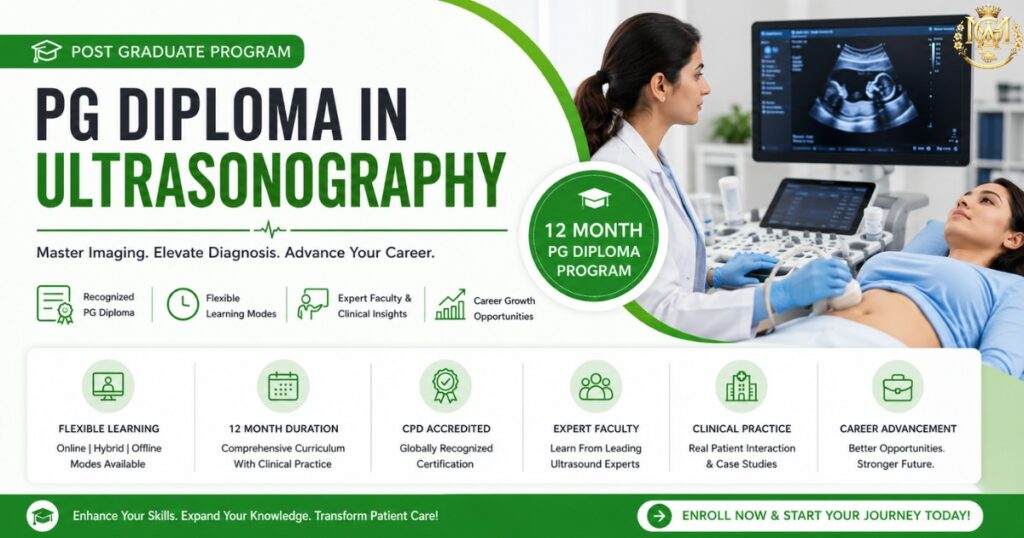
Ultrasonography has become one of the most in-demand diagnostic skills for MBBS doctors in India. It is noninvasive, fast, and used across specialties from obstetrics to emergency medicine — which is why more medical
graduates are choosing a structured PG Diploma in Ultrasonography instead of, or alongside, a full postgraduate
degree.
This guide covers everything an MBBS doctor needs to know before enrolling: eligibility, course duration, fees,
syllabus, career opportunities, and how a PG Diploma compares with a fellowship in ultrasonography. It also
explains the regulatory context every doctor practising ultrasonography in India should be aware of.
What Is a PG Diploma in Ultrasonography?
A PG Diploma in Ultrasonography is a postgraduate-level certificate program for MBBS graduates and
practising doctors that combines structured theory (ultrasound physics, anatomy, imaging protocols) with
supervised clinical training, so doctors can learn to perform and interpret diagnostic ultrasound scans across
It sits alongside — and is often compared with — MD/DNB Radiology (a full postgraduate degree), DMRD (a 2-
year diploma), and short-format fellowship programs. A PG Diploma is designed to be completed while
continuing clinical practice, typically through a hybrid of live/recorded online classes and hands-on hospital
training
Why MBBS Doctors Are Choosing Ultrasonography as a Specialisation
Ultrasound is one of the most widely used point-of-care and diagnostic imaging tools in modern medicine
because it is safe, radiation-free, and delivers real-time information at the bedside. For MBBS doctors, building
competence in ultrasonography adds a practical diagnostic skill that is useful in general practice, obstetrics and
gynaecology, emergency and critical care, and internal medicine alike.
A structured diploma gives doctors a way to build this skill formally — through supervised training and a defined
curriculum — rather than picking it up informally on the job.
Eligibility Criteria for PG Diploma in Ultrasonography After MBBS
Eligibility requirements are set by the training provider and can vary slightly between institutes. In general, the
following applies:
- A recognised MBBS degree from an institution registered with the National Medical Commission (NMC) or
an equivalent recognised authority. - Valid medical registration with a State Medical Council or the NMC.
- MD/MS and other postgraduate doctors are also eligible and often enrol to add a diagnostic-imaging skill to
their existing specialisation. - No prior radiology experience is typically required, since the course is designed to build ultrasonography
skills from the fundamentals.
Always confirm the exact eligibility criteria, document requirements, and any state-specific conditions directly
with the training provider before applying.
Course Duration & Learning Format
Most PG Diploma in Ultrasonography programs for MBBS doctors in India run for around 12 months and are
offered in flexible formats so working doctors can continue clinical practice while studying:
- Online — live and recorded theory classes, accessible from anywhere.
- Hybrid — online theory combined with clinical training at an affiliated hospital or imaging centre.
- Offline — in-person classes plus a dedicated on-site clinical training period.
Programs generally include recorded lectures for revision, structured clinical exposure, and post-course
mentorship to support doctors as they begin applying ultrasound skills in practice.
Syllabus & Curriculum: What You’ll Actually Learn
A comprehensive PG Diploma in Ultrasonography curriculum is organised by organ system and technique,
moving from fundamentals to advanced applications. A representative module structure looks like this:
| Module | Core Focus | Skill Outcome |
| Ultrasound Physics & Technology |
Acoustic principles, image formation, equipment calibration |
Understand how ultrasound images are generated and optimised |
| Abdominal Ultrasound | Liver, gallbladder, pancreas, spleen, renal anatomy |
Identify common abdominal pathologies on scan |
| Obstetrics & Gynaecology Ultrasound |
First-trimester scanning, obstetric and gynaecological imaging |
Perform routine antenatal and gynaecological scans |
| Musculoskeletal & Soft Tissue | Joint and soft-tissue imaging | Assess musculoskeletal pathology |
| Cardiovascular Ultrasound & Doppler |
Echocardiography basics, vascular Doppler |
Evaluate blood flow and basic cardiac imaging |
| Pediatric & Neurological Ultrasound |
Pediatric anatomy, neonatal brain, carotid Doppler |
Apply ultrasound in pediatric and neuro-imaging contexts |
| Advanced Techniques | Elastography, contrast- | Understand emerging and |
| enhanced and interventional ultrasound |
specialised applications | |
| Clinical Internship & Reporting | Supervised scanning, case discussions, documentation, ethics |
Build hands-on competence and reporting standards |
For the exact current curriculum, batch schedule, and faculty for this program, see Medical Global Academy’s
PG Diploma in Ultrasonography course page.
Fees & EMI Options
Course fees for a PG Diploma in Ultrasonography vary by institute, study mode, and inclusions such as clinical
training and mentorship. As of this writing, Medical Global Academy’s program is priced as follows (fees are
subject to change — always confirm the current fee on the official course page before enrolling):
| Study Mode | Course Fee |
| Online (full online access) | ₹1,00,000 |
| Hybrid (online theory + clinical attachment) | ₹1,40,000 |
| Offline (in-person + 1 month training) | ₹1,30,000 |
Interest-free (0%) EMI plans are available on eligible modes — for example, the online track can be split into 3 or
4 monthly instalments after an upfront registration payment. For exact, up-to-date fees and EMI terms, check
the
PG Diploma in Ultrasonography fee calculator on the official course page or discuss with the admissions team on
WhatsApp.
PG Diploma vs Fellowship in Ultrasonography: Which Should You Choose?
This is one of the most common questions MBBS doctors ask when planning their next step. The honest answer
depends on what kind of learning and career outcome you want.
| Parameter | PG Diploma | Fellowship |
| Learning style | Structured academic curriculum with theory + supervised clinical training | Primarily hands-on, skill-intensive clinical training |
| Typical duration | Around 12 months | Varies by program and institute, often shorter and more intensive |
| Best suited for | Doctors who want a comprehensive, exam-backed foundation across multiple ultrasound applications | Doctors who want fast, focused, practice-ready skills in a narrower area |
| Career use | Broad diagnostic-imaging competence usable across specialties | Targeted expertise for a specific clinical role or setting |
For a deeper breakdown of how fellowships and PG diplomas compare across eligibility, cost, and career impact,
see Medical Global Academy’s dedicated comparison:
Post-MBBS Fellowship vs PG Diploma in India
Career Opportunities After PG Diploma in Ultrasonography
A PG Diploma in Ultrasonography can open several career paths for MBBS doctors, depending on your existing
qualifications, state regulations, and the practice setting:
- Hospitals — working as part of the diagnostic imaging or radiology-support team.
- Diagnostic and imaging centres.
- Obstetrics, gynaecology, and women’s health clinics.
- Assisting in ultrasound-guided and interventional procedures.
- Independent diagnostic practice, strictly within what local regulations permit (see the regulatory section
below). - A foundation for further specialisation in radiology or diagnostic imaging.
Note: Detailed engagement and conversion data (e.g., which career path readers pursue most) were not
evaluated for this article, as GA4 was not available at the time of writing. Career outcomes also depend on
individual state regulations, existing qualifications, and the hiring institution.
Legal & Regulatory Considerations: PC&PNDT Act Compliance
Any facility in India that performs ultrasound examinations — including obstetric scanning — operates under the
Pre-Conception and Pre-Natal Diagnostic Techniques (PC&PNDT) Act, 1994. This law regulates the use of
ultrasound and other technologies to prevent sex selection, and it requires:
- Registration of ultrasound clinics and imaging centres with the appropriate government authority (the
State or District Appropriate Authority). - Display of the treating doctor’s qualification certificates at the facility.
- Maintenance of specific records (such as Form F) for antenatal ultrasound procedures.
Qualification requirements for independent registration under the Act — and how they apply to diplomaqualified doctors versus MD/DNB Radiology-qualified doctors — are implemented at the state level and have
been the subject of ongoing legal interpretation in Indian courts. Because requirements can vary by state and
change over time, always verify current rules with your State or District Appropriate Authority (for example,
state health department PC&PNDT cells such as the
Delhi Directorate of Health Services PC&PNDT Act page publish registration forms, training notifications, and
compliance circulars) before beginning independent ultrasound practice.
This diploma is designed to build clinical and diagnostic-imaging competence. It does not replace the specific
statutory qualifications required for independent PC&PNDT registration in a given state — doctors should
confirm their eligibility to practise independently with the relevant authority.
Is a PG Diploma in Ultrasonography Worth It After MBBS?
For many MBBS doctors, the answer is yes — provided the goal is realistic. A PG Diploma is a strong option if you
want to:
- Add a practical, widely applicable diagnostic skill to your existing practice.
- Study in a flexible, hybrid format while continuing to work.
- Build a foundation before pursuing further radiology specialisation.
It is a less suitable substitute if your specific goal is to become an MD/DNB Radiologist, since that requires a
separate, government-recognised postgraduate degree pathway. Many doctors use a PG Diploma as a practical
skill-building step, and some go on to pursue formal radiology postgraduate training afterward.\
How to Enrol in the PG Diploma in Ultrasonography at Medical Global Academy
- Check your eligibility (MBBS degree with valid registration, or an existing PG qualification).
- Choose your preferred study mode — online, hybrid, or offline.
- Speak with the admissions team on WhatsApp to get the current syllabus, batch dates, and fee/EMI details.
- Enrol and complete registration; EMI options are available for eligible study modes.
- Begin live and recorded classes, followed by supervised clinical training and a year of mentorship.
| Ready to build formal, structured expertise in diagnostic ultrasound? Explore the curriculum, faculty, fee/EMI calculator, and batch dates for the PG Diploma in Ultrasonography. |
| View the PG Diploma in Ultrasonography course page → |
Further Reading on MBBS Career Pathways
Frequently Asked Questions
What is the eligibility for a PG Diploma in Ultrasonography after MBBS?
You need a recognised MBBS degree and valid medical registration with a State Medical Council or the NMC. MD/MS and other postgraduate doctors are also eligible. Exact requirements can vary by training provider, so confirm details before applying.
How long does a PG Diploma in Ultrasonography take to complete?
Most programs, including Medical Global Academy’s, run for approximately 12 months, combining theory classes with supervised clinical training and post-course mentorship.
What is the difference between a PG Diploma and a Fellowship in Ultrasonography?
A PG Diploma offers structured academic learning with a formal curriculum alongside supervised clinical exposure, typically over about a year. A fellowship is generally shorter and more hands-on, focused on building practical skills quickly in a specific clinical setting. See the comparison table above, or read the full fellowship vs PG diploma comparison for more detail.
Can an MBBS doctor perform ultrasound without an MD in Radiology?
MBBS doctors can build ultrasound skills through diploma and certificate training, but independent practice and registration of an ultrasound facility in India is governed by the PC&PNDT Act, 1994, and enforced by state/district authorities. Qualification requirements for independent registration vary by state and have been subject to legal interpretation, so doctors should verify current requirements with their State or District Appropriate Authority rather than assume a diploma alone is sufficient for independent practice everywhere.
Is a PG Diploma in Ultrasonography a good career option after MBBS?
It can be a strong option for doctors who want a practical, widely applicable diagnostic skill without committing to a multi-year postgraduate degree, and who plan to use it within their existing or a supervised practice setting. It is not a direct substitute for an MD/DNB Radiology degree if that is your specific career goal.
What is the fee for a PG Diploma in Ultrasonography course?
Fees vary by institute and study mode (online, hybrid, or offline), and interest-free EMI options are commonly available. Check the official fee and EMI calculator for current pricing.
What career opportunities are available after a PG Diploma in Ultrasonography?
Graduates commonly work in hospitals, diagnostic and imaging centres, and obstetrics/gynaecology or women’s health clinics, assist with ultrasound-guided procedures, or use the diploma as a foundation for further specialisation in radiology — subject to the regulatory scope of practice in their state.
Sources referenced for regulatory information: Delhi Directorate of Health Services & Family Welfare — PC&PNDT Act page (health.delhi.gov.in). Course structure, curriculum, fees, and eligibility details reflect Medical Global Academy’s official PG Diploma in Ultrasonography course page as published at the time of writing; verify current details on the course page, as programs are updated periodically.