
This guide covers real 2026 numbers for every stage, so you get a clear answer on the highest paying doctors in India. We look at mbbs doctor salary for fresh graduates, then compare doctor salary in india across MD, MS, and DM specialists, so you can see the full picture from starting pay to the top earners in the field.
Quick Salary Overview (2026)
Qualification- Averaged Salary per year.
- MBBS Doctor – ₹5 – 18 Lakhs
- MD Doctor – ₹12 – 40 Lakhs
- MS Doctor – ₹15 – 60 Lakhs
DM / MCh (Super specialist) 30 lakhs -2 crores and above.
Doctor Salary in India: Monthly Breakdown (2026)
Many doctors and students search for monthly figures instead of annual packages. Here’s the monthly equivalent:
- MBBS Doctor: ₹40,000 – ₹1,50,000/month
- MD Doctor: ₹1,00,000 – ₹3,30,000/month
- MS Doctor: ₹1,25,000 – ₹5,00,000/month
- DM/MCh Super Specialist: ₹2,50,000 – ₹16,00,000+/month
These figures vary based on government vs private sector, city tier, and years of experience.
1. MBBS Doctor Salary in India
An MBBS degree is a gateway to the field of medicine and the foundation of the career of a doctor.
Average Annual Salary (2026)
- Experience & Sector Breakdown
Freshers (0–2 years)
- Government hospitals: 5 – 7 lakhs
- Private hospitals: 6 – 9 lakhs
Training positions typically involve positions of Junior Resident or Medical Officer.
Mid‑Level (3–6 years)
- Government sector: 7 – 10 Lakhs
- Private sector: 9 – 15 Lakhs
Physicians are involved in OPD, emergency, and managing patients on their own.
Senior MBBS Doctors (7+ years)
- Government jobs 10 – 14 lakhs
- private practice: 12 – 18 lakhs
The administrative work and personal consultations are considered to be very profitable.
Many MBBS doctors looking for better career growth after MBBS increase their income by enrolling in Fellowship courses for doctors that enhance practical clinical skills.To understand which specific roles pay the most, check our detailed guide on jobs after MBBS and salary.
If NEET PG isn’t part of your plan, our guide on courses after MBBS without NEET PG breaks down salary potential across fellowships, PG diplomas, and international certifications.
2. MD doctor salary in India
A doctor with an MD degree in areas such as General Medicine, Pediatrics, Dermatology or Psychiatry transforms him or her into a specialist consultant.
Average Annual Salary (2026)
- Experience & Sector Breakdown
Junior Consultant (03 years after MD)
- Government hospitals: 12 – 18 lakhs
- Private corporate hospitals: 15 – 25 lakhs
- Early private practice: 10 – 20 lakhs
Senior Consultant (4–10 years)
- Government sector: 18-28 lakhs
- Private hospitals: 25-40 lakhs
- Established private practice: 25-50 lakhs
Senior Experts / HOD (10+ years)
- Government institutions: 28 – 40 lakhs
- Corporate hospitals: 35 – 60 lakhs
- Best privates: 40 lakhs – 1 crore
3. Salary of an MS doctor in India
An MS degree provides the doctors with surgical proficiency in orthopedics, general surgery, ENT, Ophthalmology, and others.
Average Annual Salary (2026)
- Experience & Sector Breakdown
Early Career (0–3 years post‑MS)
- Government hospitals: 15 – 22 lakhs
- Private corporate hospitals: 18 – 30 lakhs
Independent Surgeons (4–10 years)
- Government sector: 22 – 35 lakhs
- Private hospitals: 30 – 50 lakhs
- Own nursing home / practice: 35 – 70 lakhs
Lead Surgeons (10+ years)
- Government hospitals: 35 – 50 lakhs
- Corporate hospitals: 45 – 80 lakhs
- High volume private surgeons: 50 lakhs – 1.5 crores
4. Salary of Super Specialist Doctor in India
Super-specialisation is the ultimate form of medical field.
Mean Annual Wage (2026)
- Experience & Sector Breakdown
New Super‑Specialists (0–5 years)
- Government institutes at the top: 30 – 50 lakhs
- Chains of hospitals, private: 40 – 70 lakhs
- Early specialty centres: 35 – 60 lakhs
Established Experts (5–15 years)
- Government jobs: 50 – 80 lakhs
- Private jobs: 70 lakhs – 1.5 crores
- Successful centres: 1– 2 crores
Experts at the National Level (15+ years)
- Government leadership positions: 80 lakhs – 1.2 crores
- Corporate healthcare: 1.2 – 2 crores
- Famous private practitioners: 1.5 – 3 croresGovernment Doctor Salary in India (AIIMS, Army & State Hospitals)
5. Government positions remain highly competitive due to job security, pension, and structured growth.
- AIIMS Doctor Salary: Junior Resident: ₹67,700 – ₹85,000/month | Senior Resident: ₹78,800 – ₹1,00,000/month | Faculty/Consultant: ₹1,50,000 – ₹2,50,000+/month
- Army Doctor Salary (AFMS): Medical Officer entry-level: ₹56,100 – ₹1,77,500/month (Level-10, 7th Pay Commission) plus military allowances, housing, and pension benefits.
- State Government Hospital Salary: Medical Officer: ₹50,000 – ₹90,000/month, varying by state and years of service.
6.Doctor Salary by Specialization in India
| Specialization | Average Annual Salary |
|---|---|
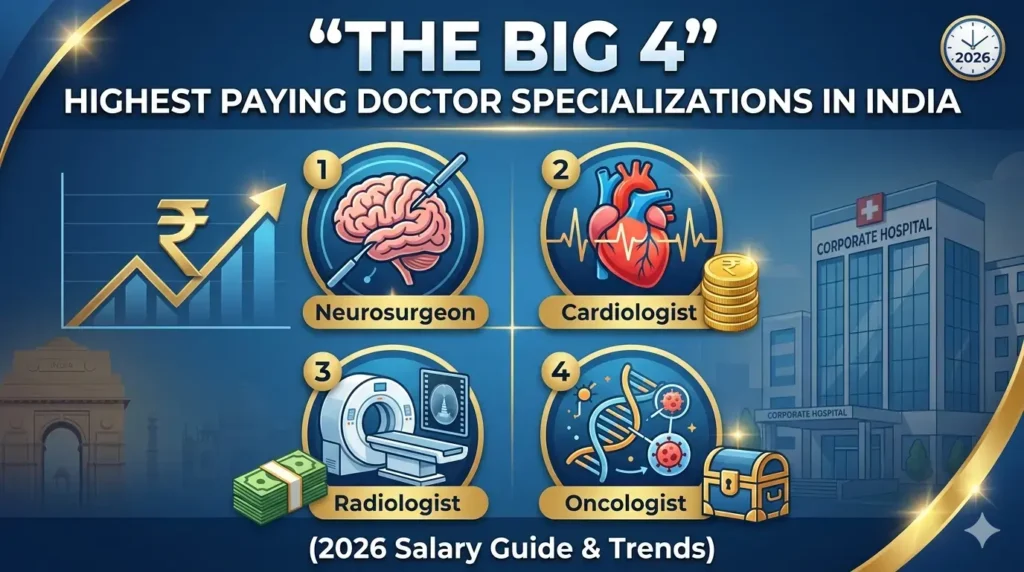
| Cardiologist | ₹25 – 80 Lakhs |
| Neurosurgeon | ₹35 Lakhs – 1.5 Crores |
| Oncologist | ₹30 – 90 Lakhs |
| Orthopedic Surgeon | ₹20 – 70 Lakhs |
| Dermatologist | ₹15 – 60 Lakhs |
| General Physician | ₹8 – 25 Lakhs |
The Major Trends that will influence Highest Paying Doctor in 2026
- Hybrid model of income: Fixed salary + teleconsultation + visiting practice.
- Tier-2 and Tier-3 urban development: Low competition and high demand.
- Government vs Private: Stability vs high earning ceiling.
- Online presence: The online reputation is now directly affecting the income.
Doctors with MD, MS, DM, MCh or fellowship programs hasten the rate of salary increase,owing to the requirement of specialization.
Conclusion
The yearly wages of an Indian doctor in 2026 do not only indicate the level of academic credentials but also the worth that a physician generates due to his knowledge, experience, and customer loyalty. Although MBBS is the basis, the branching power of MD, MS, DM, or MCh allows much better income. In the current state of healthcare, physicians who deliver clinical excellence and remain engaged in learning and with high professional presence experience the most financial and career development.
FAQs -Mean Salary of Doctor in India
How much does an MBBS doctor earn in India?
A fresh MBBS graduate in India usually earns between ₹40,000 and ₹80,000 a month, depending on the city, hospital type, and whether they work in government or private practice. Pay rises sharply once they go on to specialize
Who is the highest paid doctor in India?
Senior specialists in high-demand fields, such as cardiac surgeons, neurosurgeons and oncologists, are usually the highest paid doctors in India, with top earners crossing ₹3-5 lakh a month at major private hospitals.
What is the salary of a DM or MCH doctor in India?
DM and MCH doctors, who hold the highest super-specialty qualifications, generally earn between ₹1.5 lakh and ₹4 lakh a month, with senior consultants in metro cities often earning more.
Which is better, government or private doctor wages
The government has employment security, and benefits, and in private practice, high levels of income are offered.
Is it possible that doctors can make more in private practice
Yes. Specialization, visiting consultancy and private practice are very effective in increasing earnings.
What is the average salary of a doctor in India?
The average salary of a doctor in India ranges from ₹6 – 15 lakhs per year for MBBS graduates, going up to ₹40 lakhs – 2 crores for super specialists, depending on qualification and sector.
What is the salary difference between MD and MS doctors?
MS doctors (surgical specialists) generally earn slightly higher than MD doctors (physicians) due to procedural and surgical income, though both offer strong long-term earning potential.
Our Top High Paying Courses
Fellowship
PG Diploma
Certificate
MCh & DM Doctor Salary in India — By Specialty
MCh (Master of Chirurgiae) and DM (Doctorate of Medicine) are India’s highest super-specialty qualifications — pursued after MS or MD in fields like neurosurgery, cardiology, and oncology. As the breakdown above shows, this is also where doctor income in India reaches its peak. Here’s what that looks like broken down by specialty and by month.
MCh and DM salary in India typically works out to ₹2.5 lakh – ₹16 lakh+ a month, depending on experience and sector — consistent with the annual figures above. Entry-level super-specialists (0–5 years) usually start around ₹2.5–5.8 lakh a month, while established national-level experts can cross ₹16 lakh+ a month in corporate or high-volume private practice.
| Experience Level | Typical Monthly Salary | Sector |
|---|---|---|
| New super-specialist (0–5 years) | ₹2.5 lakh – ₹5.8 lakh | Top government institutes to private chains |
| Established expert (5–15 years) | ₹4.2 lakh – ₹16.7 lakh | Government to successful private centres |
| National-level expert (15+ years) | ₹6.7 lakh – ₹25 lakh | Government leadership to established private practice |
Monthly figures are derived from the annual ranges above. Actual pay depends on specialty, institution, and individual practice.
DM Oncology salary in India typically falls within the ₹30–90 lakh a year range shown in the specialization table above, broadly in line with other DM specialties — oncology remains one of the more consistently in-demand super-specialties due to rising patient volumes across both government and private cancer care centres.
Which Doctor Earns the Highest Salary Per Month in India?
Going purely by monthly figures, DM and MCh super-specialists earn the most in India — as the monthly breakdown above shows, this bracket runs from roughly ₹2.5 lakh to ₹16 lakh or more a month, well above the MBBS, MD, or MS brackets. Within this group, cardiologists, neurosurgeons, and oncologists typically top the chart, driven by high procedural demand and years of specialised training that few other branches require.
A Few More Common Questions
Can a doctor earn ₹1 crore a month in India? This isn’t realistic through salaried employment. It’s occasionally seen among top surgeons or specialists with a very large private practice, multiple revenue streams, and decades of reputation-building — not a standard outcome for even most senior doctors.
What does MD stand for? MD stands for Doctor of Medicine — a postgraduate degree in non-surgical specialties such as General Medicine, Pediatrics, Dermatology, and Psychiatry, pursued after MBBS through NEET PG.
What is the maximum salary a doctor can earn in India? There’s no fixed ceiling. As the specialist and super-specialist figures above show, senior DM/MCh practitioners with an established reputation, multiple income streams, or hospital equity can earn well into the ₹1.5–3 crore a year range — though this represents the top tier of the profession, not a typical outcome.
What is the salary of an MBBS doctor per month in a private hospital? As shown in the breakdown above, private-sector MBBS doctors typically start around ₹40,000–₹90,000 a month at entry level. For a full breakdown by hospital type and city, see our private doctor salary guide →.
Explore More: Doctor Salary & Career Guides
Want a deeper breakdown for your specific situation — your city, your qualification, or your sector? These guides go further into each topic covered above.
MBBS Doctor Salary — City & Experience-Wise Guide →
See how MBBS salary varies across Delhi, Mumbai, Bengaluru and other states, plus how pay changes after 5+ years of experience.
Government Doctor Salary — Pay Scale by Department →
AIIMS, state government hospitals, and army medical pay scales, broken down by department and post.
Private Doctor Salary in India →
A closer look at how private hospital and clinic pay compares to government roles, month by month.
MD Salary — India vs USA Comparison →
Weighing an international career after MD? Compare pay, living costs, and career growth between India and the USA.
Dermatology Course — Career Scope & Opportunities →
Thinking about dermatology after MBBS? See the career path, scope, and opportunities this specialty offers.
Which Medical Specialization Is Best After MBBS? →
Compare specialties by scope, demand, and career fit — not just salary — to find the right path for you.
Jobs After MBBS — Complete Guide →
Explore Medical Officer, ICU Doctor, and Private Practitioner roles available right after MBBS.