
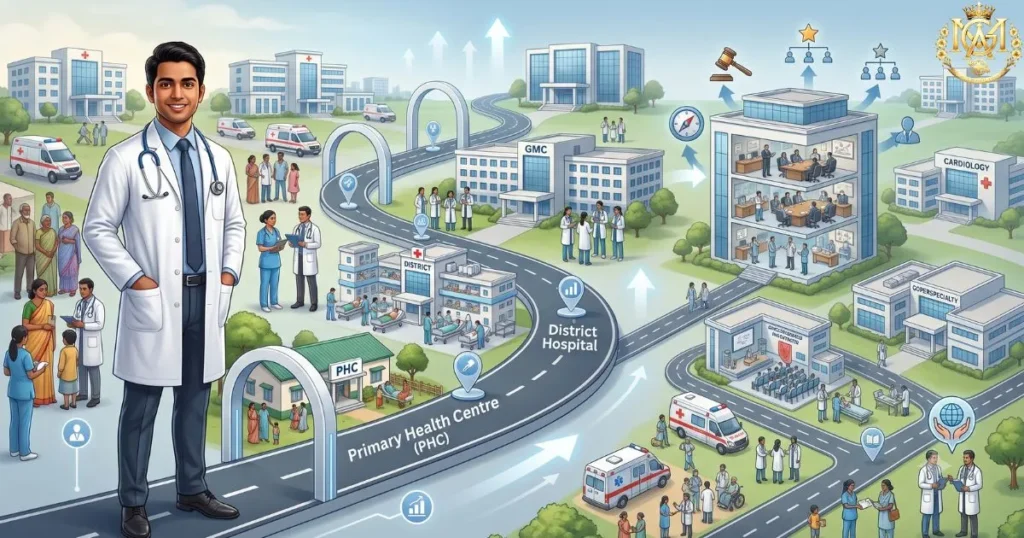
Government Jobs After MBBS: Complete Guide to Government Medical Careers in India
Completing an MBBS is a significant milestone, but for many graduates, it also marks the beginning of an important career decision. While some doctors prepare for NEET PG, others enter private hospitals or start clinical practice. At the same time, a large number of MBBS graduates actively search for government jobs after MBBS because they are looking for something beyond an attractive salary—they want job security, structured career growth, diverse clinical exposure, and the opportunity to contribute to public healthcare.
Government healthcare in India continues to be one of the largest employers of medical professionals. From Primary Health Centres (PHCs) and Community Health Centres (CHCs) to AIIMS, Railways, Armed Forces Medical Services, ESIC hospitals, and Central Health Services, doctors have access to multiple career pathways depending on their interests and long-term goals. These roles not only provide financial stability but also expose doctors to a wide variety of medical cases that strengthen clinical decision-making and professional confidence.
However, one common misconception is that every government job follows the same recruitment process or offers identical career opportunities. In reality, each role has different eligibility criteria, selection procedures, responsibilities, and growth prospects. Understanding these differences helps doctors choose a path that aligns with their professional aspirations rather than simply applying for the first available vacancy.
This guide explains how MBBS graduates can begin a government medical career, explores the major government job opportunities available in India, and provides practical insights to help doctors build a successful long-term career in public healthcare.
Can You Start a Government Medical Career Immediately After MBBS?
The short answer is yes. After completing your MBBS degree and compulsory rotating internship, you are eligible to apply for several government medical positions across central and state healthcare services. For many graduates, this becomes an excellent opportunity to gain structured clinical experience while earning a stable income.
Before applying, there are a few essential requirements that every MBBS graduate should understand.
Complete Your Internship Successfully
The compulsory rotating internship is not merely a graduation requirement—it serves as your first exposure to independent patient care under supervision. During this period, doctors gain experience across multiple departments, develop clinical judgment, and become familiar with hospital protocols.
Most government recruitment bodies require candidates to have successfully completed their internship before joining service.
Obtain Permanent Medical Registration
After internship completion, doctors must obtain permanent registration from the National Medical Commission (NMC) or the respective State Medical Council.
This registration legally authorizes doctors to practice medicine in India and is mandatory for almost every government medical recruitment process.
Without valid registration, applications for Medical Officer positions, UPSC Combined Medical Services (CMS), Armed Forces Medical Services, and many state-level recruitments are generally not accepted.
Is NEET PG Required for Government Jobs?
One of the biggest concerns among MBBS graduates is whether qualifying for NEET PG is necessary before entering government service.
The answer is not always.
Many government positions recruit doctors directly after MBBS without requiring postgraduate qualifications. Roles such as Medical Officer, General Duty Medical Officer (GDMO), contractual doctors under the National Health Mission (NHM), and several state health service positions primarily require an MBBS degree, internship completion, and valid registration.
Postgraduate qualifications become increasingly important for specialist positions, teaching appointments, and higher administrative roles later in a doctor’s career, but they are not mandatory for many entry-level government jobs.
Common Misconceptions About Government Medical Careers
Many fresh graduates delay applying for government positions because of misinformation. Understanding the facts can help doctors make more informed career decisions.
| Common Misconception | Reality |
| Government jobs require an MD/MS degree. | Many entry-level government roles recruit MBBS graduates directly. |
| NEET PG is compulsory before joining government service. | Several Medical Officer and public health positions only require MBBS and registration. |
| Government hospitals provide limited clinical exposure. | Government institutions often handle a high patient load, offering extensive hands-on clinical experience. |
| Career growth is slow in government healthcare. | Promotions, higher studies, administrative roles, and specialist positions provide multiple growth opportunities over time. |
Government Medical Career Pathways After MBBS
Government healthcare offers multiple entry routes depending on your career interests. Some positions are recruited through national-level competitive examinations, while others are filled by state governments or healthcare institutions.
| Career Pathway | Minimum Eligibility | Recruitment Authority | Typical Entry Role |
| UPSC Combined Medical Services (CMS) | MBBS + Internship + Registration | Union Public Service Commission | General Duty Medical Officer |
| State Health Services | MBBS + Registration | State Public Service Commission | Medical Officer |
| National Health Mission (NHM) | MBBS + Registration | State NHM Authorities | Medical Officer / Public Health Roles |
| Armed Forces Medical Services (AFMS) | MBBS + Registration | Armed Forces Medical Services | Commissioned Medical Officer |
| AIIMS & Government Medical Colleges | MBBS | Individual Institutions | Junior Resident / Medical Officer |
Recruitment criteria and vacancies may vary depending on the recruiting authority and official notifications.
Career Insight
Many MBBS graduates believe they must choose between preparing for postgraduate entrance examinations and starting a government job. In reality, these two goals are not always mutually exclusive. Several doctors gain valuable clinical experience through government service while simultaneously preparing for NEET PG or planning future specialization. Early exposure to diverse patient cases often strengthens both clinical confidence and long-term career planning.
What Government Career Opportunities Are Available for MBBS Graduates?
Government healthcare in India offers far more opportunities than many doctors initially realise. Beyond traditional Medical Officer roles, MBBS graduates can pursue careers in central government departments, defence services, public health programmes, premier teaching institutions, and specialised healthcare organisations.
Choosing the right opportunity depends on your professional interests, preferred work environment, and long-term career goals.
Medical Officer in State Health Services
Medical Officer positions remain one of the most sought-after government jobs after MBBS.
Doctors appointed as Medical Officers work in government hospitals, Primary Health Centres (PHCs), Community Health Centres (CHCs), district hospitals, and various public healthcare institutions. Their responsibilities include outpatient consultations, emergency care, inpatient management, preventive healthcare, and implementation of government health programmes.
These roles provide exceptional clinical exposure because government hospitals often serve large and diverse patient populations.
UPSC Combined Medical Services (CMS)
The UPSC Combined Medical Services Examination is one of the most prestigious recruitment pathways for MBBS graduates.
Successful candidates may be appointed to positions such as:
- General Duty Medical Officer (GDMO)
- Assistant Divisional Medical Officer (Indian Railways)
- Medical Officer in Central Health Services
- Medical Officer in various central government organisations
Apart from structured career progression, UPSC CMS provides doctors with opportunities to work within nationally administered healthcare systems and gain experience across multiple government institutions.
National Health Mission (NHM)
Doctors interested in community medicine and public health often find rewarding opportunities through the National Health Mission (NHM).
Working under NHM allows doctors to contribute to:
- Maternal and child healthcare
- Disease prevention programmes
- Immunisation initiatives
- Rural healthcare services
- Community health awareness
- National public health campaigns
These positions provide valuable experience in preventive healthcare and healthcare management while directly impacting underserved communities.
Armed Forces Medical Services (AFMS)
The Armed Forces Medical Services offer a unique career pathway for doctors who wish to combine clinical practice with national service.
Medical officers in the Army, Navy, and Air Force provide healthcare to defence personnel and their families while working in highly organised healthcare environments equipped with modern medical infrastructure.
In addition to professional development, AFMS offers opportunities for leadership training, multidisciplinary collaboration, and exposure to military medicine.
ESIC, Railways, AIIMS and Other Government Institutions
Several central organisations regularly recruit MBBS graduates for clinical positions.
These include:
- Employees’ State Insurance Corporation (ESIC)
- Indian Railways Medical Services
- AIIMS and Government Medical Colleges
- Municipal Health Services
- Central Government Health Scheme (CGHS)
Each organisation offers a distinct work environment, patient population, and career progression model, allowing doctors to choose roles aligned with their professional interests.
Government Career Opportunities After MBBS
| Career Option | Recruiting Authority | Primary Work Setting | Career Scope |
| Medical Officer | State Health Departments | PHCs, CHCs, District Hospitals | Clinical Practice & Public Healthcare |
| UPSC CMS | UPSC | Central Health Services & Railways | Central Government Medical Services |
| National Health Mission | State NHM | Community & Rural Healthcare | Public Health Programmes |
| Armed Forces Medical Services | Ministry of Defence | Army, Navy & Air Force Hospitals | Defence Medical Services |
| ESIC | ESIC | Multi-specialty Hospitals | Employee Healthcare Services |
| AIIMS & Government Medical Colleges | Individual Institutions | Teaching Hospitals | Clinical Practice, Teaching & Research |
What Does Career Growth Look Like in Government Healthcare?
Many MBBS graduates assume that once they secure a government job, their career remains unchanged for years. In reality, government healthcare follows a structured career progression that offers opportunities to move into specialist, academic, administrative, and leadership roles.
Your growth depends on several factors, including years of service, clinical performance, postgraduate qualifications, departmental vacancies, and continuous professional development. While the promotion process may differ across central and state services, doctors who invest in their skills and education often find rewarding long-term career opportunities.
Medical Officer – The Foundation of Your Career
Most government doctors begin their journey as Medical Officers. At this stage, the primary responsibility is to provide comprehensive patient care, manage outpatient and inpatient services, handle emergencies, and participate in public health initiatives.
This phase is crucial because it builds:
- Independent clinical decision-making
- Confidence in managing diverse medical cases
- Emergency care experience
- Leadership within multidisciplinary healthcare teams
For many doctors, these early years become the strongest foundation for future specialization and leadership.
Senior Medical Officer – Greater Responsibility and Leadership
With experience and departmental promotions, many doctors progress to Senior Medical Officer positions.
At this stage, responsibilities expand beyond patient care and may include:
- Supervising junior doctors
- Coordinating clinical departments
- Managing healthcare teams
- Improving quality of care
- Supporting hospital administration
Doctors also begin mentoring younger medical professionals while contributing to better patient management systems.
Specialist Roles After Postgraduate Training
Government healthcare strongly encourages higher education.
Doctors who complete MD, MS, DNB, Fellowship Programs, or other advanced qualifications become eligible for specialist positions within government hospitals and teaching institutions.
Specialists manage complex clinical cases, perform advanced procedures, and often receive greater academic and leadership responsibilities.
Rather than seeing postgraduate education as only a qualification, many government doctors view it as an investment in long-term professional growth.
Chief Medical Officer and Administrative Leadership
As doctors gain seniority, many transition into healthcare administration.
Positions such as Chief Medical Officer (CMO) or Medical Superintendent involve responsibilities including:
- Hospital administration
- Healthcare planning
- Policy implementation
- Resource management
- Public health coordination
- Clinical governance
These leadership roles allow experienced doctors to improve healthcare delivery on a much larger scale than individual clinical practice.
Opportunities in Teaching and Research
Government medical colleges and premier institutions also provide opportunities for doctors interested in academics.
Doctors can contribute through:
- Undergraduate and postgraduate teaching
- Clinical research
- Medical publications
- National healthcare projects
- Continuing Medical Education (CME)
Academic careers enable doctors to influence future generations of healthcare professionals while remaining actively involved in clinical practice.
Government Healthcare Career Progression
| Career Stage | Primary Focus | Professional Growth |
| Medical Officer | Patient care and clinical services | Develop core clinical experience |
| Senior Medical Officer | Departmental supervision | Leadership and team management |
| Specialist Consultant | Advanced clinical practice | Specialty expertise and complex case management |
| Chief Medical Officer | Hospital administration | Healthcare planning and policy implementation |
| Medical Superintendent | Institutional leadership | Strategic hospital management |
| Academic & Teaching Roles | Medical education and research | Teaching, publications, and professional development |
Career Insight
Government healthcare should not be viewed as a static career. Doctors who continue upgrading their knowledge, pursue postgraduate education, and strengthen their clinical expertise often progress into highly respected specialist, academic, and administrative roles.
What Challenges Do Doctors Face in Government Jobs—and How Can They Prepare?
Government healthcare offers tremendous learning opportunities, but it also comes with professional challenges that every MBBS graduate should understand before entering public service.
Being aware of these realities helps doctors prepare mentally, professionally, and emotionally for a rewarding career.
Rural Postings Build Clinical Confidence
Many government doctors begin their careers in rural or semi-urban healthcare facilities.
Although these postings may involve limited infrastructure, they also expose doctors to a wide variety of medical conditions and encourage independent clinical decision-making.
Many experienced physicians consider rural service one of the most valuable learning experiences in their careers.
Managing High Patient Volumes
Government hospitals often treat hundreds of patients every day.
Doctors must learn to:
- Prioritize emergencies
- Make timely clinical decisions
- Communicate efficiently
- Maintain high standards of patient care despite heavy workloads
Developing these skills early significantly improves long-term clinical competence.
Administrative Responsibilities
Government doctors are responsible for more than treating patients.
They also contribute to:
- Medical documentation
- Public health reporting
- National healthcare programmes
- Vaccination drives
- Health awareness campaigns
- Institutional audits
Strong organisational skills become just as important as clinical knowledge.
Balancing Higher Studies with Clinical Duties
Many doctors continue preparing for NEET PG, Fellowship Programs, or other advanced qualifications while working full-time.
Although balancing study and clinical responsibilities can be challenging, proper time management allows many government doctors to continue advancing their careers without leaving service.
Preventing Professional Burnout
Long working hours, emergency duties, emotional stress, and increasing patient expectations can affect every healthcare professional.
Doctors can reduce burnout by:
- Maintaining continuous learning
- Seeking mentorship
- Building supportive professional networks
- Prioritising physical and mental wellbeing
- Developing efficient clinical workflows
Challenges and Practical Preparation
| Challenge | Practical Approach |
| Rural postings | View them as opportunities to strengthen clinical decision-making. |
| Heavy patient load | Improve time management and communication skills. |
| Administrative work | Develop documentation and organisational skills. |
| Limited resources | Strengthen clinical examination and diagnostic reasoning. |
| NEET PG preparation | Follow a structured study plan alongside clinical practice. |
| Professional burnout | Focus on wellbeing, mentorship, and continuous professional development. |
How Can MBBS Graduates Build a Successful Long-Term Government Medical Career?
Securing a government job is only the beginning. Long-term success depends on how consistently doctors continue learning, improving, and adapting to changing healthcare needs.
The most respected government doctors are recognised not only for their years of service but also for their commitment to clinical excellence.
Strengthen Clinical Competence
Strong diagnostic reasoning, evidence-based decision-making, and patient-centred care remain the foundation of every successful medical career.
Continue Medical Education
Medicine evolves continuously. Participating in Continuing Medical Education (CME), conferences, workshops, and certification programmes helps doctors remain updated with current clinical practices.
Develop Advanced Clinical Skills
Procedural expertise and specialty-focused training often improve both professional confidence and career opportunities.
Many doctors choose Fellowship Programs or PG Diploma courses to strengthen practical clinical skills while continuing their medical careers.
Participate in Research and Teaching
Academic involvement allows doctors to contribute beyond routine patient care.
Publishing research, teaching medical students, and participating in institutional projects enhances professional credibility and leadership opportunities.
Build a Strong Professional Reputation
Long-term career success depends on more than qualifications.
Doctors who consistently demonstrate:
- Ethical practice
- Compassionate patient care
- Effective communication
- Teamwork
- Clinical excellence
naturally earn the trust of patients, colleagues, and healthcare institutions.
How Medical Global Academy Supports Doctors
Building a successful government medical career requires continuous learning long after completing MBBS.
Medical Global Academy supports this journey through Fellowship Programs and PG Diploma courses that focus on practical clinical training, evidence-based medicine, and specialty-specific skill development. These programmes are designed to help doctors strengthen their expertise, improve clinical confidence, and prepare for greater professional responsibilities while continuing their careers.
How to Become a Government Doctor After MBBS: Step-by-Step Process
Understanding the pathway helps doctors move from graduation to a confirmed government post without unnecessary delays. The process looks complex from the outside, but it follows a clear sequence — and most MBBS graduates can complete every step within six to twelve months of finishing internship.
Step 1: Complete Your MBBS and Compulsory Internship
The foundation is straightforward — finish your MBBS degree and your compulsory rotating internship. The internship is not optional; every government recruitment authority requires it as a minimum prerequisite. Without a completion certificate from your internship, your application for any Medical Officer post or central government exam will not be considered.
Step 2: Obtain Permanent Medical Registration
After internship, register with the National Medical Commission (NMC) or your respective State Medical Council. This registration is your legal authorisation to practise medicine in India and is mandatory for all government medical job applications — central and state. Provisional registration (issued during internship) is not sufficient for most recruitment processes. Apply for permanent registration as soon as your internship completion certificate is in hand.
Step 3: Choose Your Government Career Route
Not every government doctor role uses the same recruitment pathway. Before preparing applications or appearing for exams, decide which route fits your goals:
- Central government service — UPSC CMS, ESIC, Railways, AFMS, CGHS. These typically involve a national-level exam and offer postings across India.
- State government service — State PSC or State Health Department recruitment. Selection criteria, exam format, and timelines vary significantly by state.
- NHM contractual roles — National Health Mission posts at district and block level, filled by state NHM authorities on a rolling basis. These are often faster to access than permanent posts.
- Institution-specific posts — AIIMS, government medical colleges, and teaching hospitals post their own vacancies independently and recruit directly.
Step 4: Monitor Official Vacancy Notifications
Government vacancies are time-bound. A post that has applications open today may close within 30 days, and the next cycle may not open for months. Check these sources regularly:
- The UPSC website (upsc.gov.in) for CMS and central government posts
- Your State Public Service Commission website for state health department vacancies
- The state NHM portal for contractual medical officer roles
- Individual institution websites for AIIMS, ESIC, Railways medical services
- Employment News (a Government of India publication) and the NHM website for broader listings
Step 5: Prepare for the Relevant Exam or Selection Process
Central government posts require clearing a competitive exam — the UPSC CMS being the most important (covered in detail in the next section). Many state-level Medical Officer posts use a state PSC written exam. Some NHM and institution-specific vacancies use interviews or merit-based shortlisting without a separate written exam. Know exactly which process applies to the posts you are targeting before you begin preparation.
Step 6: Complete Documentation and Verification
Government recruitments have strict documentation requirements. Gather these in advance to avoid last-minute delays:
- MBBS degree certificate and marksheets (all professional exams)
- Internship completion certificate
- Permanent medical registration certificate
- Caste or category certificate (if applicable — OBC/SC/ST/EWS)
- Domicile or nativity certificate (required for most state-level applications)
- Age proof and identity documents
| Step | Action | Typical Timeline |
|---|---|---|
| 1 | Complete MBBS + internship | During final year + 1 year internship |
| 2 | Obtain permanent medical registration | 2–6 weeks after internship completion |
| 3 | Choose central vs state vs NHM route | Decide before or during internship |
| 4 | Monitor vacancy notifications | Ongoing — check official portals weekly |
| 5 | Prepare for exam or selection process | 3–6 months preparation typically required for UPSC CMS |
| 6 | Compile documents, apply, attend interview | As per notification dates |
Government Exams and Recruitment for MBBS Doctors in India (2026)
The most commonly asked question after “which government job should I target” is “which exam do I need to clear.” The answer depends entirely on which type of government post you are applying for. Central government posts use national-level competitive exams conducted by constitutional bodies; state posts use state-level processes; some organisations conduct their own recruitment directly.
UPSC Combined Medical Services (CMS) Examination
The UPSC CMS is the primary route to central government Medical Officer posts. It is conducted annually by the Union Public Service Commission and is one of the most competitive medical recruitment exams in the country.
- Eligibility: MBBS degree (including internship completion) + registration with NMC or State Medical Council. Age limit is typically up to 32 years (with relaxation for reserved categories).
- Format: A written exam (two papers covering clinical subjects at MBBS level) followed by a personality test/interview for shortlisted candidates.
- Posts filled: General Duty Medical Officer (Railways, CHS), Assistant Divisional Medical Officer (Railways), Medical Officer in Central Health Services, and similar central department posts.
- Notification: Released annually — watch the UPSC official website (upsc.gov.in) for the current year’s schedule.
State Public Service Commission Exams
Each state conducts its own Medical Officer recruitment through the State Public Service Commission (PSC) or directly through the State Health Department. These are the primary route to government Medical Officer posts in state health services, PHCs, CHCs, and district hospitals.
- Examples: BPSC (Bihar), UPPSC (Uttar Pradesh), TNPSC (Tamil Nadu), KPSC (Karnataka), MPSC (Maharashtra), Kerala PSC, Rajasthan PSC, and similar bodies in every state.
- Format: Varies by state — some conduct a written exam, others use merit-based shortlisting from MBBS marks, and some use a combination of written test and interview.
- Where to check: Your state’s official PSC website. For most states, a domicile or nativity certificate is required to apply.
NHM (National Health Mission) Recruitment
State NHM authorities issue contractual Medical Officer vacancies on a rolling basis throughout the year — often faster to access than permanent posts. These positions are funded under the National Health Mission and are filled at district, block, and taluka level across rural and semi-urban areas.
- Eligibility: MBBS + registration, usually without an additional written exam — selection is merit-based or through interview.
- Where to check: State NHM portal (each state has its own — search “[state name] NHM recruitment 2026”).
- Note: Contractual posts are not permanent government positions but provide valuable clinical experience and a salary while you prepare for permanent recruitment exams.
AFMS (Armed Forces Medical Services) Recruitment
The Armed Forces recruit MBBS doctors through Short Service Commission (SSC) and Permanent Commission (PC) pathways. SSC gives a 5-year initial service tenure (extendable), while PC is a career appointment. Selection involves a Combined Medical Services examination for some entries and direct interview-based selection for others. Check the official Join Indian Army, Indian Navy, and Indian Air Force recruitment websites for current notifications.
ESIC and Railway Medical Services
ESIC (Employee State Insurance Corporation) recruits Insurance Medical Officers through direct recruitment with a written exam and interview. Indian Railways recruits Railway Medical Officers through the UPSC CMS and also through RRB (Railway Recruitment Board) processes for certain categories. Both organisations issue vacancies independently of the state PSC cycle.
| Exam / Recruitment | Conducting Body | Posts Filled | Where to Check |
|---|---|---|---|
| UPSC CMS | Union Public Service Commission | CHS, Railways GDMO, Central Govt MO | upsc.gov.in |
| State PSC Exam | State Public Service Commission | State MO — PHC, CHC, District Hospital | Respective state PSC website |
| NHM Recruitment | State NHM Authority | Contractual MO — rural / block level | State NHM portal |
| AFMS SSC / PC | Ministry of Defence | Army, Navy, Air Force Medical Officer | joinindianarmy.nic.in / navy.gov.in |
| ESIC Direct Recruitment | ESIC | Insurance Medical Officer | esic.gov.in |
| AIIMS / GMC Direct | Individual Institution | Junior Resident / MO / Senior Resident | Respective institution website |
Vacancy alerts: Government medical vacancies do not follow a fixed annual calendar the way NEET PG does. Set up alerts on official state health department websites, your state PSC portal, and the Employment News website so that notifications reach you when they are released rather than after the application window has closed.
Can You Get a Government Job After MBBS Without PG — and Does Your College Type Matter?
These are two of the most commonly searched questions among MBBS graduates considering a government career, and both deserve a direct answer rather than a vague “it depends.”
Can you get a government job after MBBS without PG?
Yes — and this applies to the majority of entry-level government doctor posts in India.
Medical Officer positions in state health services, PHC doctors under NHM, UPSC CMS candidates, ESIC Medical Officers, Railway Medical Officers, and Armed Forces Medical Officers are all recruited at the MBBS level. A postgraduate degree (MD/MS) is not a requirement for these roles.
Where a PG qualification becomes important:
- Specialist posts — positions that require a specific clinical specialty (e.g., Specialist Surgeon, Specialist Physician at a district hospital) typically require MD/MS in the relevant subject.
- Teaching appointments — government medical college faculty positions (Lecturer, Assistant Professor and above) require a postgraduate degree plus experience.
- Senior administrative roles — CMO and above positions in state health services usually require both experience and a PG qualification as the career progresses.
For entry-level clinical service — which is where every government doctor career begins — an MBBS with internship completion and registration is sufficient.
Does it matter whether you graduated from a private medical college?
No — provided the college is recognised by the National Medical Commission (NMC).
Government recruitment authorities do not differentiate between degrees from government medical colleges and NMC-recognised private medical colleges. The MBBS degree itself is what is evaluated, not the institution that awarded it. A candidate who completed MBBS from a private NMC-recognised college and holds valid permanent registration is eligible for the same government posts as a candidate from a government medical college.
Two things that do matter regardless of college type:
- NMC recognition: Your college must be listed as recognised by the NMC. If in doubt, verify your institution’s status on the NMC website before applying.
- Domicile requirements: For state-level Medical Officer posts, many states require candidates to be domiciled in that state — this applies regardless of where you completed MBBS. If you studied in a different state, check the specific domicile eligibility rules for the state where you want to work.
| Question | Direct Answer |
|---|---|
| Can I get a government job after MBBS without PG? | Yes — most entry-level MO posts only require MBBS + registration |
| Does college type (government vs private) affect eligibility? | No — NMC recognition is what matters, not government vs private status |
| Does a PG degree help in government service? | Yes — for specialist posts, teaching, and senior roles later in career |
| Can I apply in a state different from where I studied? | Central posts — yes. State posts — check domicile rules for that specific state |
How to Join Specific Government Roles: MO, RMO, CMO and PHC Doctor
Beyond the broad categories of government employment, doctors often want to understand how specific roles are reached — how does one become a Medical Officer, an RMO, or a CMO? Each role has its own entry route, eligibility, and pathway to reach it.
How to become a Medical Officer (MO) after MBBS
The Medical Officer post is the standard entry-level government doctor role across state health services. To become a Medical Officer after MBBS:
- Complete MBBS + internship and obtain permanent medical registration.
- Apply for Medical Officer vacancies through your state’s PSC or Health Department — or through NHM for contractual MO posts.
- Clear the state PSC written exam (where applicable) or the merit-based selection (where written exams are not conducted).
- Complete police verification and document verification after selection.
- Join the allotted posting — typically a PHC, CHC, or district hospital.
For central government Medical Officer posts (Railways, CHS, CGHS), the pathway runs through the UPSC CMS exam rather than the state PSC.
How to get a job in a PHC (Primary Health Centre) after MBBS
PHC doctors are Medical Officers posted to Primary Health Centres under the state health department or NHM. The entry route is the same as a state Medical Officer post:
- Apply through state PSC recruitment or NHM contractual vacancy notifications.
- PHC postings are common first postings for newly recruited state health service doctors — especially in rural service bonds that many state governments impose for one to two years of mandatory rural service.
- Some states have dedicated rural service bond requirements as a condition of government medical college MBBS admission — these are fulfilled through PHC and CHC postings after internship.
How to become an RMO (Resident Medical Officer) after MBBS
An RMO (Resident Medical Officer) is a hospital-based role covering inpatient services, emergency duty, and ward management. In government hospitals, RMO posts are typically filled through:
- Direct institutional recruitment — government hospitals, ESIC hospitals, and medical colleges often recruit RMOs directly through their own notification processes, separate from the state PSC.
- As part of a Medical Officer cadre — in many district hospitals, “RMO” is not a separate cadre but a duty assignment given to the Medical Officers posted there.
- Check the individual hospital or state health department for current RMO vacancy notifications, as these are institution-specific.
How to become a CMO (Chief Medical Officer) after MBBS
A Chief Medical Officer (CMO) is a senior administrative and clinical leadership role — not an entry-level position. Reaching the CMO level is a long-term career goal, not an immediate post-MBBS step. The typical pathway:
- Start as a Medical Officer — as described above.
- Accumulate service years and performance — most state services require a minimum number of years in service before promotion to Senior Medical Officer and eventually to the CMO cadre.
- Complete a postgraduate qualification — while not always mandatory at every stage, an MD/MS or equivalent is typically required for promotion beyond the Senior MO level in most state services.
- Develop administrative competence — CMO roles involve health planning, budget management, coordination with district administration, and public health programme implementation alongside clinical oversight.
For doctors interested in health administration alongside clinical practice, MGA’s Fellowship programs and Certificate courses in relevant specialty areas help build the clinical depth that supports long-term career progression in government service.
| Role | Entry Route | Minimum Qualification | Who to Apply Through |
|---|---|---|---|
| Medical Officer (MO) | State PSC exam or NHM selection | MBBS + registration | State PSC / State Health Dept / NHM |
| PHC Doctor | State MO recruitment — PHC posting | MBBS + registration | State PSC / NHM |
| RMO (Resident Medical Officer) | Direct hospital recruitment or MO cadre posting | MBBS + registration | Individual hospital / institution |
| Central Govt MO | UPSC CMS exam | MBBS + registration | UPSC (upsc.gov.in) |
| CMO (Chief Medical Officer) | Promotion from within state health service | MBBS + years of service + PG typically required | Internal promotion — not direct recruitment |
Frequently Asked Questions
Can I get a government job immediately after MBBS?
Yes. After completing your MBBS, compulsory internship, and medical registration, you can apply for several government positions, including Medical Officer roles, UPSC CMS, NHM, AFMS, ESIC, and various state health service recruitments.
Which government job is best after MBBS?
The answer depends on your career goals. Medical Officer positions provide excellent clinical exposure, while UPSC CMS, AFMS, AIIMS, and state health services offer structured career progression and diverse professional opportunities.
Is NEET PG mandatory for government jobs?
No. Many entry-level government medical jobs recruit MBBS graduates directly without requiring a postgraduate qualification. However, higher qualifications become valuable for specialist and senior leadership positions.
Which exams should MBBS graduates prepare for?
Common recruitment pathways include UPSC Combined Medical Services (CMS), State Public Service Commission (PSC) examinations, and institution-specific recruitment conducted by organisations such as AIIMS, ESIC, and AFMS.
Can government doctors pursue higher studies while working?
Yes. Many government doctors prepare for NEET PG or pursue Fellowship Programs and PG Diploma courses while continuing their clinical responsibilities, depending on institutional policies and career plans.
How can Fellowship Programs support career growth in government healthcare?
Fellowship Programs help doctors strengthen practical clinical skills, improve specialty knowledge, and enhance confidence in managing complex cases. Continuous skill development often supports long-term professional growth alongside government service.
Final Thoughts
Government jobs after MBBS offer much more than employment—they provide an opportunity to build a meaningful medical career dedicated to patient care and public service. From Medical Officer positions to leadership roles in healthcare administration, government service offers structured career progression, valuable clinical exposure, and opportunities to make a lasting impact on community health.
While every career path comes with challenges, doctors who remain committed to continuous learning, ethical practice, and professional development are well positioned for long-term success. Whether your goal is to become a specialist, educator, administrator, or public health leader, investing in your knowledge and practical skills will always be one of the most important decisions you make.
Medical Global Academy supports doctors at every stage of this journey by offering Fellowship and PG Diploma Programs that help bridge the gap between academic knowledge and real-world clinical practice, empowering healthcare professionals to grow with confidence throughout their careers.